


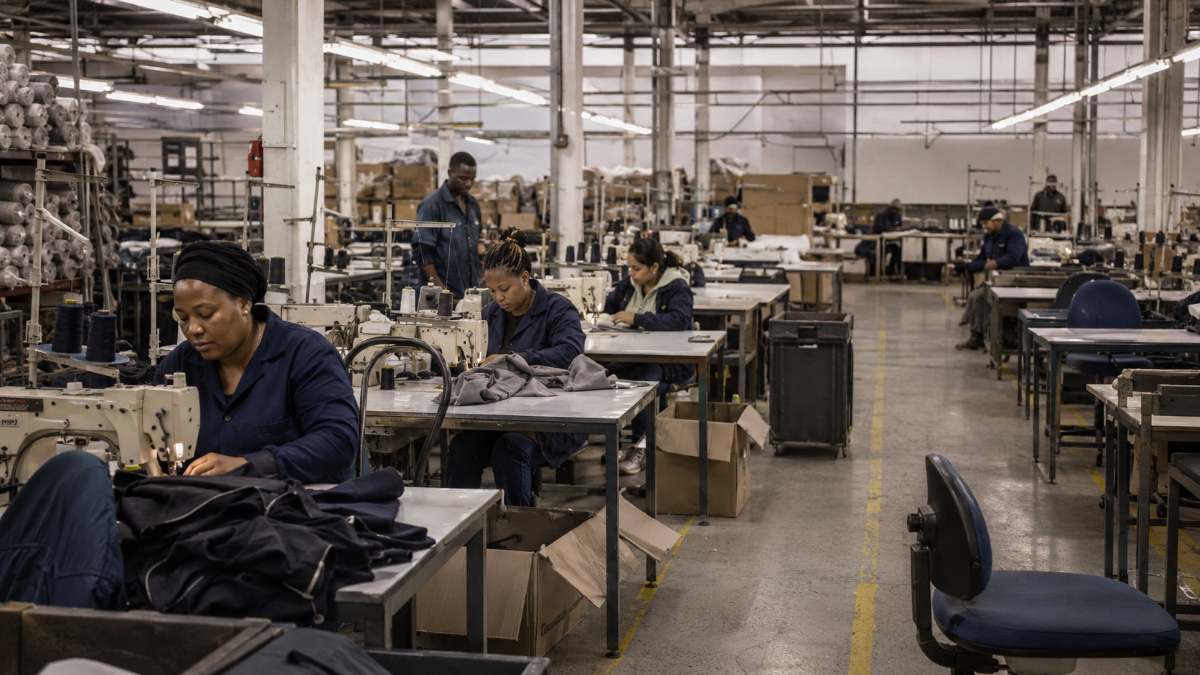
Newcastle’s Cut, Make and Trim (CMT) textile industry is facing mounting pressure, with factory owners reporting that manufacturing orders have fallen by as much as 50% compared with the same period last year.
The decline has forced several factories to operate on short time, temporarily send workers home and focus primarily on surviving until the sector’s traditional peak production period between September and December.

While government inspections and parliamentary scrutiny have dominated public debate around Newcastle’s textile sector, local industry representatives warn that the resulting reputational damage, declining orders and continued shortage of skilled machinists could place thousands of jobs at risk.
Newcastle Local Municipality Councillor and long-time factory owner Alex Liu told Newcastillian News that the town has approximately 440 CMT factories employing thousands of workers.
According to Liu, the industry has remained under intense scrutiny since parliamentary oversight inspections were conducted in Newcastle during February 2026.
Those inspections uncovered serious labour and living-condition concerns at several factories, prompting renewed attention on alleged exploitation, immigration compliance and weaknesses within South Africa’s clothing supply chain.
However, Liu argued that the consequences had extended beyond the factories where serious non-compliance was allegedly identified.
“Several retailers have given clear instructions to their suppliers to avoid Newcastle factories, so the manufacturing has seen its orders drop by 50% as compared to the same timeframe as last year. This has led several factories to now operate on short time, and the situation is deteriorating on a month-to-month basis,” he emphasised.
According to Liu, numerous workers have either been placed on reduced hours or temporarily sent home while factory owners wait for production volumes to recover.
He further told Newcastillian News that many businesses were now attempting to remain operational until the busier manufacturing period later in the year, when retailers traditionally begin placing larger orders ahead of the festive season.
“All CMT factory owners have been painted with the same brush, and when we asked Parliament to clear the names of the innocent factories, we were ignored. So, while they want to portray themselves as though they are helping people, they are causing collateral damage in the process. We have all been badly affected,” he explained.
Moreover, Liu acknowledged that improved labour, immigration and workplace compliance remained necessary within the industry.
However, he claimed that inspections had not adequately distinguished between factories making measurable efforts to comply and those showing little regard for legal requirements.
“Simply put, they did not start with the worst offenders. Instead, they raided factories indifferently. Regardless if the factory owners were attempting to be 60% compliant, 70% compliant, or even 80% compliant, they just don’t care anymore.
“Secondly, some of the factories have been doing their best to be compliant, but they are being treated as if they were one of the worst offenders there are. And in the end, some of the factory owners just give up hope, because no matter what we do, we are treated in the same manner as those who do not even bother trying to comply,” stated Liu.
The heightened scrutiny followed a Parliamentary Portfolio Committee oversight inspection on 6 February 2026, during which officials visited factories in Newcastle and raised concerns about conditions described as resembling sweatshops.
Public attention intensified after committee member Juliet Basson shared footage recorded during inspections in Newcastle’s Riverside Industrial Area.
The footage, which circulated widely on social media, allegedly showed boxed clothing carrying labels associated with major South African retailers, including The Foschini Group and Pick n Pay.
To read Newcastillian News’ previous coverage of the parliamentary inspections, click here.
Beyond regulatory pressure, Liu said Newcastle’s CMT industry was being undermined by increasingly unsustainable production prices.
Under the CMT model, retailers and suppliers provide factories with manufacturing contracts based largely on the cost of cutting, assembling and finishing each garment.
According to Liu, these contracts are frequently awarded to the factory offering the lowest price, forcing manufacturers into aggressive competition for limited work.
He explained that if suppliers paid an average CMT price of R5 per garment, the local industry could generate approximately R50 million in monthly revenue.
With wages accounting for roughly half of factory operating costs, Liu estimated that around R25 million could flow directly to workers each month, much of which would subsequently circulate through Newcastle’s economy.
However, he claimed that the prices currently offered by suppliers made it increasingly difficult for factories to meet all operating and labour costs.
“This has led to a direct result that CMT factories cannot afford national minimum wages. Although they can afford the minimum wages for skilled machinists, they simply cannot afford to pay the same rate to non-skilled workers,” stressed Liu.
He argued that government should reconsider whether a uniform national minimum wage adequately reflected the substantial differences in living and operating costs between smaller towns such as Newcastle and metropolitan centres such as Durban.
Nevertheless, any changes to the wage framework would require careful consideration to ensure that workers were not left more vulnerable while factories attempted to remain commercially viable.
Liu further identified the shortage of skilled machinists as one of the sector’s most serious operational challenges.
Although the employment of foreign nationals has become a major source of public and political debate, he maintained that many legally employed foreign workers possessed specialised manufacturing skills that remained in limited supply locally.
“The majority of the factories rely on foreign skilled machinists, and if you remove them, you will collapse the productivity of the factory.”
According to Liu, the issue was not simply a preference for foreign labour but a shortage of suitably trained South African machinists.
He referred to an incident in Durban where a factory owner was allegedly instructed by representatives of March and March to dismiss two Malawian machinists.
“He told them that if they could not find him local skilled machinists, he would have to dismiss the 20 locals he did employ as well,” Liu pointed out.
Liu said the example demonstrated how a small number of experienced machinists could support the employment of a significantly larger local workforce.
He argued that the longer-term solution lay in greater investment in vocational education, practical textile training and skills development programmes capable of producing enough qualified South African machinists to meet industry demand.
Despite the difficulties facing the sector, Liu acknowledged efforts by the Newcastle Municipality to engage factory owners.
According to him, the Municipality had begun working with industry stakeholders to improve compliance standards while attempting to limit further reputational damage to Newcastle’s manufacturing sector.
He warned that continued loss of confidence among retailers could have consequences extending well beyond individual factory owners.
“It’s important to remember that factories offer secure employment and factory owners don’t grow horns and are not evil, they are just trying to survive in this highly competitive industry. And, to some extent, CMT owners are just as much victims as the workers, being exploited by the supply chain.”
Nevertheless, the challenges facing Newcastle’s CMT industry cannot be reduced to a choice between protecting workers and protecting factories. Serious labour, immigration and workplace violations must be addressed, and businesses that disregard the law cannot be shielded from accountability.
At the same time, enforcement that fails to distinguish between repeat offenders and factories actively working towards compliance risks damaging the very employment base it is meant to protect.
Factory owners remain responsible for lawful wages, safe working conditions and proper documentation.
However, retailers and suppliers also face questions over the prices they pay, the pressure they place on manufacturers and the extent to which the broader supply chain contributes to the conditions now under scrutiny.
Without viable production rates, stronger skills development and a more targeted compliance process, the sector may continue losing orders, workers and investor confidence.
For Newcastle, the consequences extend far beyond the factory floor.
Thousands of households depend directly on CMT employment, while local shops, transport services and other businesses benefit from the wages generated by the industry. If serious non-compliance is allowed to continue, workers remain exposed to exploitation.
If the entire sector is treated as irredeemably tainted, compliant factories and innocent employees could be pushed out of work.
The challenge now is to restore lawful and dignified working conditions without collapsing one of Newcastle’s largest employment sectors in the process.

Whether government, retailers, suppliers and factory owners can find that balance before the peak production season will determine not only the future of the CMT industry, but also the livelihoods of thousands of people who depend on it.
What are your thoughts on all of this and the insights shared? Let us know below.
Do not forget to read:











One Response
Coming from the clothing sector I agree that the Councillor is stating facts . Government opened a training school at a significant cost in newcastle but focused on domestic sewing operations and not industrial . This was a waste of money and had no influence for the actual purpose of getting these workers ready for the industrial sector