

For several years, discussions around Newcastle’s economic future have been dominated by a deeply uncomfortable question: What happens to the town if the industries that built its economy continue to decline?
That concern intensified as uncertainty mounted around ArcelorMittal South Africa’s Newcastle Works, which has historically supported thousands of direct and indirect livelihoods across the town and surrounding region.

While negotiations involving AMSA, the Industrial Development Corporation and government remain underway, no definitive agreement had been reached by the time this article was published.
The Newcastle Works had also been mothballed as part of the steelmaker’s restructuring and performance improvement measures, leaving the town’s industrial future under considerable pressure.
However, while much of the public conversation has centred on what Newcastle could lose, two separate developments are beginning to suggest what the town could become, if everything works out as planned.
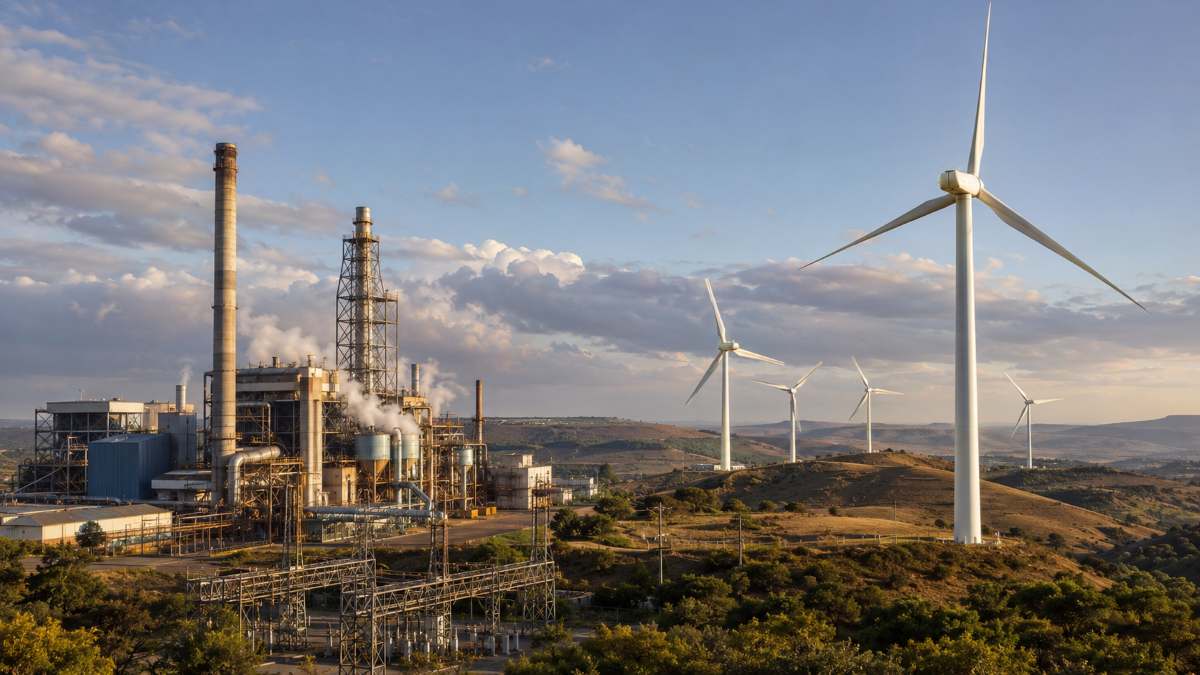
At the Karbochem Industrial Park, Lions Bay Energy is advancing the approximately R200 million redevelopment of the former KCE Plant, with the project’s focus having shifted from an earlier gold-processing concept towards energy production.
At the same time, Mulilo is progressing with an estimated R8 billion wind energy development outside Newcastle, comprising 33 turbines and a planned generating capacity of 240MWAC.
The projects are vastly different in their scale, technology and intended operations. Yet, viewed together, they introduce a potentially important change in Newcastle’s economic story.
Rather than remaining almost entirely dependent on the future of conventional heavy industry, could Newcastle be starting to establish a broader economy in which energy production supports renewed industrial activity, investment and specialised employment?
Firstly, the Lions Bay development centres on the former KCE Plant, a long-idle facility situated within the Karbochem Industrial Park.
Early planning for the site involved modifying the plant to produce power and steam while also roasting refractory gold concentrates.
However, following further technical and commercial assessment, Lions Bay Energy CEO Martin Kruse said the company’s focus shifted towards energy production as a more viable and scalable long-term use for the facility.
The plant was originally commissioned in 2014 to provide steam within Karbochem’s industrial operations.
Lions Bay now intends to progressively refurbish and recommission the plant over an estimated 12 to 18 months.
The company plans to produce electricity and process steam, with the latter intended to support BroChem’s industrial operations on the same site.
Furthermore, this proximity is central to the project, as the steam leaving the turbines can be used directly by surrounding industrial users rather than being lost through conventional cooling and condensation processes.
According to Kruse, this allows the facility to operate at close to 80% efficiency, compared with the substantially lower efficiency ordinarily associated with conventional thermal power generation.
This remains a company-provided estimate that will ultimately be tested once the plant is fully operational.
The facility is designed to use discarded, low-grade coal that the company says is generally unsuitable for other uses. Lions Bay maintains that the process will use material that would otherwise remain in waste stockpiles, while ash generated during combustion could potentially be repurposed for masonry and other industrial applications.
However, the project’s significance for Newcastle stretches beyond the technology being installed.
Kruse estimated that bringing the plant back into full operation would require investment of approximately R200 million. He said much of this expenditure could remain within Newcastle through local engineering, fabrication, construction, maintenance and skilled labour.
While specialised components would still need to be sourced elsewhere, the company believes the town already possesses much of the technical expertise required to refurbish, operate and maintain the facility.
“What we are trying to do is reindustrialise Karbochem,” Kruse said during an on-site interview with Newcastillian News.
That ambition is especially important when considered against the number of industrial properties and facilities across South Africa that have fallen into disuse after major employers closed or reduced their operations.
Rather than abandoning the existing infrastructure, Lions Bay is attempting to give it a new commercial purpose—one centred primarily on producing the energy required by industry.
If successful, the project could demonstrate that Newcastle’s dormant industrial assets still hold major value when investment, technical execution and realistic demand are brought together.
While Lions Bay is repurposing existing infrastructure, Mulilo’s Newcastle Wind Energy Facility represents an entirely new energy development.
The proposed facility will be situated approximately 15 kilometres northwest of Newcastle and will comprise 33 Envision Energy turbines, each rated at 8MW.
Mulilo has confirmed that the project will have a capacity of 264MWDC, or 240MWAC. Electricity produced by the turbines will enter the Eskom grid through the Incandu Main Transmission Substation, using an approximately 23-kilometre, 132kV overhead power line.
Moreover, the development was estimated at approximately R8 billion.
Jointly, the project is not being developed under South Africa’s Renewable Energy Independent Power Producer Procurement Programme and therefore does not carry the economic development obligations prescribed under that programme.
Nevertheless, the company has committed itself to supporting surrounding communities, applying a 50-kilometre catchment area for potential social investment initiatives throughout the project’s expected 20-year operational lifespan.
However, while the development has cleared several important hurdles, it has not yet reached the construction phase that would unlock its full investment and employment potential.
As of July 2026, only early works and site preparations were underway, with Mulilo anticipating financial close during August 2026. Once this milestone is reached, the main construction programme is expected to begin and continue for approximately 24 months.
The project has already received environmental authorisation, which was granted on 4 October 2024, followed by SPLUMA approval on 17 June 2025 and Civil Aviation Authority approval on 20 February 2026.
Mulilo has also secured a grid connection budget quotation.
Therefore, while the project is significantly advanced, financial close remains the decisive step before full construction can proceed and its wider economic impact can begin taking shape.
Even then, neither the Mulilo development nor Lions Bay can individually replace the economic scale, employment footprint or surrounding business activity historically associated with AMSA’s Newcastle Works.
The wind project is expected to create substantial activity during construction, but many of those jobs will be temporary.
Mulilo has also clarified that earlier references by the Newcastle Municipality to more than 1,000 jobs should not be interpreted as 1,000 permanent positions at the facility, with the figure likely reflecting direct, indirect and induced employment across the broader supply chain and over the project’s full lifespan.
The long-term contribution of Lions Bay will similarly depend on whether the former KCE Plant returns to sustained operation, reliably supplies steam and electricity, supports the industrial businesses already operating at Karbochem and helps attract further activity to the site.
Therefore, the emergence of two energy developments does not mean Newcastle’s economic challenges have been resolved. What they do offer, however, is an early indication that the town’s industrial future may no longer need to be discussed solely in terms of steel production and the survival of one dominant employer.
Should both projects move forward as planned, they could create demand for a host of businesses across multiple sectors.
The construction activity could also benefit accommodation providers, security companies, caterers and other supporting services.
However, the extent to which Newcastle benefits will depend largely on how much of the work and procurement remains local, and whether local workers and businesses possess the qualifications, experience and capacity required by increasingly specialised energy developments.
Therefore, this places a level of responsibility on Newcastle’s schools, colleges and training institutions, which will need to consider whether young people are being prepared for the technical opportunities these investments could create.
Training linked to electrical systems, mechanical engineering, renewable energy, high-voltage infrastructure, industrial maintenance, environmental management and occupational safety could become increasingly valuable.
Without this preparation, Newcastle could host major investments while much of the skilled work is carried out by contractors and employees brought in from other areas.
However, perhaps the greatest potential benefit of these developments extends beyond the jobs created directly by either project.
Lions Bay’s model is based on producing energy alongside the industrial businesses that require it, meaning its success could help restore activity at Karbochem by providing nearby users with locally generated steam and electricity.
Mulilo’s wind project, meanwhile, will feed electricity into the broader Eskom grid rather than directly supplying Newcastle households or businesses, but it could still strengthen the town’s position within South Africa’s expanding private energy sector.
This does not mean residents should expect lower municipal electricity bills, nor does it suggest that factories will immediately begin relocating to Newcastle.
Furthermore, reliable and competitively priced energy has become an increasingly important consideration for companies deciding where to establish or expand their operations.
Newcastle already possesses industrial land, engineering expertise, established transport connections, grid infrastructure and a workforce shaped by decades of manufacturing and heavy industry.
If these existing advantages are supported by functioning energy developments, the town could become increasingly attractive to manufacturers, processors and the businesses that support them.
The Lions Bay development also shows that Newcastle’s future may not depend exclusively on attracting entirely new projects.
Repurposing existing industrial facilities could offer a more practical route towards restoring economic activity, particularly where roads, power connections, engineering layouts and other costly infrastructure are already in place.
Rather than allowing dormant facilities to deteriorate further, existing sites could be given a new purpose that responds to changing industrial and energy demands.
For years, discussions around Newcastle’s economy have been dominated by closures, uncertainty and concern over what the town stands to lose if its major industries continue to decline.
Those concerns remain legitimate. AMSA’s future has not yet been secured, the Lions Bay facility is still being refurbished and Mulilo must still reach financial close before full construction can begin. Any suggestion that Newcastle has already undergone an economic transformation would therefore be premature.
However, the emergence of two separate energy developments—one reviving dormant industrial infrastructure and the other introducing large-scale wind generation—does begin to change the conversation.
For the first time in some time, Newcastle’s future is not being discussed only in terms of what could disappear, but also in terms of what could emerge in its place.
Therefore, the true measure of these projects will not be found in investment announcements, projected job figures or public statements.
It will be determined by whether they become fully operational, whether local businesses secure meaningful work, whether residents receive fair and transparent access to employment opportunities and whether the investments encourage further industrial activity.
Newcastle’s steel history will remain an important part of the town’s identity, regardless of what happens in the coming months with AMSA. But if Lions Bay and Mulilo deliver on their plans, energy production could begin forming part of a broader and more resilient industrial future—one in which Newcastle is no longer expected to stand or fall on the fate of a single company.
What are your thoughts on all of this? Could energy production offer Newcastle a meaningful new economic direction, or is it still too early to determine the long-term impact of these developments? Let us know in the comments section below.
While you are here, do not forget to read: When Little Ears, Noses and Throats Need Big Care: Meet Newcastle’s Trusted ENT Specialists