When a patient needs surgery, confidence matters. Not only in the procedure itself, but in the experience, judgement and teamwork of the specialists guiding that patient from diagnosis through to recovery.
At Mediclinic Newcastle, this level of care is supported by a highly-skilled and dedicated team of general surgeons whose work extends far beyond the operating theatre.
From diagnosing complex conditions and performing planned procedures to responding to urgent trauma cases, general surgery remains one of the most essential disciplines within hospital-based healthcare.
This level of access is particularly important for Newcastle and the surrounding communities, where specialised surgical care closer to home can reduce the need for patients to travel to larger centres for many procedures.
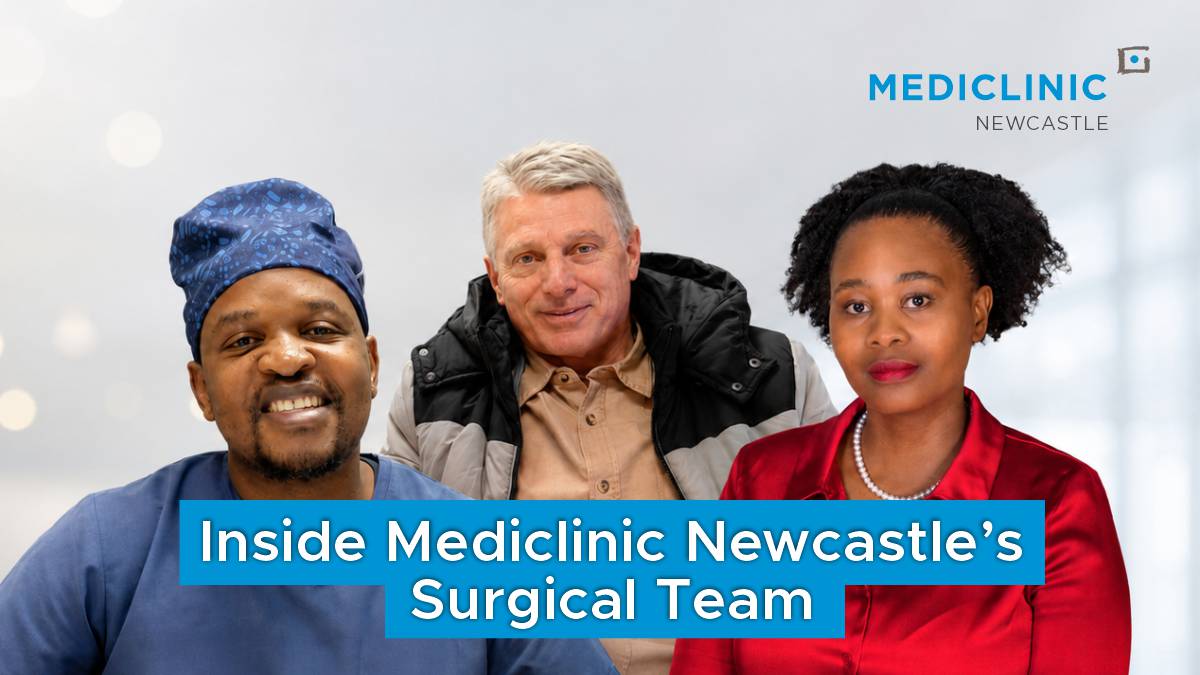
At the centre of this offering is Mediclinic Newcastle’s team of three general surgeons: Dr Rea Ndaku Dr Ayanda Shabalala and Dr Anton Botha.
Together, they bring specialist expertise, clinical judgement and a collaborative approach to patient care, supported by the hospital’s multidisciplinary team of nurses, theatre staff and clinical support personnel.
The team was further strengthened in April 2026 with the arrival of Dr Botha, a specialist surgeon and former Head of General Surgery at Addington Hospital.
With more than three decades of experience across both the public and private healthcare sectors, he adds considerable surgical depth, leadership and mentorship to the hospital’s general surgery department.
Speaking about the role of general surgery, Dr Botha explained that the discipline covers an exceptionally broad field.
“Anatomically, we deal with problems all over the body, skin problems, gastric cancer, colon cancer, skin cancers, and internal organs, ranging from the gastrointestinal system, which is all the way from the mouth to the rectum, the thyroid, parathyroid, adrenal glands, the vascular system, which includes blood vessel problems, etc.”
This range of care highlights the versatility required of general surgeons, who are often called on to assess, diagnose and manage a wide spectrum of conditions.
Beyond planned and diagnostic procedures, Dr Botha also emphasised the important role general surgeons play in trauma care. As he noted, general surgeons are fundamentally trained to manage trauma and are often among the first specialists involved in serious emergency cases.
His clinical interests further extend to bariatric and metabolic surgery, an increasingly important field focused on supporting patients who require sustainable weight management solutions.
Complementing this expertise, Dr Shabalala explained that quality surgical care extends well beyond the operating theatre.
A specialist in general surgery with experience in minimally invasive techniques, he previously served as Registrar of Forensic Medicine between July 2016 and January 2017, before continuing as Registrar of General Surgery from February 2017 at Universitas Hospital.
Drawing on this background, Dr Shabalala said surgeons must understand the patient as a whole, including their personal and family medical history.
“It is crucial for surgeons to fully understand their patients, with our scope of work including looking at the patient’s family and establishing if they have hereditary health conditions, especially when it comes to conditions such as colon cancer. This means that we as surgeons must also be in contact with the local GPs, so as to gather as much information about our patients as possible.”
This approach reflects the value of strong communication between surgeons, general practitioners and the broader healthcare team.
It also ensures that patients are assessed with a fuller understanding of their medical background and possible risk factors.
According to Dr Shabalala, collaboration within the surgical team is equally important. Working alongside Dr Botha and Dr Ndaku, the team follows a model of shared responsibility, cross-cover and professional support.
“There is cross cover, different levels of interests and experience, but for us, patient care is immensely important,” he said.
Dr Ndaku echoed this view, stressing the importance of professional dialogue and shared decision-making in surgery.
Before joining Mediclinic Newcastle in early 2023, Dr Ndaku served as a consultant for the Limpopo Department of Health and later worked in full-time private practice at Mediclinic Ermelo.
This experience has given her valuable clinical and institutional insight, which she now brings to the Newcastle team.
“It is dangerous for a surgeon to work in isolation, because a surgeon who doesn’t take advice is a dangerous surgeon. Dr Shabalala, Dr Botha and myself will phone each other in the theatre for assistance. In surgery, one needs to follow the book, but after a few years, when you grow comfortable as a surgeon, you learn other techniques which are not necessarily in textbooks but work, which is why we contact each other, so as to ensure we do not miss anything.
“One of the things I learned during my studies is that if you put 10 surgeons in a room with a patient, they will all have an opinion and they will all be right, and this is why Dr Botha, Dr Shabalala and I work in collaboration,” she added.
For Dr Shabalala, this team dynamic has clear practical value for both doctors and patients.
“It takes a lot of pressure off, knowing that you have highly trained and experienced surgeons working at your side and offering guidance where necessary. Through us working closely together, we are able to truly make an impactful difference in our patients’ lives.”
This collaborative culture is supported by Mediclinic Newcastle’s broader focus on clinical standards, structured support systems and ongoing patient care.
Dr Botha explained that the hospital places strong emphasis on monitoring patient outcomes, reviewing feedback and ensuring that clinical teams have access to the equipment and resources needed to perform effectively.
“Mediclinic Newcastle monitors patient outcomes, while also monitoring patient and doctors’ feedback, and does its best to keep up to date with our needs in terms of equipment, and all the necessary things we need to perform surgical practices.”
In line with this commitment to continuous improvement, the hospital is also exploring the introduction of advanced video recording technology for endoscopic and laparoscopic procedures.
This would allow procedures to be documented and, where appropriate, shared with patients and referring general practitioners, supporting greater transparency, continuity of care and post-operative understanding.
At an operational level, Dr Ndaku described Mediclinic Newcastle as a structured and responsive healthcare environment, with clear channels of support for both doctors and patients.
“There are different channels in place with dedicated staff to call, heads of departments, and nursing managers on the ground with the doctors to see what issues we are facing, from managerial to the clinical aspect, with the Nursing Manager, Belinda Naude, always being available for us in regard to good patient outcomes, and of course there is the Client Experience Manager, who assists the surgeons with patient care.”
This integrated support framework helps the surgical team deliver efficient, patient-focused care within a well-coordinated hospital environment.
Turning to the hospital’s surgical capabilities, Dr Shabalala said Mediclinic Newcastle is well-positioned to support patients from Newcastle and surrounding towns.
“Mediclinic Newcastle goes all out in their theatre, and surgeons are able to do a lot within the facility, meaning that Newcastle residents do not have to travel far for all their procedures. Newcastle might be a ‘small’ town, but we need to change this mindset, as Mediclinic Newcastle, alongside me and my colleagues, are able to assist the Newcastle community and the surrounding towns with their medical needs.”
Together, the experience of Dr Botha, Dr Shabalala and Dr Ndaku, supported by Mediclinic Newcastle’s clinical systems, theatre capabilities and multidisciplinary staff, positions the hospital as an important provider of general surgical care in northern KwaZulu-Natal.
As healthcare needs continue to evolve, the strength of the team lies not only in individual expertise, but in the way the surgeons work together.
Their shared approach to patient care, communication and professional support reflects a model built on collaboration, clinical responsibility and trust.
For patients and referring practitioners, this means access to experienced surgical care closer to home, backed by a hospital environment focused on patient outcomes, continuity of care and clinical excellence.
Through this combined expertise and support, Mediclinic Newcastle continues to reinforce its role as a trusted healthcare provider for Newcastle and the surrounding region.
What surgical care is available at Mediclinic Newcastle?
Mediclinic Newcastle offers access to specialist general surgical care, including planned procedures, diagnostic assessments, trauma-related surgical support and treatment for a range of conditions involving the gastrointestinal system, skin, glands and other areas of the body.
Who are the general surgeons at Mediclinic Newcastle?
Mediclinic Newcastle’s general surgery team includes Dr Rea Ndaku, Dr Ayanda Shabalala and Dr Anton Botha. Together, they bring a collaborative approach to patient care, supported by the hospital’s theatre staff, nurses and broader clinical team.
Why is local surgical care important for Newcastle patients?
Access to specialist surgical care closer to home can reduce the need for patients in Newcastle and surrounding towns to travel to larger centres for many procedures, while ensuring continuity of care within a familiar hospital environment.
How does Mediclinic Newcastle’s surgical team support patient outcomes?
The team works through collaboration, shared decision-making and cross-cover between surgeons, while being supported by Mediclinic Newcastle’s clinical systems, nursing teams, theatre capabilities and patient feedback processes.
One Response
Newcastle Medi Clinic can be lucky to have Dr Bota as surgeon. He attended to my fiance. His diagnosis was very accurate, and the procedure was done very efficiently. My fiance has no more problems. He will only be an asset to Newcastle medi Clinic.
Newcastillian News invites your input. We ask that you keep your remarks courteous and on-topic. We do not allow any form of hate speech, such as racist or sexist comments. All comments are subject to moderation in line with our User Rules and Commenting Policy.












One Response
Newcastle Medi Clinic can be lucky to have Dr Bota as surgeon. He attended to my fiance. His diagnosis was very accurate, and the procedure was done very efficiently. My fiance has no more problems. He will only be an asset to Newcastle medi Clinic.