


PAID CONTENT: Newcastle Municipality
In any town, the difference between structured growth and economic conflict often comes down to one fundamental factor: how land is used.
Without clear control over land use, businesses begin to encroach on residential areas, industrial activity starts to disrupt commercial zones, and informal trading can overwhelm public spaces.
Over time, this leads to congestion, safety concerns, declining property values, and reduced investor confidence.
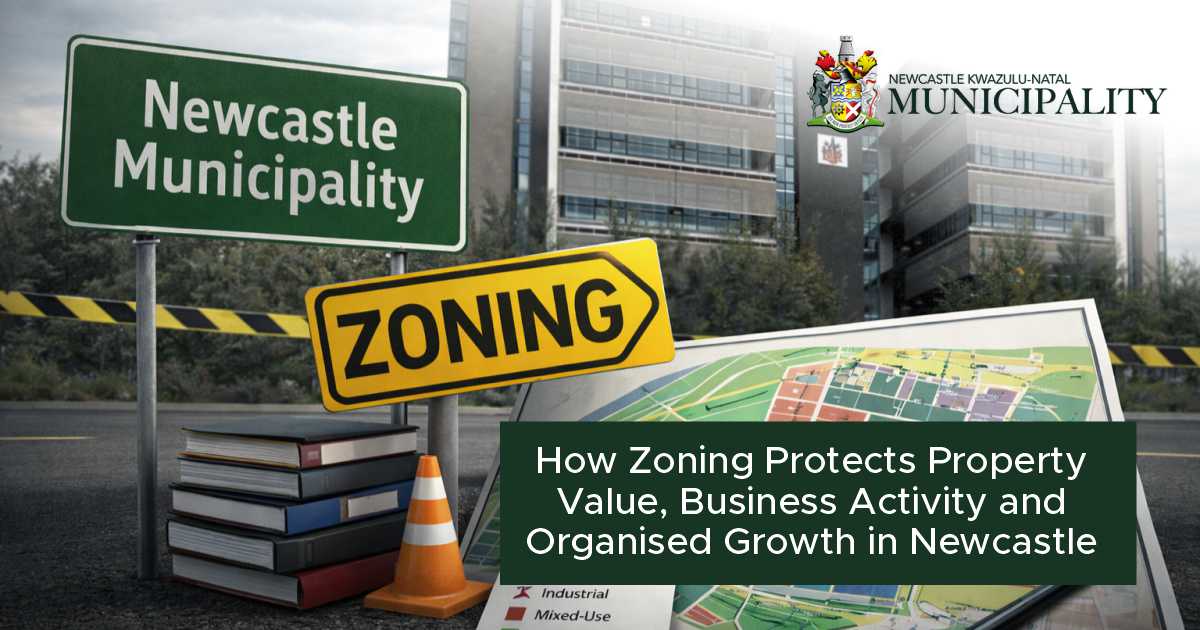
In Newcastle, zoning regulations form one of the primary tools used to prevent this outcome.
They provide the structure that ensures different types of economic activity can take place in appropriate areas, supported by the right infrastructure and without undermining surrounding land uses. Zoning, in this context, is not simply a regulatory exercise.
It is a system that protects the town’s economic stability.
Zoning regulations classify land into specific use categories such as residential, commercial, industrial, or mixed-use. These classifications determine what activities may take place on a property, under what conditions, and subject to which approvals.
This framework ensures that land use across Newcastle is organised rather than reactive.
A residential area is protected from high-impact industrial activity, commercial zones are positioned where access and infrastructure can support them, and industrial operations are located where they can function efficiently without creating conflict.
Zoning also works alongside planning instruments such as the Spatial Development Framework, ensuring that land use decisions align with long-term development priorities and infrastructure planning.
Rather than limiting development, zoning provides clarity, allowing businesses, developers, and property owners to make decisions within a structured and predictable environment.
Property value is closely tied to the surrounding environment. Investors and property owners rely on the stability of that environment when making long-term decisions. When zoning is properly applied and enforced, it protects property values by ensuring that neighbouring land uses remain compatible.
A commercial property retains its value when surrounded by other appropriate business activity. A residential area remains stable when protected from disruptive or incompatible uses.
Without zoning, this stability breaks down. Uncontrolled development can introduce activities that reduce desirability, create congestion, or place pressure on infrastructure.
Over time, this uncertainty discourages investment and weakens confidence in the local property market.
Therefore, zoning provides the assurance that development will follow defined rules rather than unpredictable patterns. This predictability is one of the most important factors influencing investment decisions.
Land use conflict occurs when activities on one property negatively impact surrounding properties or undermine the intended function of an area. This can take many forms.
Commercial operations may emerge in residential areas without appropriate approvals, creating traffic, noise, or safety concerns. Industrial activity may encroach on commercial zones, affecting accessibility and customer experience.
Buildings may be converted into uses they were not designed for, placing strain on infrastructure and neighbouring properties.
Left unmanaged, these conflicts can escalate into broader economic problems. Business districts may lose functionality, residential areas may become unstable, and infrastructure systems may be pushed beyond capacity.
Zoning regulations, supported by land use management and enforcement mechanisms, are designed to prevent these conflicts before they take root.
They provide a structured framework for assessing development proposals and resolving incompatibilities in a controlled and lawful manner.
Public open spaces, including pavements, transport nodes, and civic areas, are critical components of Newcastle’s economic activity. These spaces support movement, accessibility, and, in many cases, informal trade.
However, these spaces must function for multiple users simultaneously.
Unregulated trading in public areas can quickly lead to blocked access, reduced visibility for formal businesses, and safety concerns for pedestrians and commuters.
Zoning and municipal bylaws play an important role in regulating how these spaces are used. They set parameters for where trading may occur, under what conditions, and in a manner that ensures public spaces remain functional and accessible. This does not eliminate informal economic activity.
Rather, it seeks to structure it in a way that balances opportunity with order, allowing both formal and informal sectors to operate without undermining one another.
Beyond zoning categories, the way buildings interact with public space has a direct impact on economic performance.
Space planning and urban design influence how businesses present themselves to the street, how customers access premises, and how pedestrian movement flows through commercial areas.
Frontage control, being the management of how buildings face and engage with public spaces, plays a particularly important role in shaping economic activity.
Active frontages, where businesses are visible and accessible from the street, contribute to vibrant commercial environments.
They encourage foot traffic, improve safety through natural surveillance, and create stronger connections between businesses and their customers.
Poorly designed or unmanaged frontages, on the other hand, can reduce accessibility, limit visibility, and weaken the overall performance of a commercial node. For informal traders, spatial placement also affects visibility, accessibility, and coexistence with formal businesses.
Thoughtful spatial planning ensures that these different elements operate together rather than in competition.
Through coordinated space planning and frontage control, the municipality helps shape commercial environments that are functional, attractive, and economically productive.
Zoning frameworks are only effective if they are consistently applied and enforced. Therefore, without enforcement, even well-designed planning systems lose their value.
Unauthorised developments, unlawful land use changes, and non-compliant activity can gradually erode the structure that zoning is intended to maintain.
Through land use management processes, compliance monitoring, and enforcement action where necessary, the municipality ensures that zoning regulations remain effective in practice.
This protects compliant businesses, supports fair competition, and maintains confidence in the local economic environment.
Zoning is often perceived as a restriction on what property owners can do. In reality, it serves a far broader purpose. It protects property values, supports business stability, prevents conflict between land uses, and ensures that development occurs in a structured and sustainable manner.
By maintaining clear zoning frameworks and enforcing them consistently, Newcastle creates an environment where businesses can operate with confidence and where long-term investment is supported.
Information relating to zoning regulations, land use applications, and planning policies can be accessed through the official Newcastle Municipality website:
Reader takeaway
Zoning is not a restriction on growth — it is the structure that protects property value, prevents conflict, and supports a stable and investable economic environment in Newcastle.
FAQs:
Zoning regulations are rules that determine how land may be used in specific areas, such as for residential, commercial, industrial or mixed-use purposes. They help ensure development takes place in an organised and lawful way.
They help protect property value by keeping surrounding land uses compatible. A residential area, for example, is less likely to lose value when protected from disruptive commercial or industrial activity nearby.
Zoning creates a more predictable environment for business owners, developers and investors. It gives clarity on what can happen in an area, which supports confidence, planning and long-term investment.
It helps prevent situations where unsuitable activities spill into the wrong areas, such as high-impact business activity in residential zones or unlawful changes to building use that place pressure on infrastructure and neighbouring properties.
Without consistent enforcement, unlawful land use changes and non-compliant developments can erode the structure of a town, create conflict, weaken investor confidence and place added strain on public infrastructure.













One Response
The only problem that we struggle with as normal citizens is that we don’t have access to Newcastle gis to be able to check on our own the zoning. I have enquired on getting access to the system with no reply.
I think just like other municipalities this should be available online.