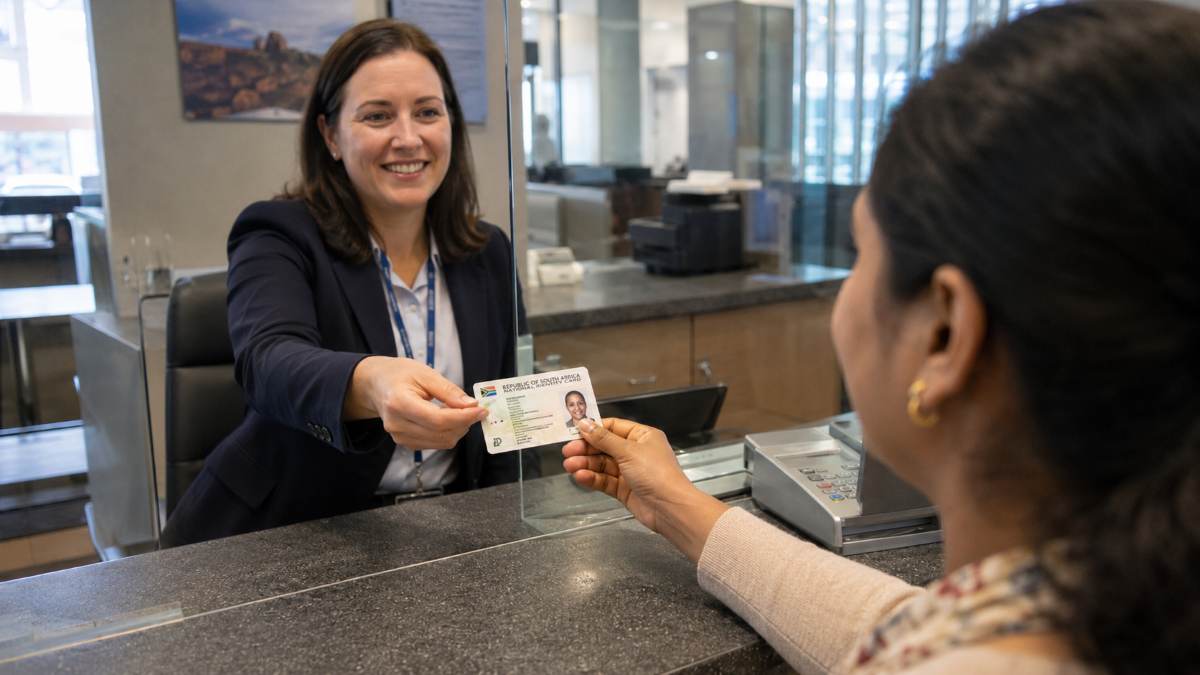
South Africans wanting to replace their green barcoded identity books can use an online Department of Home Affairs platform to locate bank branches offering Smart ID Card services.
Home Affairs Minister Dr Leon Schreiber promoted the service during a Digital Partnership media event held with First National Bank at Canal Walk in Cape Town on Monday, 3 August 2026.

According to the Department, the online platform enables residents to identify participating bank branches offering Smart ID services. The information will be updated as additional branches are activated under the Department’s growing partnership with the banking sector.
Residents can access the official branch information through the Department of Home Affairs’ Digital Partnership portal.
While the service was highlighted again during Monday’s event, Home Affairs has directed residents to the same official branch-finding address since the Digital Partnership became operational on 9 March 2026.
The Department stated that the partnership had expanded to 372 participating bank branches nationwide, while more than 500,000 Smart ID applications had been processed through participating banks since the programme entered its operational phase.
The expansion is intended to make it easier for South Africans to replace the green barcoded ID book without travelling long distances or waiting in queues at traditional Home Affairs offices.
Under the previous bank-based model, selected branches effectively hosted miniature Home Affairs offices, with applicants required to use the eHomeAffairs system, make online bookings and visit the branch for biometric capture.
The new Digital Partnership connects participating banks directly to Home Affairs through a secure digital gateway. This allows the banks to provide the application service through their own systems and service environments.
According to the Department’s official explanation of the Digital Partnership, customers do not need to use eHomeAffairs to make a booking or payment under the new system.
Instead, applications are handled directly through participating banks.
However, the precise customer process may differ between banks. Residents are therefore encouraged to confirm the requirements and operating arrangements of their selected branch before travelling.
The current phase of the programme is available to green ID book holders converting to Smart ID Cards and existing Smart ID holders applying for replacement cards. It also includes qualifying naturalised South African citizens and permanent residents.
Furthermore, the Department’s official platform states that applicants do not need to bring existing identity documents when completing the process at participating branches. Applications must be completed in person because biometric information needs to be captured and verified.
Home Affairs charges R140 for a Smart ID Card, although the Department cautions that participating banks may charge an additional convenience fee.
Applicants should check the relevant bank’s official website for its applicable fees and processes.
Once an application has been completed, the Smart ID Card must currently be collected from the bank branch where the application was submitted. The participating bank will communicate the collection arrangements to the applicant.
However, the bank-based service does not yet cover every Home Affairs application.
First-time Smart ID applications, including applications by young South Africans turning 16, are not currently available through participating branches. Jointly, passport applications, late registrations of birth, name changes, amendments to personal details and other complex civic services must still be handled through Home Affairs.
These services are expected to be added progressively as the Department expands and stabilises the Digital Partnership.
The rollout began on 9 March 2026 with nine participating branches. By 22 July 2026, the Department reported that the programme had expanded to 327 bank branches.
Together with 214 modernised Home Affairs offices, this provided 541 locations offering Smart ID services at that stage, compared with 214 locations before the Digital Partnership began.
According to the entity, Home Affairs intends expanding the programme to approximately 750 participating bank branches before the end of 2026. Together with the Department’s modernised offices, this could give South Africans access to approximately 1,000 Smart ID service locations.
The Department also plans to introduce first-time Smart ID applications, passport applications and the home delivery of identity documents through later phases of the programme.
Home Affairs has repeatedly encouraged the approximately 16 million South Africans who still use green barcoded ID books to move onto the Smart ID system.
According to the Department, the older document remains vulnerable to identity theft and financial fraud.
Moreover, Schreiber said the Department’s Home Affairs @home reform programme was intended to move services closer to where people live, work and conduct their banking.
Residents wanting to determine whether a participating bank branch is available near them can visit the official Home Affairs bank-service portal.
What are your thoughts on this? Let us know below.
Do not forget to read: Ladysmith Court Sentences Man to 12 Years for Murder of Off-Duty Police Officer