

PAID PROMOTION: Newcastle Municipality
Property is one of the most significant forms of investment for individuals, businesses, and developers alike. Whether it is a family home, a retail premises, a warehouse, or a commercial building, the value of that property depends not only on location or market demand, but also on safety, legality, and compliance with municipal regulations.
In Newcastle Municipality, building inspections and compliance processes form a critical — though often unseen — part of protecting the local property market.
These systems help ensure that buildings are safe to occupy, developments are lawful, and investments are protected from the risks associated with unsafe or unauthorised construction.
While inspections may sometimes be viewed as regulatory hurdles, they serve a much broader purpose: maintaining confidence in the built environment and supporting long-term economic stability.
Why Building Compliance Matters in a Growing Town
As Newcastle continues to expand and evolve, the way properties are used naturally changes over time. Residential buildings are sometimes converted into offices or consulting rooms, older commercial premises are renovated to accommodate new types of businesses, and extensions or alterations are made to meet growing operational needs.
New developments also emerge as economic activity shifts and demand for space increases.
These changes are a normal part of urban growth, but they also introduce complexity. A building designed for one purpose is not always suitable for another without structural or technical adjustments.
Increased occupancy, different equipment requirements, altered layouts, or higher utility demand can place pressure on structures and infrastructure that were never originally designed for that level of use.
Without proper oversight, such transitions can create significant risks.
Structural alterations made without approval may compromise safety. Buildings may be occupied beyond their intended capacity. Fire safety measures or access requirements may no longer be adequate. In other cases, increased demand on water, sewer, or electrical systems can create strain that affects neighbouring properties or surrounding infrastructure.
Beyond physical safety, there are also legal and financial implications.
Unauthorised alterations or unlawful changes of use can complicate property transactions, delay insurance claims, and create disputes between neighbours or property owners.
In commercial areas, non-compliant premises can negatively influence the value and attractiveness of surrounding properties, impacting investment confidence across an entire node.
Building compliance exists to manage these risks before they become problems.
Through plan approvals, inspections, and enforcement of national building standards, the municipality ensures that construction, renovations, and alterations are carried out in a manner that is safe, lawful, and appropriate for the intended use of the property.
This process protects the people occupying the building, but its impact extends much further. It safeguards neighbouring property owners whose investments could otherwise be affected by unsafe or non-compliant development.
It helps maintain consistent standards across business districts and residential areas, ensuring that individual decisions do not unintentionally undermine broader economic stability.
Seen through this lens, building compliance is not simply a technical requirement. It is a protective mechanism for the entire local property ecosystem — supporting confidence, stability, and long-term investment in Newcastle’s built environment.
The Role of Building Inspections
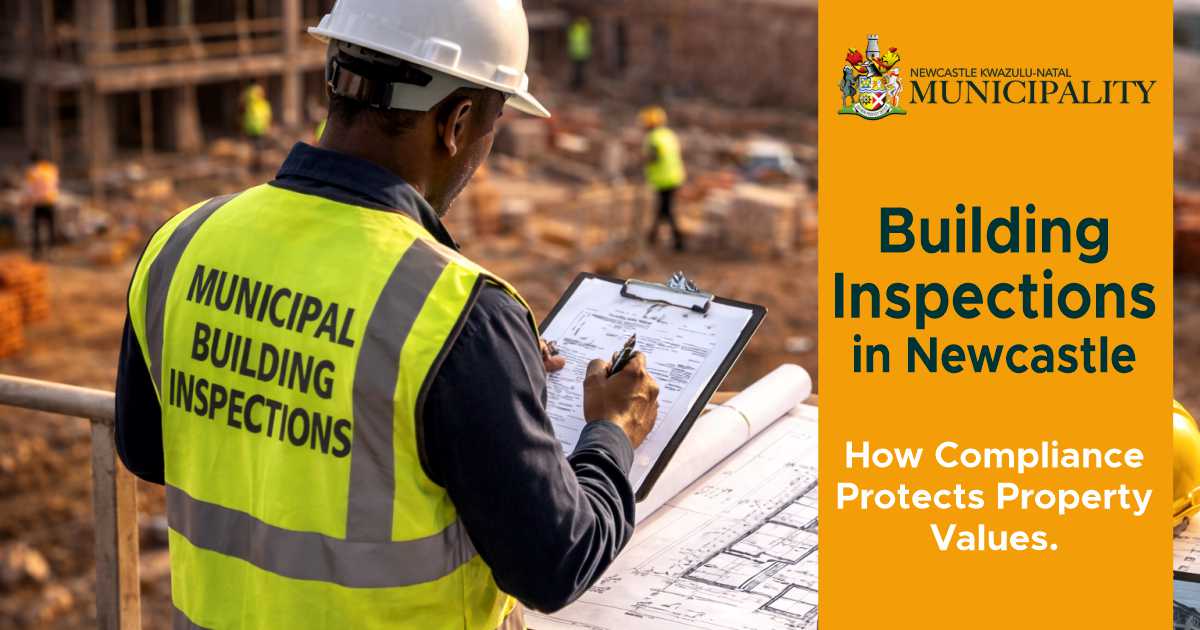
Municipal building inspections are conducted at key stages during construction or renovation. These inspections verify that the work being carried out matches approved plans and meets safety and regulatory standards.
Inspectors assess whether structural elements are being implemented correctly, whether safety requirements are met, and whether changes to buildings remain lawful and suitable for their intended use.
This process helps prevent scenarios where:
- Buildings are altered in ways that compromise safety
- Structures exceed approved capacity or usage limits
- Unauthorised additions create risk for occupants or neighbours
- Properties are used for purposes they were never designed to accommodate
Rather than being a final obstacle, inspections provide early detection of issues that could result in costly corrections or legal complications later.
Protecting Property Values Through Compliance
A compliant property market supports stable property values. Buyers, tenants, and investors are more confident in areas where buildings meet recognised standards and where illegal or unsafe structures are addressed.
If compliance systems did not exist, unsafe or poorly constructed buildings could reduce the attractiveness of entire neighbourhoods or commercial zones. Property owners who invest responsibly would face declining value due to the actions of non-compliant operators.
By ensuring consistency in building standards, the municipality helps maintain trust in the local property market — a key factor influencing long-term investment decisions.
Supporting Legal Certainty for Owners and Investors
One of the most important outcomes of building compliance is legal certainty. Approved plans, inspections, and compliance records provide documentation that supports property transactions, financing applications, and insurance requirements.
Banks, insurers, and prospective buyers typically require assurance that a building is lawful and safe. Properties with unauthorised alterations or unresolved compliance issues can face delays in sales, difficulties obtaining insurance, or reduced market value.
By maintaining compliance systems, the municipality helps ensure that properties remain legally secure assets rather than potential liabilities.
Safety, Responsibility, and Economic Stability
Building compliance is also closely linked to public safety. Commercial buildings and business premises often accommodate employees, customers, and the broader public. Ensuring these spaces meet safety standards protects lives and reduces risks that could lead to financial loss or reputational damage for businesses.
From an economic perspective, safe and compliant properties contribute to stable business environments, protect employment, and reduce costly disruptions caused by unsafe structures or legal enforcement actions.
Preventing Long-Term Urban Decline
History in many towns and cities shows that poorly regulated building activity can have long-term consequences that extend far beyond individual properties. When construction takes place without oversight, when buildings are altered without approval, or when compliance standards are not consistently maintained, the effects often appear gradually rather than immediately.
Over time, unauthorised structures, unsafe renovations, or buildings used for purposes they were never designed to accommodate can begin to affect entire areas.
Safety risks increase, infrastructure may become overloaded, and maintenance standards decline. As these issues accumulate, the surrounding environment can become less attractive to businesses, investors, and property owners who depend on stability and predictable standards.
Business nodes are particularly vulnerable to this process. If non-compliant properties begin to dominate an area, it can lead to reduced investor confidence, higher insurance concerns, and hesitation from businesses considering expansion or relocation.
Property owners who have invested responsibly may find themselves competing against premises operating outside of standards, which can gradually erode both confidence and value within that node.
Once decline begins, reversing it often requires significant intervention and investment. Preventing decline is therefore far more effective — and less costly — than attempting to fix it later.
Municipal oversight through inspections and compliance processes serves as a preventative measure against these outcomes. Regular inspections and enforcement help ensure that development remains aligned with approved plans, that buildings remain safe and lawful, and that changes to the built environment occur in a structured and sustainable manner.
This ongoing oversight supports long-term urban quality by maintaining consistent standards across neighbourhoods and business districts. It helps protect not only individual buildings but the overall economic health and visual integrity of the town, ensuring that growth strengthens existing areas rather than contributing to gradual deterioration.
In this way, compliance and inspections are not simply reactive tools — they are part of a long-term urban management strategy designed to preserve the quality, functionality, and economic resilience of Newcastle’s built environment.
Building Compliance and Economic Development
Although building inspections are often viewed as technical or regulatory functions, they play an important role in economic development. Investors and developers are more likely to commit capital to areas where standards are enforced consistently and where property assets retain long-term value.
Compliance provides predictability — and predictability is a key ingredient in encouraging development and expansion.
To ensure compliance, the Newcastle Municipality explained that it has a Building Transgression Penalties schedule, as per the approved Municipal Tariffs of Charges.
Elaborating on this, the Newcastle Municipality explained;
“This is a tool that is used by the Building Inspectorate to monitor and control building contravention in terms of the National Building Regulations and Building Standards Act, (Act No. 103 of 1977), Municipal Building Bylaws, as well as other associated legislation. Therefore, anyone contravening the NBR&BSA will be liable to fine in terms of Chapter IV (Section 9.2 (a)) of the Newcastle Municipality Building Bylaws.”
It should be highlighted, that as per the Newcastle Municipality, failure to pay the fine within a prescribed period will result in the unpaid fine being added onto their rates account immediately upon the expiry of the prescribed period of 30 days.
Additionally, should anyone fail to comply with the notice, the Newcastle Municipality may suspend its Municipal services provided to the subject property.
A Shared Responsibility
Ultimately, building compliance is a shared responsibility between property owners, developers, and the municipality. The goal is not to prevent development, but to ensure that growth takes place safely, legally, and in a way that protects everyone involved.
By maintaining a structured compliance environment, the municipality helps create confidence in Newcastle’s property market — supporting both economic growth and community wellbeing.
Accessing Building Compliance Information
Property owners, developers, and businesses can access relevant forms, policies, and municipal information through the official website of Newcastle Municipality:
Building inspections in Newcastle help ensure that construction, renovations, and changes of use comply with municipal bylaws and national building regulations. They protect public safety, safeguard property values, and prevent costly legal or structural issues that may arise from unauthorised development.
If a property is found to be non-compliant, the Newcastle Municipality may issue a notice of contravention and impose fines in terms of the National Building Regulations and municipal building bylaws. Failure to resolve compliance issues can affect property transfers, insurance claims, and may result in penalties being added to the rates account.
Yes. In most cases, structural alterations, extensions, changes of use, and significant renovations require approved building plans before work begins. Undertaking construction without approval can result in fines and the need to reverse or correct unauthorised work.
A compliant property market supports stable property values. When buildings meet recognised safety and regulatory standards, buyers and investors have greater confidence. Unlawful or unsafe structures can negatively impact surrounding properties and reduce overall market stability.
Building transgression penalties are fines imposed when property owners contravene municipal building regulations. According to Newcastle Municipality, unpaid fines may be added to the property’s rates account after 30 days, and municipal services may be suspended if notices are ignored.
Property owners and developers can access relevant forms, policies, and compliance information through the official Newcastle Municipality website:
https://newcastle.gov.za/