


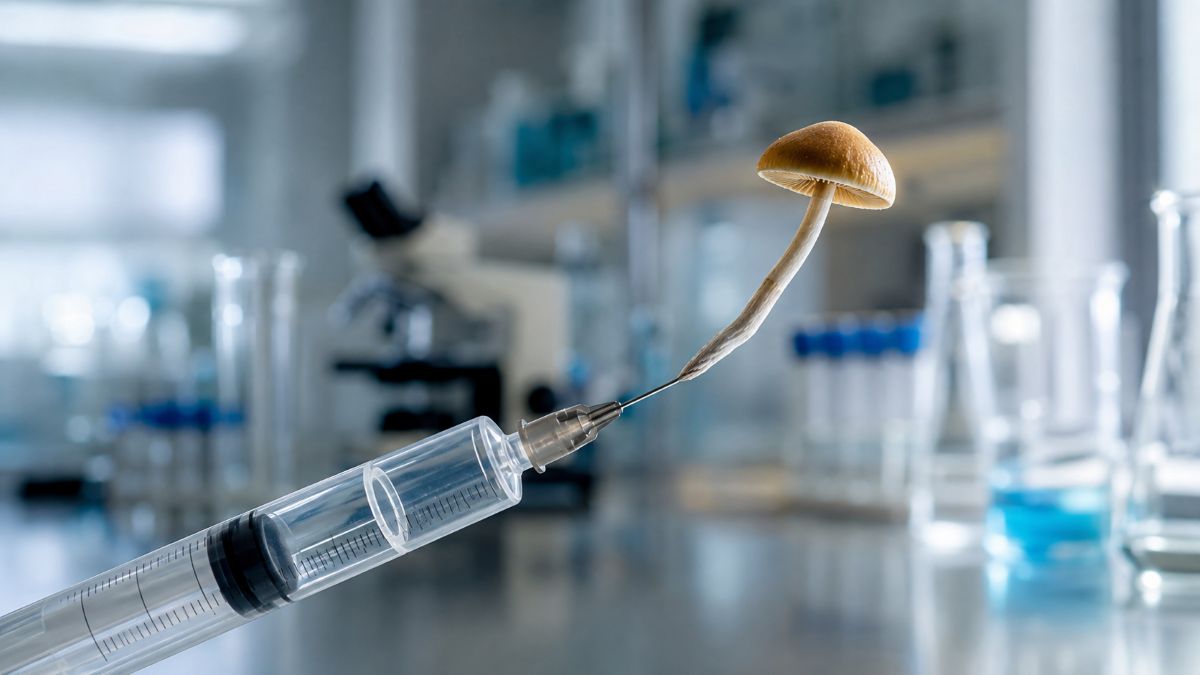
Once pushed to the margins of medicine and dismissed almost entirely as an illicit hallucinogen, psilocybin is rapidly becoming one of the most closely studied compounds in neuroscience and mental-health research.
The active psychedelic substance found in so-called magic mushrooms is being investigated for its possible effects on depression, anxiety, addiction, trauma, inflammation and the ageing brain.

At the centre of this work is a particularly compelling question: can psilocybin help the brain physically change, reorganise and recover?
The answer emerging from laboratories and clinical trials is increasingly difficult to dismiss. Psilocybin appears capable of producing rapid changes in the way neurons connect and brain regions communicate, with some effects remaining detectable weeks after a single dose.
However, claims that magic mushrooms simply “regenerate neurons” move ahead of the available evidence.
The strongest findings concern neuroplasticity—the brain’s ability to modify its connections, reorganise its networks and adapt in response to experience. Evidence that psilocybin creates entirely new neurons, known as neurogenesis, has largely come from animal studies and has not yet been established in people.
A landmark 2021 study published in the journal Neuron gave researchers an unusually detailed view of what psilocybin can do at the cellular level.
Using two-photon microscopy, researchers repeatedly examined living neurons in the frontal cortex of mice before and after administering a single dose of psilocybin. Within 24 hours, the density and size of dendritic spines had increased by approximately 10%.
Dendritic spines are tiny protrusions extending from neurons. They form part of the junctions through which nerve cells receive signals and communicate with one another.
Their growth therefore represents the creation or strengthening of neural connections, rather than the replacement of an entire dead neuron.
These structural changes persisted for at least one month. The mice also demonstrated increased excitatory neurotransmission and improvements in stress-related behaviour.
A 2025 study published in Nature took the work further, examining which brain cells and serotonin receptors were involved in psilocybin’s lasting effects.
Researchers found that a single dose increased dendritic-spine density in two principal types of pyramidal neurons within the medial frontal cortex. The study also linked parts of the response to serotonin 5-HT2A receptors, which play a central role in the psychedelic effects produced by psilocybin.
Further animal research has found similar changes in the hippocampus, a part of the brain closely involved in memory, learning and emotional processing.
A 2023 study examining fear extinction in mice found that psilocybin restored dendritic complexity and spine density that had been reduced by fear conditioning. Researchers also recorded increases in proteins associated with plasticity and in cellular markers connected to neurogenesis in the hippocampus.
The treated mice became better able to extinguish learned fear responses. Researchers suggested that the mechanism could eventually prove relevant to exposure-based therapies for conditions such as post-traumatic stress disorder, although the study did not establish that psilocybin treats PTSD in people.
Similarly, a 2024 study published in the Journal of Psychopharmacology found that psilocybin increased dendritic branches, spine density and proteins involved in synaptic function in the prefrontal cortex and hippocampus of mice.
It also activated the BDNF-TrkB-mTOR pathway, a biological signalling system involved in neuronal growth, survival and plasticity, while increasing cells carrying a marker associated with the development of new neurons.
Animal findings cannot simply be transferred to the human brain. Nevertheless, they provide biological evidence that psilocybin does considerably more than temporarily change perception.
In May 2026, that picture advanced with the publication of an exploratory human study in Nature Communications.
Researchers from Imperial College London and the University of California, San Francisco, studied 28 healthy adults who had never previously taken a psychedelic substance.
Participants first received a 1mg dose of psilocybin, used as the low-dose comparison, and later received a 25mg dose capable of producing a strong psychedelic experience.
Their brains were examined using electroencephalography, functional magnetic resonance imaging and diffusion tensor imaging before, during and after the sessions.
Within the first two hours of the 25mg dose, researchers recorded increased cortical entropy. In this context, entropy refers to a greater diversity and unpredictability of brain activity.
Rather than repeatedly following its usual, well-established patterns, the brain appeared to enter a more flexible and less constrained state.
Participants who experienced the largest increases in entropy tended to report greater psychological insight the following day. That insight, in turn, was associated with improved wellbeing one month later.
The researchers also found changes in the movement of water along neural tracts connecting prefrontal and deeper brain structures.
These differences remained detectable one month after the 25mg dose and were not seen following the 1mg comparison dose.
The imaging findings were consistent with possible lasting anatomical changes in the brain’s white-matter pathways. However, diffusion imaging does not allow scientists to watch individual neurons grow, and the researchers did not claim to have demonstrated the regeneration of human brain cells.
The study was also small, involved psychologically healthy volunteers and did not establish whether the same changes would occur in people with depression, dementia, traumatic brain injuries or other neurological conditions.
Nevertheless, it represents an important shift. Structural changes previously observed directly in animal brains are now being accompanied by preliminary evidence of lasting anatomical change in living human participants.
Other human research has shown that psilocybin can temporarily disrupt deeply established communication patterns across the brain.
A 2024 study supported by the United States National Institutes of Health repeatedly scanned seven healthy participants before, during and after controlled psilocybin sessions.
The largest changes occurred in the default mode network, which is active during self-reflection, autobiographical thinking and internally focused thought. The disruption was substantially greater than that produced by the stimulant methylphenidate.
Researchers believe this temporary loosening of established brain organisation could help explain why psilocybin is being studied for conditions involving rigid, repetitive patterns of thought.
The clinical findings involving depression are encouraging, although not universally positive.
A 2023 randomised clinical trial published in JAMA involved 104 adults with major depressive disorder. A single 25mg dose of synthetic psilocybin, administered with psychological support, was associated with a rapid and sustained reduction in depressive symptoms over six weeks when compared with an active placebo.
An earlier Phase 2 trial published in the New England Journal of Medicine involved 233 people with treatment-resistant depression. Those receiving 25mg experienced a greater reduction in depression scores after three weeks than those receiving the 1mg control dose.
However, the benefits were accompanied by adverse effects, including headache, nausea and dizziness. Suicidal thoughts, behaviour or self-injury were recorded across the dosing groups, with researchers stressing the need for careful clinical monitoring.
More recent findings have reinforced the need for restraint.
A 2026 trial involving 144 participants with treatment-resistant depression did not meet its primary measure of treatment response at six weeks. It produced exploratory evidence of possible benefit on secondary measures, but also recorded two serious reactions, including one case of hallucinogen-persisting perception disorder.
This is not a field in which every study produces a spectacular success. That inconsistency is precisely why controlled research remains necessary.
The growing interest has also attracted Bryan Johnson, the American technology entrepreneur known for conducting extensively measured experiments in pursuit of longevity.
Johnson and his team administered three psilocybin sessions over three months while monitoring 249 biomarkers.
According to results published by his Blueprint project, his systemic inflammation measurement fell by more than 35%, moving below the test’s detection threshold.
Brain measurements taken during the experience reportedly showed reduced activity in prefrontal and premotor areas, increased sensory and auditory integration, and more entropic brain patterns. Johnson interpreted these changes as reflecting reduced rumination, increased cognitive flexibility and brain activity resembling a younger, less rigid state.
His cortisol rose sharply during the peak of the experience before returning to baseline later in the day.
The experiment also produced an unwanted finding. Johnson subsequently reported that his sperm count fell from the 99.6th percentile to the 77.7th percentile after two doses.
Johnson’s measurements are intriguing, but they do not constitute a clinical trial.
He was the only participant, there was no blinded control group and hundreds of measurements were taken, increasing the possibility that some changes occurred through chance, normal biological variation or unrelated factors.
His inflammation result cannot establish that psilocybin reduces inflammation in the wider population, just as the sperm-count finding cannot prove that psilocybin damages male fertility. Both require controlled research involving substantially larger groups.
Johnson undertook the experiment with medical supervision, a professional facilitator and within a legal setting. His experience should not be confused with using unmeasured mushrooms recreationally or attempting to reproduce a clinical protocol at home.
Furthermore, South African scientists are also contributing to the developing field.
In February 2026, researchers associated with the University of the Free State published a study in Scientific Reports examining the possible combined effects of psilocybin and other compounds found in psychedelic mushrooms.
Using network pharmacology and molecular simulations, the team identified possible interactions involving neuroplasticity, inflammation, synaptic signalling and neurological pathways.
The research is particularly interesting because naturally occurring mushrooms contain more than isolated psilocybin. However, it was computational work rather than a clinical trial, meaning the predicted effects must still be confirmed experimentally.
Earlier South African laboratory research has also examined the anti-inflammatory properties of local psilocybin-containing species, including Psilocybe natalensis.
These studies were conducted under research permits because psilocybin remains a controlled Schedule 7 substance in South Africa.
Its recreational and unsupervised medicinal use is not legally permitted. Approved research requires the necessary regulatory and ethical authorisation.
The legal restriction is not the only reason clinical trials operate under tightly controlled conditions.
Psilocybin can produce fear, panic, confusion, increased blood pressure, nausea and highly distressing psychological experiences. People with personal or family histories of psychosis or bipolar disorder are commonly excluded from trials because of concerns that psychedelics may trigger mania or psychotic symptoms.
The dose used in research is measured, the participant is screened beforehand, the environment is controlled, and trained professionals provide support during and after the experience. These factors are part of the treatment being studied, not optional extras surrounding the fungus.
The larger scientific story is therefore neither that magic mushrooms miraculously regrow the brain nor that decades of prohibition prove they have no medical value.
Psilocybin appears to create a temporary period in which the brain becomes less rigid and more capable of reorganising itself. Animal studies show rapid and lasting growth in neuronal connections.
Early human imaging now suggests that structural changes may also persist after the psychedelic experience has ended, while clinical trials indicate potential value for some people with depression.
What remains unresolved is how reliably those changes can be directed towards healing, which patients are most likely to benefit, what the long-term risks may be and whether the psychological experience itself is essential to the outcome.
Those questions are no longer being asked at the fringes of science.
They are being investigated in some of the world’s leading neuroscience laboratories, medical journals and clinical programmes—and the evidence is developing at remarkable speed.
What are your thoughts on this? Let us know below.
Be sure to read: