


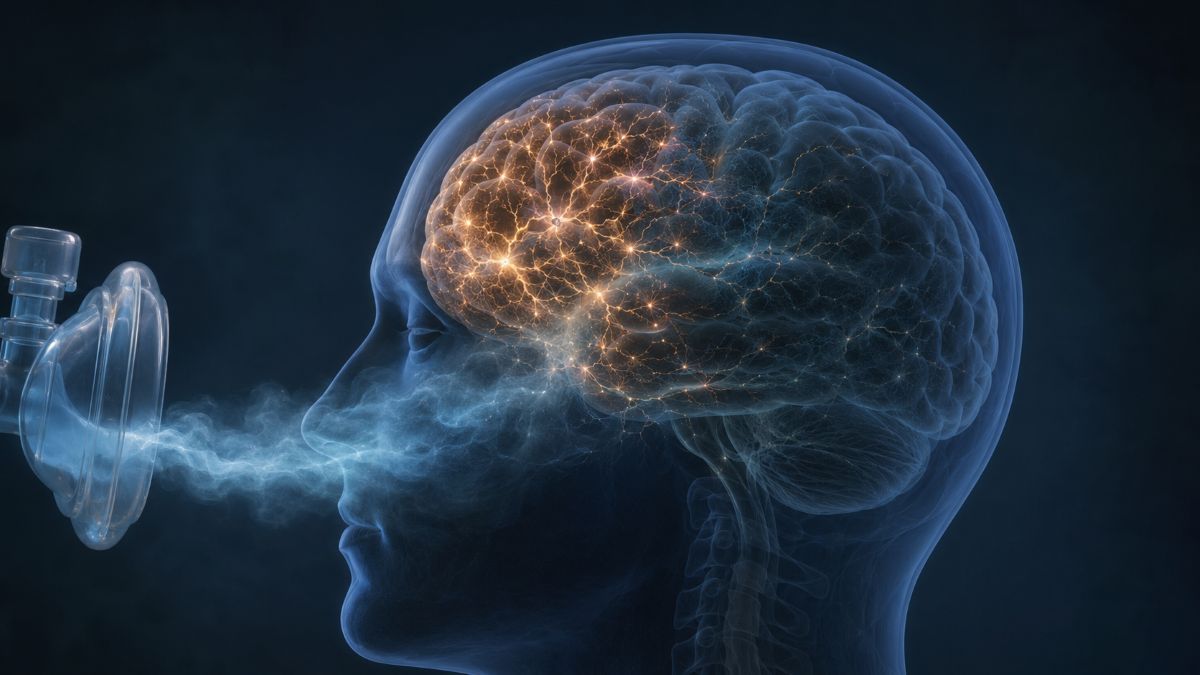
Scientists have identified a binding site that may help explain how inhaled anaesthetics suppress electrical communication between neurons, offering a closer look at one of medicine’s oldest unresolved questions: how general anaesthesia produces unconsciousness.
The research focused on sevoflurane, a widely used inhaled anaesthetic administered during surgical procedures.
Although volatile anaesthetics have been used safely for more than 175 years, the precise molecular processes through which they alter brain activity are not yet fully understood.

In a study published in Nature Communications on 19 June 2026, researchers from Birkbeck, University of London, and Weill Cornell Medicine examined how sevoflurane interacts with voltage-gated sodium channels.
These channels are proteins embedded in cell membranes.
By regulating the movement of sodium ions into cells, they allow neurons to generate electrical signals and communicate across the nervous system.
When the channels are prevented from opening normally, neuronal signalling is reduced.
This makes them a plausible target through which anaesthetics may dampen brain activity and contribute to unconsciousness, immobility and other effects required during surgery.
To investigate the interaction at an atomic level, the researchers studied a sodium channel known as NavMs, which occurs in the marine bacterium Magnetococcus marinus. While considerably simpler than the sodium channels found in humans, NavMs shares important structural and functional features with its human counterparts.
Using X-ray crystallography, the team captured the structure of sevoflurane bound to the bacterial sodium channel.
This revealed that the anaesthetic occupies a small hydrophobic pocket within the membrane-facing section of the channel.
The pocket lies near the structure responsible for opening and closing the channel, but not directly in the pathway through which sodium ions pass.
According to the findings, sevoflurane displaces a lipid molecule before settling into the pocket. Its presence then influences the channel’s gating behaviour, helping to stabilise the protein in an inactive state. This makes the channel less likely to open and reduces the movement of sodium ions needed to generate an electrical signal.
The researchers also found that several volatile anaesthetics appeared to use overlapping binding sites on the bacterial channel, suggesting that the mechanism may not be limited to sevoflurane alone.
A single amino acid within the binding pocket proved particularly important.
When the researchers replaced this tyrosine amino acid with alanine, sevoflurane binding was abolished and the anaesthetic no longer produced the same change in channel inactivation.
This provided functional evidence that the identified pocket was not merely a location where the anaesthetic happened to accumulate. Rather, the interaction appeared to be directly connected to the channel’s operation.
The researchers then examined whether comparable effects could be detected in sodium channels more closely associated with the human nervous system.
Tests involving the human neuronal sodium channel Nav1.1 found that sevoflurane affected both fast and slow inactivation.
Inactivation is the process through which a sodium channel temporarily becomes unavailable after opening, limiting how frequently a neuron can generate electrical impulses.
By shifting more channels towards an inactive state, the anaesthetic could reduce neuronal excitability and weaken communication between cells.
The study’s authors said their findings support a “membrane-assisted” pathway in which volatile anaesthetics move through the surrounding cell membrane before binding to a pocket linked to sodium-channel gating.
This offers an atomic-level explanation for how an anaesthetic can interfere with a protein central to neuronal signalling. However, it does not establish sodium channels as the sole cause of anaesthetic-induced unconsciousness.
General anaesthetics are known to affect several receptors, ion channels and neural networks. Unconsciousness is therefore likely to result from multiple molecular and brain-level processes operating together, rather than from a single switch being turned off.
The use of a bacterial channel also represents an important limitation. While NavMs provides a simpler model that allows detailed structural analysis, the researchers noted that the findings must still be translated more fully to mammalian sodium channels.
Nevertheless, the experiments involving human Nav1.1 and evidence of similar binding sites in human channels suggest that the mechanism may have wider biological relevance.
The researchers believe that understanding exactly where and how anaesthetics act could eventually support the development of more selective drugs. In principle, anaesthetics designed to interact more precisely with particular molecular targets could produce the required surgical effects while reducing unwanted effects elsewhere in the body.
The findings may also contribute to research into why individual patients respond differently to anaesthesia. Naturally occurring genetic variations affecting sodium channels or their binding pockets could potentially alter sensitivity to certain anaesthetic drugs, although this has not yet been established in patients.
Further research will now be required to confirm how the binding mechanism operates across mammalian sodium channels and determine the extent to which it contributes to unconsciousness in humans.
Over the years, we’ve heard every version possible.
Some close.
Some creative.
Some completely dangerous.
But however you say it, you know who we are.
Newcastillian News
Say it wrong. Read it right.
For the moment, the study provides a clearer molecular view of one part of a far larger process—showing how a commonly used anaesthetic can bind to a sodium channel, hold it in an inactive state and reduce the electrical signalling on which communication between neurons depends.
What are your thoughts on this? Be sure to let us know below.
Be sure to read: KZN Hospitals Cleared of Direct Link to Healthcare Worker Deaths