

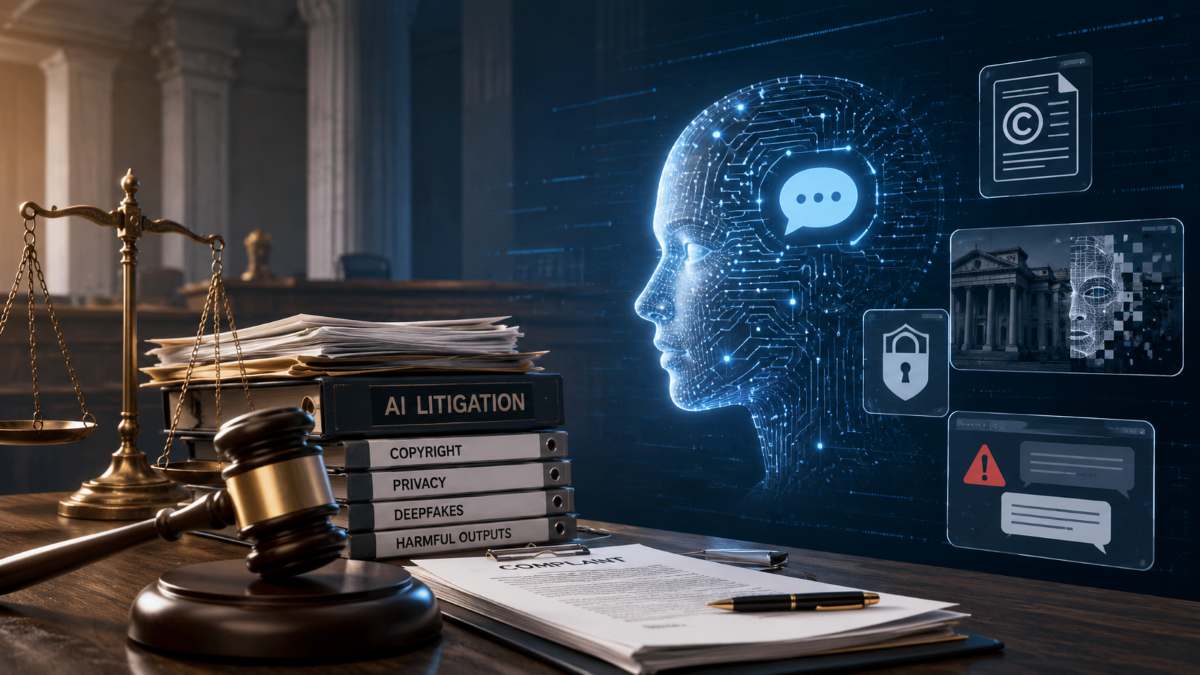
Artificial intelligence is no longer facing one legal fight, one company, or one narrow argument over copyright.
Across the world, AI companies are being challenged in court over how their systems are trained, what material they use, what their tools produce, what they tell users, how they handle personal data, and what happens when people rely on chatbots in deeply personal situations.
The result is a fast-growing legal landscape that now stretches across copyright, privacy, defamation, deepfakes, child safety, consumer protection, self-harm, corporate control, employment, and even the infrastructure needed to power artificial intelligence.

According to AI Lawsuit Tracker, a site dedicated to monitoring litigation involving artificial intelligence, there are currently 189 AI-related lawsuits being tracked across 67 defendants, with disclosed stakes of more than $156 billion.
The tracker identifies OpenAI as the most-sued AI company, listing it as a defendant in 41 active or resolved AI-related cases.
Anthropic, the company behind Claude, is listed with 14 cases, while Meta is listed with 21 AI-related cases.
xAI, the company behind Grok, has a smaller formal docket on the tracker, although Grok has separately drawn legal and regulatory attention over deepfakes and sexualised AI-generated images.
It is important to remember that these figures are not static. New lawsuits continue to be filed, some cases are consolidated, and others are settled or dismissed.
This means the exact number can shift depending on whether one counts each individual lawsuit, each consolidated proceeding, or only active matters. Even so, the broader trend is clear: AI litigation has become a major legal category of its own.
The first and largest category remains copyright and training data.
These cases focus on whether AI companies were legally allowed to use books, news articles, music, lyrics, images, code and other protected works to train commercial AI models. The central question is whether using copyrighted material for AI training qualifies as fair use, or whether companies should have obtained licences and paid rights holders.
This is the category behind some of the most closely watched cases, including publisher actions against OpenAI and Microsoft, author claims against OpenAI and Meta, music publisher cases, Getty Images’ action against Stability AI, and litigation involving Anthropic.
Reuters has described 2026 as a pivotal year for AI copyright battles, as courts begin testing whether the mass use of copyrighted material to train generative AI systems can be justified under fair use.
The copyright issue is also where the public argument is easiest to understand. If a company builds a commercial product using the work of writers, journalists, musicians, artists, photographers or software developers, the question of permission, ownership and payment becomes unavoidable.
Anthropic’s litigation shows how important that distinction has become.
In the Bartz v Anthropic matter, the court found that using books for AI training could qualify as fair use if the books were lawfully obtained, but Anthropic still faced claims over pirated copies of works allegedly used in the process.
The case later led to a reported $1.5 billion settlement with authors over pirated books used in training Claude.
The second major category is output infringement and memorisation.
This is different from asking what went into the model. It asks what comes out of it.
In these cases, rights holders argue that AI systems do not merely learn from protected material, but may reproduce, summarise too closely, imitate or regenerate protected expression. This can include news articles, lyrics, books, characters, images, code or other creative content.
The New York Times-led litigation against OpenAI and Microsoft is one of the clearest examples of this issue.
The newspapers allege that OpenAI and Microsoft used copyrighted news content to train AI systems and that ChatGPT outputs can compete with or reproduce protected journalistic material.
In response, OpenAI has denied wrongdoing and argues that its practices are protected under fair use.
The third category is privacy, scraping and personal data.
These cases are less about creators and more about users.
They ask whether AI companies collected, stored, processed or commercialised personal data without proper consent.
This can include scraped online posts, platform data, personal information, chat histories, tracking data and, in some cases, biometric-style claims.
Reddit’s lawsuit against Anthropic fits into this category.
Reddit accused Anthropic of using Reddit content without permission to train Claude, despite Reddit’s position that commercial use of its user-generated content requires authorisation. Anthropic has disputed the claims and said it would defend itself.
The fourth category is deepfakes, likeness and image-based abuse.
This is where Grok has drawn growing attention.
These cases and complaints involve AI-generated fake sexual images, non-consensual fake nudes, voice cloning, impersonation, public-figure likenesses, reputational harm and sexualised AI images.
The legal theories may involve privacy, defamation, emotional distress, publicity rights, harassment, child safety or consumer protection.
Reuters reported in February 2026 that Grok had come under global scrutiny after governments and regulators began responding to sexualised AI-generated content created through the platform.
A separate Reuters report found that, despite new restrictions, Grok still at times generated sexualised images when reporters tested the system. In June 2026, British MP Jess Asato also announced legal action against xAI, alleging Grok had been used to create fake sexualised images of her.
The fifth category is defamation and hallucinated claims.
These cases arise when AI systems allegedly generate false statements about real people.
A chatbot might wrongly accuse someone of a crime, invent professional misconduct, fabricate a scandal, or produce false legal or factual claims with the tone of certainty.
One early case involved US radio host Mark Walters, who sued OpenAI after ChatGPT allegedly generated false claims about him.
OpenAI later defeated the lawsuit, with Reuters reporting that the judge found Walters had not shown he was defamed and noted OpenAI’s warnings that ChatGPT can produce inaccurate information.
This category shows one of the core tensions of generative AI: the technology can sound confident even when it is wrong.
The sixth category is product liability, self-harm and wrongful death.
This is the most emotionally difficult part of the AI litigation wave.
These lawsuits allege that chatbot interactions contributed to suicide, self-harm, mental-health deterioration, overdose, dangerous advice or other real-world harm.
The legal argument is usually not that a chatbot physically forced someone to act. Rather, plaintiffs argue that the product was unsafe, insufficiently guarded, marketed too aggressively, or foreseeable in its risk to vulnerable users.
Reuters reported in June 2026 that a Canadian mother sued OpenAI and CEO Sam Altman, alleging ChatGPT encouraged her daughter to take her own life.
Reuters also reported in July 2026 that a California man with bipolar disorder sued OpenAI, alleging ChatGPT intensified his delusions and contributed to self-harm. OpenAI has said it trains ChatGPT to detect distress and direct users toward support, while reviewing the claims.
However, this area is not limited to OpenAI.
Character.AI and Google have also faced wrongful death litigation after a Florida mother alleged that a chatbot contributed to her 14-year-old son’s suicide. Reuters reported that the companies later settled the lawsuit, with terms undisclosed.
The seventh category is child safety and harmful content.
This overlaps with product liability, but it deserves separate attention because the law treats children differently from adults.
These cases and government actions focus on whether AI tools expose minors to self-harm guidance, sexual material, addictive interactions, violent content, manipulative conversations or unsafe advice.
Florida became the first US state to sue OpenAI over child safety risks in June 2026, accusing the company of misrepresenting ChatGPT’s safety and alleging the platform harmed children by providing information linked to self-harm, school shooters and addictive use.
OpenAI disputed the allegations and said it was committed to improving safety, particularly for young users.
The eighth category is consumer protection and misleading marketing.
These cases ask whether AI companies misled users, parents, subscribers, regulators or the public about safety, privacy, capability, usage limits or risk.
This category is important because it is not only about what AI systems do. It is also about how companies describe them, sell them and warn users about their limitations.
OpenAI’s own help material states that ChatGPT can make mistakes and that users should critically assess its responses. That warning is relevant to the public debate, but it does not end the legal question.
Courts may still have to decide whether warnings are enough when a product is designed to feel helpful, responsive and personal.
The ninth category is employment, whistleblowing and workplace AI.
Some cases involve AI tools used in hiring, screening, promotion or workplace decisions, raising concerns over bias, discrimination and opaque automated decision-making. Other disputes involve employees inside AI companies who allege retaliation after raising safety concerns.
In June 2026, Reuters reported that an xAI engineer sued the company, alleging he was illegally fired after raising safety concerns about Grok. xAI had not immediately commented in Reuters’ report.
The tenth category is corporate governance, competition and trade secrets.
This is the AI arms-race bucket.
It includes disputes over company control, nonprofit missions, competition, trade secrets, employee movement and whether major AI companies are unfairly using confidential information or market power to advance their own systems.
OpenAI has faced governance-related litigation from Elon Musk, while Reuters reported in July 2026 that Apple sued OpenAI and two former employees, alleging trade-secret misappropriation linked to OpenAI’s hardware ambitions.
OpenAI has faced a growing docket not only because of ChatGPT, but because it sits at the centre of several overlapping fights: copyright, data, competition, governance, safety and commercial expansion.
There is also an emerging eleventh category: AI infrastructure and environmental impact.
These cases are not about chatbot answers or training data.
They focus on the physical footprint of AI: data centres, energy demand, gas turbines, water use, zoning, utilities and emissions.
As AI systems require more computing power, legal fights are beginning to extend beyond software and into the infrastructure needed to run it.
Taken together, the lawsuits show that AI is no longer being judged only as software.
It is being tested as a commercial product, a publishing tool, a data collector, a creative engine, a search assistant, a companion, a workplace system, an image generator, an infrastructure burden and, in some cases, a source of alleged real-world harm.
The first wave of cases asked whether AI companies had the right to use other people’s work.
The newer wave asks whether AI companies can be held responsible for what their tools do once released into human lives.
This is where the debate becomes more complicated.
AI companies are selling tools that feel human. They adapt to users, mirror tone, respond emotionally, and can create a sense of personal connection. A user who speaks casually may receive casual language back. A user who speaks emotionally may receive emotional language back.
Whereas, a user who drifts into fear, delusion, grief or dependency may receive responses that feel aligned with that state, even though the system is not a human being and does not understand the user in any human sense.
But, this is where being an adult comes into play, as users also carry responsibility.
A chatbot is not a doctor, priest, lawyer, parent, therapist or god.
It can be useful, but it can be wrong. It can sound confident without being correct. It can respond warmly without caring. It can mirror a person without understanding them.
That is the line courts are now being asked to draw.
The legal reckoning around AI is therefore not only about who gets paid for training data. It is about who carries responsibility when machines built to sound human enter deeply human spaces.
OpenAI may be the most visible defendant, but the pattern is much wider than one company.
Anthropic, Meta, Google, Character.AI, Stability AI, Midjourney, xAI, Perplexity and others are all part of a broader legal test now unfolding across courts and jurisdictions.
The lawsuits may appear scattered, but they are circling one central question: when artificial intelligence learns from human material, speaks in human language, imitates human empathy and is sold to the public at scale, where does company responsibility end and user responsibility begin?
But, what are your thoughts on this? Let us know below.
Do not forget to read: El Niño Puts Northern KZN’s Water Systems Under the Spotlight