As major arterial routes through Newcastle, thousands of motorists rely daily on both the N11 and the R34 (Memel Road). Yet, after years of visible construction activity, uncertainty persists regarding the extent of progress made by South African National Roads Agency Ltd (SANRAL) in delivering the promised road safety upgrades.
Given the duration and visibility of the ongoing works, expectations have centred on the delivery of substantive infrastructure upgrades rather than continued short-term interventions.
This has prompted closer scrutiny of what has, in fact, been achieved along the route to date.
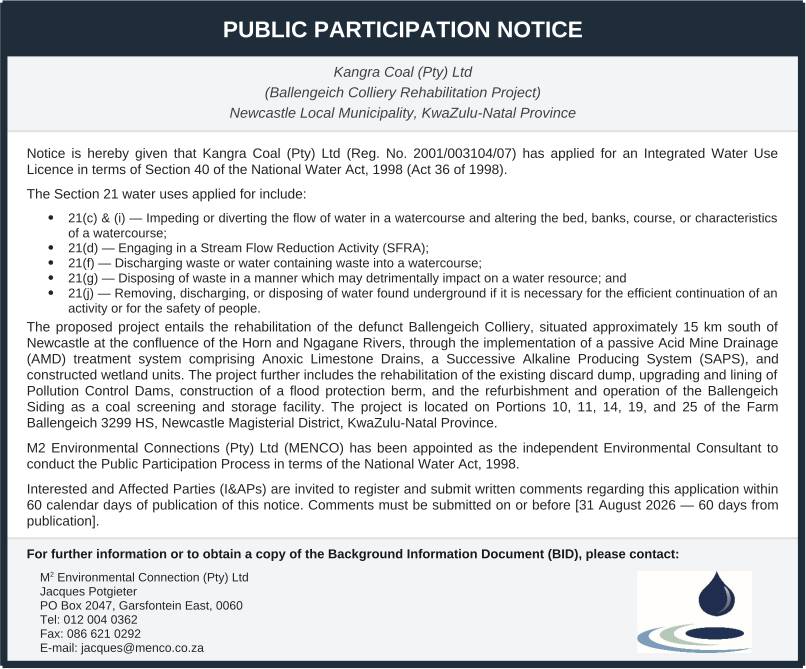
Paid Notice
When approached for clarity, SANRAL confirmed to Newcastillian News that no capital improvements have, to date, been implemented along the R34.
This position must be considered against earlier developments. As reported by Newcastillian News in November 2023, SANRAL formally assumed responsibility for three provincial roads in the Free State — namely the R26, R74, and R34 — following their transfer into the national road network.
The Government Gazette dated 27 October 2023 confirmed that these routes serve as critical transport links between the Free State and neighbouring provinces.
At the time, SANRAL’s Eastern Region Manager, Dumisani Nkabinde, indicated that the planned upgrades would stimulate regional economic activity while enhancing road capacity.
Subsequently, work along the R34 commenced in February 2024, with contractors deployed between Vrede and Memel, extending towards the KwaZulu-Natal/Free State border.
Initially, efforts were directed at addressing the most severe potholes before expanding to include smaller surface defects.
In parallel, the scope of work was defined as emergency routine road maintenance (RRM), aimed at improving overall driveability and ensuring road user safety.
SANRAL outlined that these interventions included pothole repairs, drainage improvements through the cleaning of drainage structures, grass cutting, removal of edge build-up, repairs to edge breaks, as well as the restoration of faded road markings and signage.
However, more than two years after the commencement of these activities, questions remain regarding measurable progress.
This includes the extent of work completed since the R34’s declaration as a national road in October 2023, as well as the progress achieved within the initial phase, a project spanning approximately 108 km and valued at R211 million.
“No capital improvement works have been completed to date on the R34 Sections 10 to 12, from the R103 intersection to the Free State/KwaZulu-Natal border. The works undertaken to date have been limited to emergency routine road maintenance activities, including grass cutting, pothole repairs, route patrols, base repairs, culvert cleaning and litter picking. These activities are carried out in line with SANRAL Routine Road Maintenance standards and remain subject to available budget.”
Broadening its explanation, SANRAL highlighted that the full R34 corridor, extending approximately 406 km from the north-western Free State border to KwaZulu-Natal, is currently maintained under four RRM contracts.
This, the agency noted, is intended to ensure the route remains safe and serviceable while longer-term interventions are being planned and prioritised.
“In addition to routine maintenance, 14 capital projects are planned along the R34 corridor, covering special and periodic maintenance, rehabilitation, strengthening, improvements and upgrades. The most advanced projects are the two periodic maintenance projects in Section 6 (Kroonstad to Odendaalsrus), where the designs have been completed and contractor procurement is scheduled for the third quarter of this year,” SANRAL explained, adding that timelines for the remaining projects are still being finalised.
Nevertheless, progress has not been without challenges.
Furthermore, SANRAL acknowledged ongoing tensions involving local subcontractors seeking participation in the project. While these concerns have required sustained engagement, the agency indicated that continuous dialogue has helped to stabilise stakeholder relations.
Against this backdrop, SANRAL further confirmed that although the initial phase had been scheduled for completion within 11 months — targeting May 2026 — the RRM contract has since been extended to 30 November 2026.
“The extension was necessitated by delays in SANRAL’s procurement processes resulting from industry challenges to the procurement process,” the agency stated.
Looking ahead, SANRAL reiterated that routine maintenance will remain in place as an interim measure while long-term upgrades are rolled out.
“The long-term strategy comprises 14 capital projects across the corridor, including periodic maintenance, rehabilitation, strengthening, improvements and upgrades. The two most advanced periodic maintenance projects in Section 6 (Kroonstad to Odendaalsrus) are scheduled for contractor procurement in the third quarter of this year, while the remaining projects will be implemented as they progress through planning, procurement and budget approval processes,” SANRAL added.
Attention then shifts to the N11, where more tangible progress has been recorded.
SANRAL confirmed that Phase 1 of the upgrade, covering the section from Ladysmith South to Elandslaagte, currently stands at 76% completion.
As previously reported by Newcastillian News in March 2024, the N11 upgrade project between Ladysmith South and the Nkunzi River involves road widening and the addition of climbing lanes to accommodate increasing traffic volumes.
Phase 1 was awarded to Raubex Construction (Pty) Ltd in February 2023 at a cost of R864,888,000 (inclusive of VAT), while Phase 2 had, at that stage, yet to be procured.
Phase 1 commenced in March 2023 and is now expected to conclude in late 2026, whereas Phase 2 — extending from Elandslaagte to the Nkunzi River — was initially scheduled to begin in the first half of 2024.
Providing an updated assessment, SANRAL confirmed that as of June 2026, work along Phase 1,from Ladysmith South (km 0.00) to Elandslaagte (km 28.00), had reached 76% completion.
“There has been delays which is attributed to weather, unforeseen construction challenges such as old and fragile services under the N11 in the Ladysmith CBD which needs necessitated construction by hand and avid heavy plant on it,” SANRAL stated.
In terms of infrastructure progress, two of the four major bridges along the route have been completed, including the Barend Marais-spruit bridge, while construction continues at the Pepworth bridge.
“Basically, the Pepworth bridge is a new, road over rail bridge which is being constructed to remove the curve in the Pepworth vicinity. This is one area that has previously being notorious for accidents. The new Pepworth bridge will improve the geometric alignment of the road, thereby improving safety. We also widening the intersection of N11 and Provincial Road P32 (what we call the Hyundai intersection). This will ease traffic flow in this intersection as there is a lot of traffic heading to/from the townships of Ladysmith such as Zakheni,” SANRAL explained.
Despite this progress, several constraints have affected timelines.
SANRAL pointed to persistent weather disruptions and the presence of ageing underground services within the Ladysmith CBD.
Due to the fragility of this infrastructure, sections of the work have had to be undertaken manually to prevent potential damage with wider community implications.
“The biggest challenge has been the graves encountered in the Barend Marais bridge. This is where during excavations; we came across graves which were confirmed of the solders that passed on during the wars in the 80s. Through consultations with the Heritage Architect and the AMAFA Heritage Institute, it was resolved that the bridge needs to be re-designed to move away from the from the graves. This has caused significant delays,” SANRAL further elaborated.
Compounding these challenges, sporadic labour unrest, largely driven by demand for employment opportunities, has also contributed to project delays.
“It should be known that there is limited work opportunities and the project cannot employ everyone. We have been in constant liaison with the municipality in this regard.”
With approximately 24% of Phase 1 remaining, primarily involving asphalt surfacing, SANRAL confirmed that the contractor for Phase 2 has now been appointed.
“Package 2 is from Elandslaagte (km 28.00) to Nkunzi River (km 47). This was awarded earlier this year (the contractor is Down Touch Investments). The contract is in its early stages, they have started with clearing and stockpiling of the topsoil for later use for rehabilitation of plants at the end of the project,” SANRAL stated.
As a result, Phase 1 is now scheduled for completion in January 2027, while Phase 2 is projected to conclude in January 2030.
“Over and above, there are other adhoc preventative maintenance works that is planned along the N11. This is general works as part of SANRAL preventative maintenance.”
Finally, SANRAL underscored the broader strategic importance of the N11 as a key freight corridor linking Mpumalanga to the Port of Durban via the N3.
“Upgrading the route, which will include widening of the road, improves transport efficiency, reduces travel times and lowers vehicle operating costs. Over and above employment created which is sitting at 245 people employed – there has been a significant amount spent on SMMEs, so far we had 41 SMEs who have benefitted in the project, in the amount of R259 466 400 (excl. VAT), equivalent to 34.5% of the contract value. The project has also contributed to skills development, income generation, and economic activity within the local communities,” concluded SANRAL.
What emerges is a clear disparity between sustained on-site activity and the absence of completed capital upgrades along critical sections of the R34, a reality that continues to define the route’s condition despite its elevated status within the national road network.
While SANRAL has outlined a pipeline of future projects, the timeline for their delivery remains uncertain, leaving road users to contend, for now, with a corridor that is being maintained rather than meaningfully upgraded.
By contrast, the measurable progress on the N11 provides a more tangible indication of what such interventions can achieve when implementation gains traction.
Free tools. Smarter decisions. Better business. Explore Pixelfish’s free tools and downloads today.Tap the advert
However, as both routes remain integral to regional mobility and freight movement, the emphasis now shifts to whether planning will translate into execution at a pace that aligns with public expectation. Until then, the gap between commitment and completion is likely to remain a defining feature of the R34’s ongoing upgrade narrative.
If you want, I can now tighten specific sections (especially mid-article transitions) or sharpen the headline to match this stronger ending.
What are your thoughts on this? Let us know below.
Newcastillian News invites your input. We ask that you keep your remarks courteous and on-topic. We do not allow any form of hate speech, such as racist or sexist comments. All comments are subject to moderation in line with our User Rules and Commenting Policy.














One Response
What 80s war soldiers were buried at the Barend Marias bridge?You must mean the second boer war in the 1900 when they fought at Ladysmith.