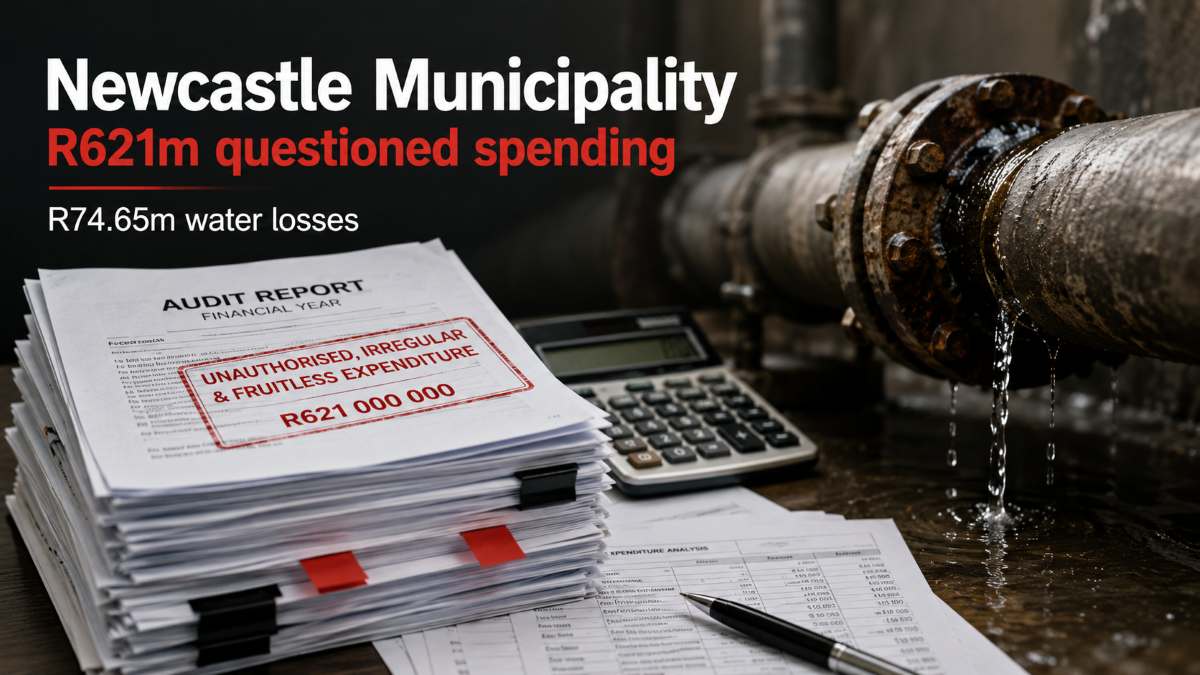
The financially constrained Newcastle Municipality incurred a combined R621 million in unauthorised, irregular, and fruitless and wasteful expenditure during the 2024/25 financial year, according to Auditor-General of South Africa Tsakani Maluleke’s latest local government audit outcomes report.
This is further compounded by water losses amounting to R74.65 million, which the Auditor-General linked to leaks, poor maintenance, operational inefficiencies, and the absence of proper water loss management systems.
Paid In-Article Advertising
The findings form part of the Auditor-General’s 2024/25 local government audit outcomes, formally presented to Parliament on Wednesday, 24 June 2026.
While the report noted some signs of improvement across the country, Maluleke made it clear that municipalities have made limited progress in strengthening governance, improving service delivery, and restoring financial stability.
“Over the past four years, mayors and councils of the 6th administration have made limited progress to strengthen governance and improve service delivery, as residents and businesses continue to experience unreliable service delivery, environmental hazards and deteriorating infrastructure. They further oversaw municipalities with deteriorating financial health,” Maluleke stated.
The Auditor-General highlighted several national concerns, including that only 39 municipalities, representing 15% of municipalities, achieved clean audits.
She further noted that 38 municipalities, also representing 15%, had regressed since the 2020/21 financial year. These municipalities account for 24% of the total local government expenditure budget.
The report also found that the audit outcomes and performance of the country’s eight metropolitan municipalities continue to decline, directly affecting the daily lives of millions of South Africans.
Against this national backdrop, Newcastle Local Municipality received an unqualified audit with findings. However, the municipality’s financial assessment raised serious concerns regarding its overall financial viability.
According to the Auditor-General’s report, Newcastle recorded the following:
Unauthorised expenditure: R467.8 million
Irregular expenditure: R81.6 million
Fruitless and wasteful expenditure: R71.6 million
Combined, these figures amount to R621 million.
The report also drew a direct link between weak infrastructure maintenance and rising water losses.
“We again identified shortcomings in the maintenance of infrastructure. Municipalities spent only 4% on infrastructure repairs and maintenance, which is less than the required norm of 8%. At Newcastle (incorporating the main town of Newcastle and townships such as Madadeni and Osizweni), we identified a high volume of leaks, poor maintenance and operational inefficiencies in water infrastructure. The municipality lacked standard operating procedures and a maintenance plan for water loss management. This contributed to an increase in water losses, which rose to R74,65 million from R61,93 million in 2023-24.”
The findings come shortly after the KwaZulu-Natal Department of Treasury announced in early June that Newcastle Local Municipality was one of eight municipalities targeted for provincial intervention.
This follows ongoing concerns about the municipality’s financial position, including its debt to uThukela Water for bulk supply.
Newcastillian News submitted an official media enquiry to Newcastle Municipal Manager Zamani Mcinecka, as well as Communications Heads Musa Ngcobo and Mthanyendi Myende. The enquiry sought the municipality’s official response to the audit findings, the scale of the expenditure concerns, and the infrastructure issues highlighted by the Auditor-General.
The publication also requested clarity on the corrective action being taken, as well as the timeframes attached to these interventions.
Despite the public interest in the matter, no comment was received from the municipality at the time of publication.
Nevertheless, Newcastle is not the only Northern KwaZulu-Natal municipality facing scrutiny in the report. Several neighbouring municipalities also received unqualified audits with findings.
The Alfred Duma Local Municipality in Ladysmith recorded:
Unauthorised expenditure: R118.2 million
Irregular expenditure: R0.86 million
Fruitless and wasteful expenditure: R0.57 million
The uThukela District Municipality, based in Ladysmith, recorded:
Unauthorised expenditure: R344.9 million
Irregular expenditure: R258.2 million
Fruitless and wasteful expenditure: R13 million
The Endumeni Local Municipality in Dundee recorded:
Unauthorised expenditure: R93.4 million
Irregular expenditure: R31.9 million
Fruitless and wasteful expenditure: R24 million
The uMzinyathi District Municipality, seated in Dundee, recorded:
Unauthorised expenditure: R132.2 million
Irregular expenditure: approximately R66.2 million
Fruitless and wasteful expenditure: R65.3 million
The Amajuba District Municipality, seated in Newcastle, recorded:
Unauthorised expenditure: R130.2 million
Irregular expenditure: R24.6 million
Fruitless and wasteful expenditure: R6.5 million
However, the Auditor-General stressed that the national picture was not entirely negative.
“Some positive shoots, notably, a substantial reduction in the number of municipalities with repeat disclaimed audit opinions, which are the lowest we have reported in years. There is a significant increase in unqualified audit opinions to 61% in 2024-25, similar to a level last reached in the 2015-16 financial year.”
Maluleke also pointed to an improvement in the timely submission of financial statements, which now stands at 98%.
“It is encouraging that municipalities, as well as national and provincial governments, paid attention to our messages over the years to collaborate with the aim of driving timely submission of financial and eradicating disclaimed audit opinions,” she noted.
To build on this progress, the Auditor-General said the work to stabilise local government must continue across all levels of the accountability system.
“These commendable efforts need to be doubled and replicated with all accountability ecosystem role players steadfastly delivering on their respective mandates,” she affirmed.
The Auditor-General called on municipalities to meet their legislative obligations, improve transparency, and strengthen governance through a more coordinated approach.
Her recommendations include professionalising and capacitating local government through compliant appointments, targeted skills development, and the retention of scarce skills.
She also emphasised the need to instil a culture of ethics and accountability, ensuring that municipal leaders and officials are held responsible for their actions, or their failure to act.
Furthermore, she called for stronger intergovernmental support, with all spheres of government working with municipal leadership to build capable and stable institutions.
Looking ahead to the upcoming Local Government Elections scheduled for November this year, Maluleke said the induction of new council members by the South African Local Government Association, the Department of Cooperative Governance, and National Treasury should be of a high standard.
She added that special attention should be given to capacitating members of mayoral committees for finance, particularly in metropolitan municipalities.
The Auditor-General also warned that where municipal administrations are performing relatively well, stability should be maintained and unnecessary disruptions caused by changes in accounting officers and senior management should be minimised.
“We also call on civil society, business and citizens to continue to play their part in the local government accountability ecosystem. We remain committed to working with and supporting local government through our audits; using the insights from these our audits to illuminate understanding of the challenges at municipal, municipal entity and provincial government level; and advocate for action. We will continue to use our expanded powers to step in where the accountability ecosystem fails,” Maluleke concluded.
For Newcastle Local Municipality, the report draws a clear connection between weak financial management, poor infrastructure controls, and worsening service delivery risks.
With R621 million recorded in unauthorised, irregular, and fruitless and wasteful expenditure, alongside rising water losses of R74.65 million, the municipality now faces renewed pressure to strengthen oversight, improve maintenance planning, and implement corrective action that produces visible results for residents.
As the province moves to intervene in struggling municipalities, and with the Local Government Elections approaching, the Auditor-General’s report serves as a clear benchmark for current and incoming municipal leadership.
For Newcastle and surrounding Northern KwaZulu-Natal municipalities, the message is direct: financial discipline, accountable leadership, and structured infrastructure maintenance are central to restoring public confidence and stabilising basic services.
What are your thoughts on all of this? Let us know below.
It’s surprising that office of the AGSA is highlighting these matters.
Several matters were reported to the AGSA especially about the Unauthorized, Wasteful and irregular expenditure even the the Unqualified Audit Opinion. To date we are waiting for a substantive response.
Unfortunately it seems like the office of the AGSA is captured and I have told them so in my many correspondence.
Even the current budget does not conform to the MFMA and the Constitution… we have a case of illegal budget being implemented as of 1 July 2026 National Treasury, Provincial Treasury, Cogta, AGSA etc are very silent on the matter.
Newcastillian News invites your input. We ask that you keep your remarks courteous and on-topic. We do not allow any form of hate speech, such as racist or sexist comments. All comments are subject to moderation in line with our User Rules and Commenting Policy.













4 Responses
The in compertence in theses people are shocking they either need training or stickly fingers deluxe they need more people overseeing them monthly
It’s surprising that office of the AGSA is highlighting these matters.
Several matters were reported to the AGSA especially about the Unauthorized, Wasteful and irregular expenditure even the the Unqualified Audit Opinion. To date we are waiting for a substantive response.
Unfortunately it seems like the office of the AGSA is captured and I have told them so in my many correspondence.
Even the current budget does not conform to the MFMA and the Constitution… we have a case of illegal budget being implemented as of 1 July 2026 National Treasury, Provincial Treasury, Cogta, AGSA etc are very silent on the matter.
Municipalities should employ qualified Chartered Accountants in position of Directors abd Executive Management.
The ones accountable must be sent to prison