As national pressure grows around compliance within South Africa’s informal trading sector, Newcastle Municipality has begun taking action in the town’s central business district.
The move comes amid ongoing claims that undocumented traders are placing strain on formal businesses, while government structures across KwaZulu-Natal face growing calls to enforce municipal by-laws more consistently.
Stop guessing what your customers want. A Newcastillian News Customer Insight Survey gives your business real feedback, better-informed decisions, and stronger marketing.
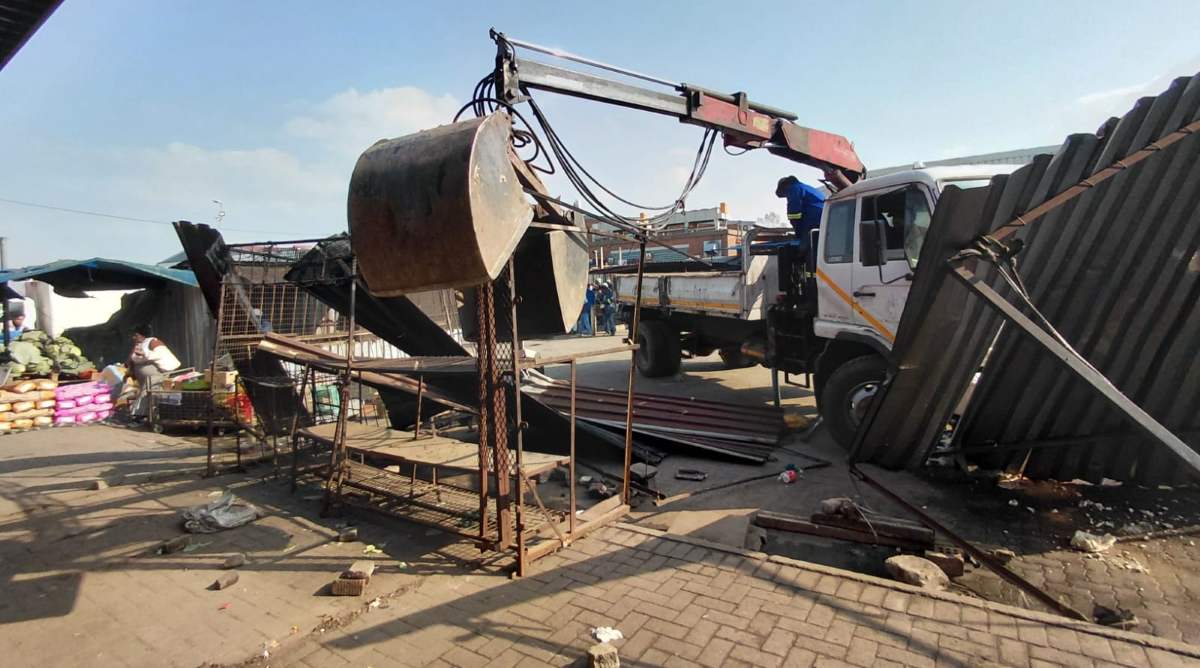
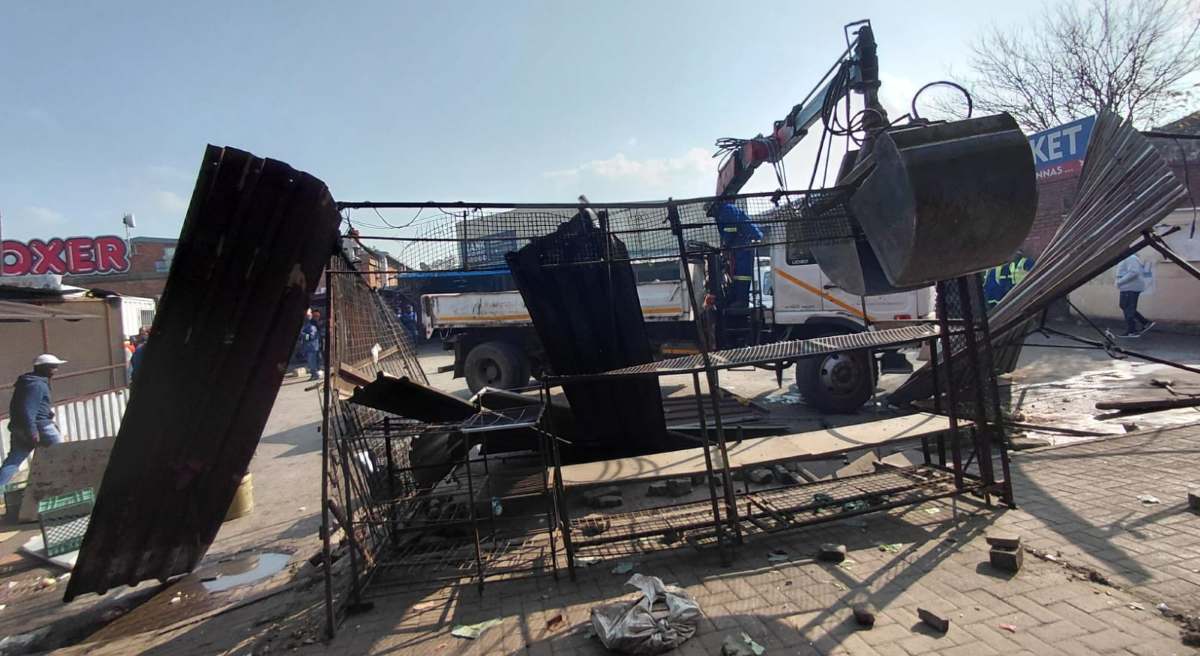
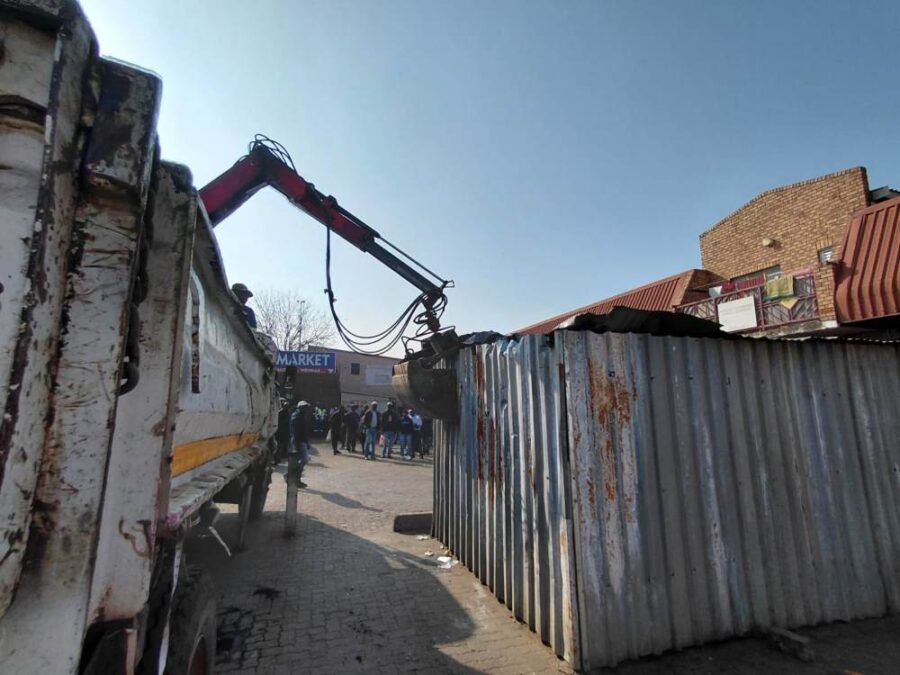
In Newcastle, that pressure translated into visible action on Thursday, 18 June 2026, when municipal officials moved against informal traders operating without the required permits. At the same time, the Municipality began dismantling shacks and removing containers that had allegedly been erected unlawfully within the CBD.
According to Newcastle Municipality’s Department of Local Economic Development and Tourism, the intervention is grounded in the Informal Trading By-law of 2014. Specifically, section 8.2.1 states that:
“An informal trader must not erect any structure for trading or storage of trade goods and services, whether movable or immovable, without the approval of the municipality.”
Despite this legal framework, the scale of the issue appears to be significant.
“The Municipality conducted an enumeration process for illegal structures in the CBD and learnt that there are 76 shacks, four Wendy houses and a total of 35 containers,” the department noted.
Further clarifying the extent of non-compliance, the Municipality indicated that all four Wendy houses, along with 20 of the identified containers, had been illegally installed within the CBD. Officials therefore maintain that enforcement action is unavoidable, with the removal process now proceeding in line with section 8.2.1 of the by-law.
The operation will unfold in two phases. The first phase focuses on the removal of shacks, after which enforcement teams will move on to dismantling Wendy houses and impounding containers.
“All shacks will be disposed, and containers will be impounded and released upon payment of the impoundment fee,” the Municipality confirmed.
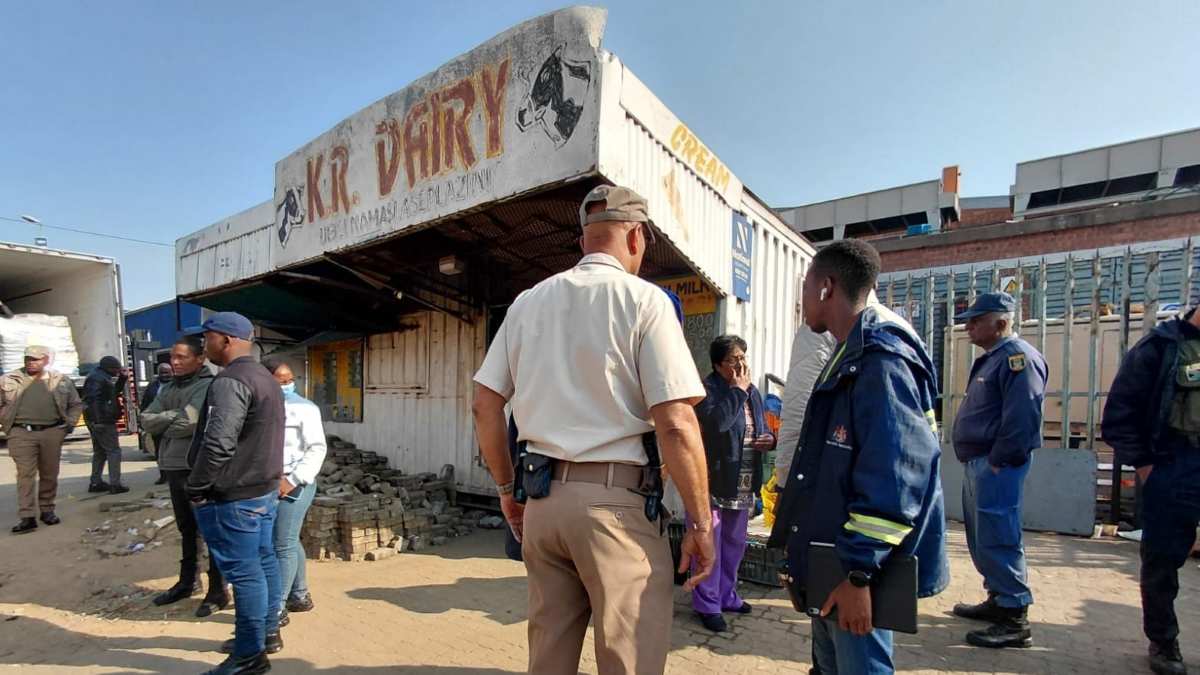
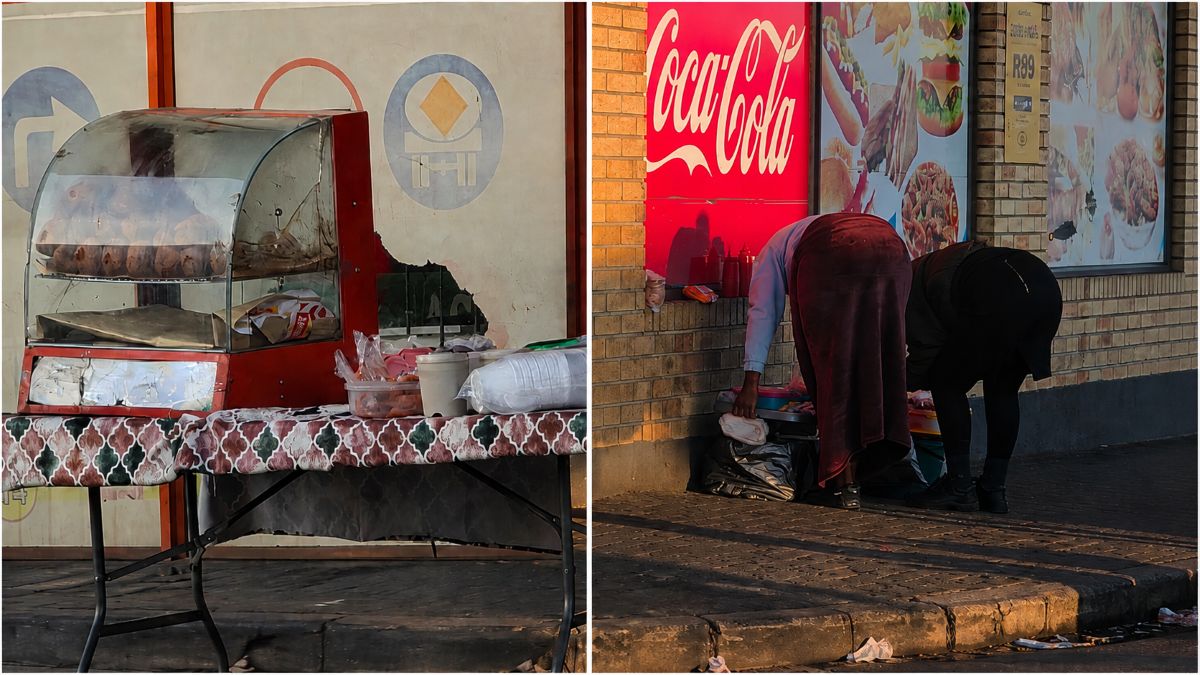
On the ground, the operation along Kirkland Street drew significant attention from traders, business owners and members of the public.
While some observed the process without incident, others voiced frustration, particularly those who have operated in the area for several years.
One informal food trader, who has conducted business from the same location for years, said she felt the enforcement was unfair.
“I brought the container years ago, and no one said a thing about it, even when I secured my informal trading licence to operate in town and updated it when necessary. Now I get told it has to be moved, this is unfair.”
Responding to such concerns, a municipal official present during the operation stressed that there is a clear distinction between holding a valid informal trading permit and receiving approval to erect a physical structure.
The official said that in several cases, traders had failed to formally notify or engage the Municipality regarding their infrastructure needs.
“There are some who are uneducated on the subject. But there are those who are simply attempting to erect structures, hampering foot traffic and access to authorised businesses under the pretence that they never knew that they were not allowed to,” stated the official, who asked not to be named.
Beyond informal trading structures, Newcastle Municipality has also broadened its regulatory focus to include the local textile industry.
As previously reported by Newcastillian News, the Local Economic Development Unit has initiated a process to update its database of Cut, Make and Trim businesses operating within the municipal jurisdiction.
The exercise is intended to improve the Municipality’s understanding of the local clothing and textile manufacturing sector, while strengthening engagement with key industry stakeholders.
Factory owners, clothing manufacturers, textile operators, labour consultants and relevant industry bodies have been called upon to submit detailed information about their operations.
Newcastle’s enforcement drive forms part of a broader regional trend, with municipalities across Northern KwaZulu-Natal intensifying efforts to address non-compliance within their CBDs.
In Dundee, a coordinated compliance operation conducted on Monday, 15 June 2026 exposed widespread regulatory failures.
Inspectors found that approximately 99% of the businesses visited were operating without valid trading permits, in direct contravention of municipal by-laws. Fire safety concerns were also identified, further highlighting the extent of non-compliance.
These findings have unfolded against a backdrop of heightened national scrutiny on migration management, as well as growing public debate around undocumented immigration ahead of the planned national shutdown scheduled for 30 June 2026.
To read more about the planned shutdown,click here.
Meanwhile, the renewed enforcement activity in Newcastle and Dundee is unfolding alongside broader provincial policy positioning on migration.
On 17 June 2026, KwaZulu-Natal Premier Thamsanqa Ntuli used a sitting of the Provincial Legislature to reaffirm the provincial government’s stance on undocumented migration, describing it as a complex governance issue requiring coordinated intervention.
While acknowledging the historical role of migration in supporting economic and cultural development, Ntuli cautioned that undocumented migration continues to place strain on governance systems and public services.
“Migration itself is not the problem. The challenge before governments is how to manage migration in a manner that protects human dignity, safeguards the rule of law, strengthens public confidence, and ensures that development benefits all who live within our communities,” he emphasised.
He further noted concerns raised by communities across KwaZulu-Natal around public safety, labour market pressures, service delivery challenges and social cohesion, while stressing the need to uphold legal and constitutional principles.
“Our responsibility is to confront facts with facts, challenges with solutions, and anxieties with leadership. We must reject xenophobia and discrimination in all their forms, but we must equally reject the notion that the rule of law is optional.”
Reinforcing this balance, the Premier emphasised that constitutional governance requires both the protection of human rights and the enforcement of the law.
“Human dignity and lawful governance are not opposing choices. They are mutually reinforcing obligations. A state that exercises compassion must also exercise responsibility,” he said.
Ntuli also highlighted the province’s Engangeni Ngesango Iyafohla Programme of Action, which is aimed at strengthening migration governance, enhancing law enforcement capacity, disrupting criminal syndicates and improving coordination across government structures.
As part of this programme, KwaZulu-Natal will convene its Second Provincial Round Table on Undocumented Foreign Nationals later this month.
The engagement is expected to bring together government departments, law enforcement agencies, traditional leadership, business, labour, civil society and academic stakeholders.
The Premier said the engagement is expected to produce a consolidated Programme of Action to guide provincial responses going forward.
“The reality before us is that no single institution can address this challenge alone. This challenge demands a whole-of-government and whole-of-society response,” Ntuli stated.
He concluded by urging cooperation and restraint across all sectors, calling for practical solutions over division.
“Let us reject the politics of division, fear, and scapegoating. Let us equally reject complacency and inaction,” he said.
In Newcastle, the latest enforcement action is not merely a clean-up operation.
It appears to be an attempt by the Municipality to reassert control over public space, informal trading activity and the use of municipal land within the CBD.
By acting against structures that have stood for years, the Municipality is now confronting a problem shaped not only by non-compliance, but also by inconsistent enforcement over time. This places both traders and officials in a difficult position, as long-standing informal practices are now being tested against by-laws that are being applied more visibly.
Set against the findings in Dundee, the message across Northern KwaZulu-Natal is becoming increasingly clear. Municipalities are tightening compliance, and informal or irregular trading arrangements are no longer being overlooked as readily as before.
The immediate impact is already visible on the ground.
However, the longer-term outcome will depend on whether this enforcement is sustained, consistent and supported by clear administrative processes.
Without that, the risk remains that order is not restored, but merely reset under public pressure.
With all of this in mind, what are your thoughts on the above? Let us know below.
Would be informative to have the numbers for all these categories – how many of these 165 structures are/were operated by citizens, how many by legal/documented non-citizen immigrants, how many by illegal/undocumented immigrants. Is it predominantly illegals or predominantly citizens? Is the illegal question really as big as presented by the self-appointed pressure groups operating outside the boundaries of the law?
Newcastillian News invites your input. We ask that you keep your remarks courteous and on-topic. We do not allow any form of hate speech, such as racist or sexist comments. All comments are subject to moderation in line with our User Rules and Commenting Policy.














One Response
Would be informative to have the numbers for all these categories – how many of these 165 structures are/were operated by citizens, how many by legal/documented non-citizen immigrants, how many by illegal/undocumented immigrants. Is it predominantly illegals or predominantly citizens? Is the illegal question really as big as presented by the self-appointed pressure groups operating outside the boundaries of the law?