


PAID CONTENT: Newcastle Municipality
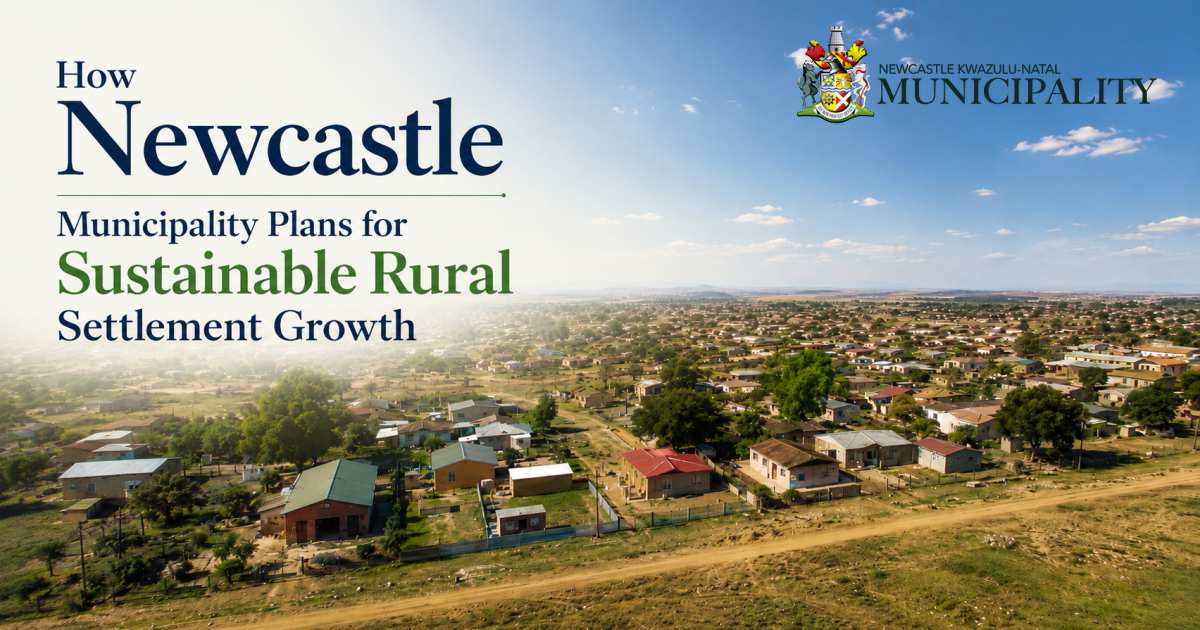
Rural settlement development is one of the less visible areas of municipal planning, yet it has a direct influence on how communities grow, how services are delivered, and how public infrastructure is prioritised; hence, Newcastle Municipality has initiated the planning to formalise uBuhlebumzinyathi Farm, which has ± 30 000 informal households.
While urban development is often associated with business sites, housing projects, industrial expansion and commercial nodes, rural settlement growth carries its own planning demands.
These demands go beyond where homes are located.
They include road access, water provision, sanitation, electricity, waste management, stormwater control, emergency access, land-use compliance and the long-term ability of the municipality and its partners to support communities in a structured way.
For Newcastle Municipality, rural settlement development forms part of the broader responsibility of guiding growth across the municipal area and this responsibility is the reason the municipality has initiated the engagements with Khathide Traditional Council and Khumalo Traditional Council of formalising the uBuhlebomzinyathi Area.
This means looking at how rural communities are developing, what services they require, where infrastructure pressure is emerging, and how settlement patterns can be managed in a way that supports residents while avoiding future service delivery challenges.
At its core, rural settlement development is not simply a housing matter.
It is a planning, infrastructure and service delivery matter.
When settlements grow without proper planning, residents can be left in areas where roads are poor, services are difficult to extend, sanitation is inadequate, or emergency response access is limited.
Over time, this can create frustration for communities and place additional pressure on municipal resources.
Proper planning helps avoid these outcomes. By assessing where growth is taking place and how rural areas connect to the wider municipal network, Newcastle Municipality is better positioned to understand which areas require attention, where infrastructure may need to be strengthened, and where future development may create long-term strain if not carefully managed.
Rural settlement development also requires a clear understanding of land use. In many areas, rural communities have grown over time due to historical settlement patterns, family occupation, traditional land arrangements, farm settlements or movement closer to transport routes and economic opportunities.
These realities must be understood within a formal planning environment so that growth does not happen in a way that creates disputes, service delivery backlogs or unsafe living conditions.
The Municipality’s Integrated Development Plan and Spatial Development Framework help guide this process. These planning tools provide direction on how Newcastle should grow, where development should be supported, how land should be used, and how infrastructure investment should be approached.
For rural settlements, this is especially important because communities cannot be viewed in isolation.
A household outside the urban centre still needs access to roads, schools, healthcare, water, electricity, sanitation, waste services and economic opportunities.
Rural settlement planning, therefore, looks at more than the location of homes.
It considers how people move, where children attend school, how residents access clinics, how waste is managed, whether roads can support public transport and emergency services, and whether infrastructure can realistically be provided or improved over time.
This planning approach also supports better service delivery. Where development is structured and properly assessed, it becomes easier to plan for roads, water, sanitation, electricity, refuse removal and stormwater systems.
Where settlement growth is scattered or unplanned, services become more difficult and more expensive to provide. This can leave communities waiting longer for improvements while placing pressure on the Municipality’s ability to respond efficiently.
Land ownership and household records are another important part of the settlement-development picture. Where ownership is unclear, where inherited properties have not been properly transferred, or where households are unsure who is responsible for municipal accounts, planning and service delivery can become complicated.
Accurate records help protect residents, support municipal accountability and ensure that services are linked to the correct properties and households.
For this reason, settlement development also connects to title deeds, property administration and responsible land use. These are not only legal or administrative matters. They affect how communities are recognised, how services are managed, how accounts are handled, and how future development is planned.
Rural settlement development also has an economic dimension. When rural communities are better connected to transport routes, business areas, schools, clinics and public facilities, residents have improved access to work, trade, education and services. This can support small business activity, informal trade, agricultural value chains and local economic participation.
Planning therefore supports more than residential growth. It helps create the conditions for rural communities to function more effectively within the broader Newcastle economy.
Better access, clearer land-use planning and improved infrastructure coordination can help rural residents participate more fully in economic life while reducing the risk of communities becoming isolated from services and opportunity.
Rural development also requires coordination between different spheres of government and stakeholders.
Depending on the area and the nature of the project, this may involve Newcastle Municipality, provincial departments, national departments, traditional leadership, landowners, service providers and community representatives.
The Municipality’s planning function helps ensure that development is aligned with local requirements and that projects are approached with land use, infrastructure, service delivery and community impact in mind.
This coordination is important because rural settlement challenges are often complex. A single issue may involve land ownership, housing needs, road access, water supply, environmental conditions and community expectations.
Without coordination, projects can become delayed, disputed or difficult to implement. With better alignment, development can be approached in a more practical and transparent way.
Be sure to read: Reducing Red Tape: How Newcastle Processes Business-Related Municipal Applications












2 Responses
Good idea for Newcastle residents in rural settlements
Thanks for all what is mentioned we are committed to work hand and hand together we’ll stand