



Every wastewater treatment plant tested in northern KwaZulu-Natal is allegedly illegally discharging untreated or partially treated sewage directly into rivers that supply drinking water to more than 1.2 million residents.
That is the stark, unambiguous conclusion of AfriForum’s Water Quality Monitoring Report 2025, released on Wednesday, 10 December 2025.
Of the six facilities sampled in Amajuba and Zululand districts in August 2025, not one complied with national discharge standards – delivering a compliance rate of 0 %.

Far from an isolated regional problem, this collapse reflects a national emergency. Across South Africa, 94 out of 109 tested sewage plants (86%) released contaminated effluent, and in six provinces – Eastern Cape, Free State, Gauteng, KwaZulu-Natal, Mpumalanga and Northern Cape – the failure rate was 100%.
Household taps in Newcastle, Vryheid, Dundee and Utrecht still run clear and safe, yet the rivers that feed those reservoirs are now heavily polluted with faecal coliforms, nitrates and phosphates.
Lambert de Klerk, AfriForum’s lead environmental analyst, put it bluntly: “This is no longer a maintenance issue. These are open sewers running through people’s backyards and farms. The crisis is worse than load-shedding because you can live without electricity for a few hours – you cannot live without clean water.”
At first glance, KwaZulu-Natal appears to be performing strongly. The province recorded 100 % drinking-water compliance in 2025, with samples from Newcastle, Vryheid (AbaQulusi), Dundee (Endumeni), Utrecht (eMadlangeni), and other sites all meeting SANS 241 standards. Nationally, 88 % of municipal samples were safe – essentially unchanged from 87% in 2024.
Beneath that reassuring surface, however, lies a far grimmer reality. Only 14 % of sewage plants nationwide produced legally dischargeable effluent, and in northern KwaZulu-Natal, the figure was zero.
Over the past five years, just two of AfriForum’s 39 provincial wastewater tests have passed – a compliance rate of only 5 %.
Marais de Vaal, AfriForum’s advisor for Environmental Affairs, warns that the apparent stability is dangerously deceptive: “The apparent stability in drinking water quality is nothing to celebrate. It is tottering on an increasingly fragile foundation that conceals a serious collapse in the rest of the system. While most municipalities manage to keep drinking water within legal limits, the complete failures of sewage treatment plants are causing the rivers and dams that supply this water to be polluted on a large scale.”
The report documents specific, repeated breaches:
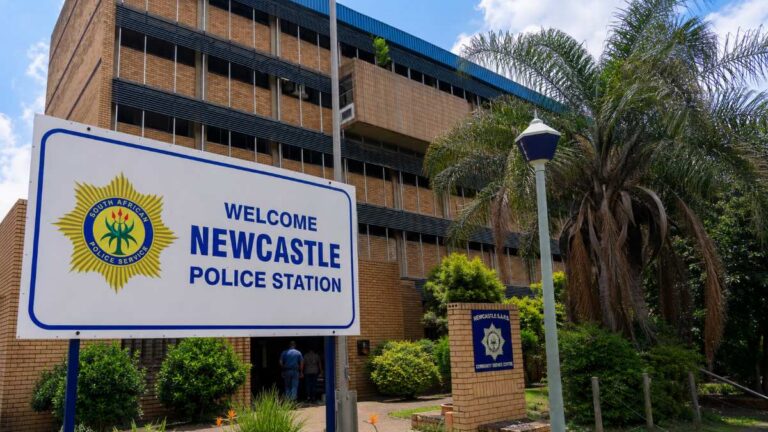
- Newcastle Local Municipality: effluent entering the Ncandu River registered E. coli levels more than ten times the legal limit, with nitrates and phosphates also far exceeding permitted concentrations.
- AbaQulusi Local Municipality (Vryheid): the main works recorded 86 % non-compliance, sending heavily polluted effluent into the Blood River.
- Endumeni (Dundee) and eMadlangeni (Utrecht): both plants scored zero compliance, contaminating the Wasbank and Klein-Draai rivers, respectively.
As a direct consequence, downstream communities in Alfred Duma Local Municipality (Ladysmith) and farming areas around Dannhauser are already experiencing livestock deaths, falling crop yields and near-constant sewage overflows in townships such as Osizweni, Madadeni and Bhekuzulu.
All four municipalities remain under formal non-compliance notices from the Department of Water and Sanitation, with the latest directives issued in March 2025 after persistently poor Green Drop scores.
Furthermore, De Vaal attributes the collapse to years of systemic neglect. Maintenance spending averages only 3 % of asset value against an international benchmark of 8%, while 26% of municipalities lack water services development plans and 82 % of infrastructure projects are delayed. Last week’s Auditor-General report confirmed that 99 % of sewage plants nationwide fail at least one quality standard.
As raw water becomes increasingly polluted, treatment costs are spiralling. Water boards are forecasting bulk-tariff increases of 10% or more next year – costs that will inevitably be passed on to households and industry.
“If this trend continues,” De Vaal cautioned, “the water crisis will surpass the energy crisis.”
AfriForum has already served formal letters on the six failing plants, demanding comprehensive 90-day remediation plans and offering technical support. Should the municipalities fail to act, the organisation will seek urgent High Court interdicts to halt the illegal discharges.
Now in its 13th year of independent nationwide testing – effectively filling the void left by the suspended official Blue and Green Drop programmes – AfriForum is calling on residents to use the hard evidence in this report to demand accountability and to become active stewards of their own water security.
For northern KwaZulu-Natal, the message is clear and urgent: safe drinking water at the tap is currently being sustained only by purification plants working overtime on increasingly contaminated raw water. Without swift and decisive intervention, that thin margin of safety will vanish.
As reported by Newcastillian News in July 2025, Department of Water and Sanitation audits had already highlighted persistent problems in Newcastle, with Blue Drop scores declining from 89.06% in 2014 to 84.35% in 2023, and Green Drop performance dropping from 78% in 2013 to 58% in 2021.
Between January and May 2025, IRIS monitoring showed 97.3 % microbiological compliance for drinking water, yet Ncandu River samples regularly exceeded 2 400 CFU/100 ml due to malfunctioning pump stations and broken manholes. Non-compliance notices were issued in March 2025, following a July 2024 directive over raw-sewage spills. Seven new pumps have since been installed, with further upgrades scheduled for 2026.
Additionally, in August 2025, Newcastillian News broadened the lens, revealing that only three Blue Drop-certified systems exist across the entire province, non-revenue water loss stands at 605 %, and northern districts – Amajuba, uThukela and Zululand – dominate the high-risk and critical-risk categories.
Experts, therefore, urged immediate CoGTA intervention and stronger community monitoring through initiatives such as AfriForum’s #CleanWater campaign.
More recently, on 3 December 2025, Newcastillian News reported that Amajuba District recorded KwaZulu-Natal’s highest water-supply interruption rate at 83.2%.
This has driven heavy reliance on water tankers, contributing to national irregular expenditure of R420 million in 2023/24. Only 3% of municipal asset value is currently spent on maintenance – far below the 8% global benchmark – while 14% of provincial water systems remain in poor or critical condition.
The evidence is now conclusive: northern KwaZulu-Natal’s wastewater treatment system is in total failure, with 100% of tested plants illegally polluting the very rivers that supply drinking water to 1.2 million people. The fact that tap water still meets SANS 241 standards is not a sign of success — it is the last line of defence working overtime on filthy raw water.

The Government’s own 2025 plans, audits and funding commitments confirm the scale of the crisis and show that interventions have begun.
Whether those measures will be fast enough and large enough to prevent the collapse of drinking-water quality depends entirely on execution. The window for fixing this before the next major public-health emergency is closing rapidly.
Frequently Asked Questions (FAQs):
The failures stem from long-term systemic neglect, including under-investment in maintenance, ageing and malfunctioning infrastructure, inadequate staffing, and the absence of updated Water Services Development Plans in many municipalities. National audits confirm that 99% of sewage plants fail at least one quality standard, demonstrating that these failures are structural rather than incidental.
Municipal purification plants are currently compensating for the pollution by running intensive treatment processes. This allows drinking water to remain within SANS 241 limits — but the margin of safety is shrinking as raw-water contamination increases. Experts warn that the current stability is fragile and depends on plants operating under severe strain.
Untreated or partially treated sewage contaminates rivers with E. coli, faecal coliforms, nitrates and phosphates. This can trigger waterborne diseases, ecological collapse, fish kills, livestock deaths, declining crop yields, and persistent sewage overflows in residential areas. It also raises purification costs and threatens long-term water security.
AfriForum has delivered formal letters demanding 90-day remediation plans and is prepared to approach the High Court for interdicts if illegal discharges continue. The Department of Water and Sanitation issued non-compliance notices in March 2025, and municipalities have begun limited upgrades, including pump replacements and scheduled infrastructure improvements for 2026.
Residents can use AfriForum’s report to press local authorities for accountability, participate in monitoring programmes like the #CleanWater campaign, report sewage leaks and infrastructure failures, and support civil-society and community-driven oversight. Public pressure remains a significant catalyst for government compliance.







One Response
When you have shit for brains shit will flow.