

With all this talk of asbestos pipes requiring replacement and constant reports from residents regarding the state of local water sources, Newcastillian News consulted the Department of Water and Sanitation (DWS) to confirm the current Blue Drop and Green Drop certification status for Newcastle Local Municipality’s water supply and to determine the dates of the most recent audits.

The Blue Drop Report, issued by the South African DWS, provides a rigorous assessment of drinking water quality and management practices across municipalities.
It evaluates the entire water supply chain—from source to tap—against national standards (SANS 241), identifying risks, ensuring compliance, and awarding “Blue Drop Certification” to exemplary water service authorities, thereby promoting sustained improvement and safeguarding public access to safe, potable water.
Similarly, the Green Drop Report focuses on wastewater management, auditing treatment works and collection systems to ensure discharged effluent complies with environmental standards, protecting critical water resources. It identifies operational deficiencies, highlights areas requiring urgent intervention, and recognises institutions achieving “Green Drop Certification” for outstanding performance.
Addressing these issues, DWS Spokesperson Mavasa Wisane clarified that the Department released the Green Drop 2022 and Blue Drop 2023 reports, based on national audits of wastewater and drinking water systems, respectively.
“Newcastle Local Municipality has regressed in its performance since 2014, resulting in a decrease in its Blue Drop score from 89.06% in 2014 to 84.35% in 2023. Whereas, the Green Drop 2022 report showed that the Newcastle Local Municipality regressed in its performance from the score of 78% in 2013 to 58% in 2021. These and other years’ audit reports are available on the DWS website (https://ws.dws.gov.za/IRIS). These audits are done biennially, and there is an assessment process currently underway with the reports expected to be released at end of the year,” elaborated Wisane.
Examining Newcastle’s water quality further, particularly in terms of microbiological (e.g., E. coli, total coliform) and chemical (e.g., heavy metals, pharmaceuticals) compliance with South African drinking water standards, Wisane noted that the DWS, through its Integrated Regulatory Information System (IRIS), monitors each Water Service Authority’s (WSA) drinking and wastewater quality data, which must be uploaded within seven days each month.
For Newcastle Local Municipality, IRIS data from January to May 2025 indicates microbiological and chemical compliance levels of 97.3% and 99.9% for drinking water, and 99.9% and 96.8% for wastewater, respectively.
Wisane further explained that the DWS continuously monitors WSA data via IRIS. “However, the WSAs are allowed to amend their monitoring programs uploaded onto the IRIS to include strategic points covering areas showing vulnerabilities in its supply systems. uThukela Water and Newcastle Local Municipality carry out periodic water sample tests at the reservoirs and affected reticulation sample points,” noted Wisane.
To ensure public safety, Newcastillian News sought details on DWS protocols for informing residents about water quality issues, including potential contamination, and any advisories issued in the past 12 months.
Wisane emphasised that, under the National Water Act, WSAs must promptly notify consumers of water quality failures through any communication channel and advise on risk mitigation measures, such as issuing “Boil Water Notices” where required.
She added, “The WSA is expected to immediately activate its Incident Management Protocol (IMP) to correct the encountered problem of water quality failure. Once the issue is resolved, it then notifies the consumers through the means highlighted. The Newcastle Local Municipality has reported to have over the last 12 months used Wards War Rooms, Ward Councillors, and social media platforms (WhatsApp, Facebook, X, etc.) to notify its consumers. Assessment of the protocols and implementation thereof form part of the Blue Drop assessments.”
On the issue of health risks, Newcastillian News asked Wisane about the DWS’s assessment of sewage and industrial contamination in Newcastle’s water sources, such as the Nguma and Ncandu Rivers, and its impact on potable water, particularly for underserved communities with limited access to alternative water sources.
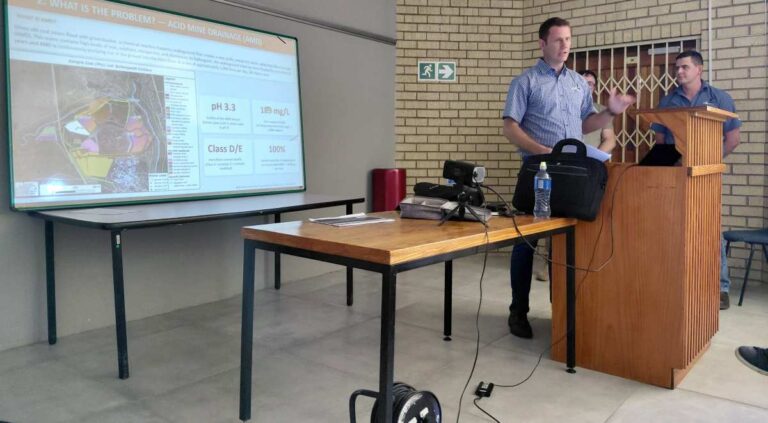
Wisane stated that the Ncandu River’s monitoring network includes an upstream reference point to assess non-point source impacts within Newcastle. “Monitoring data from various points along the Ncandu River indicate elevated levels of microbial contamination, with total Coliform counts exceeding 2,400 colony-forming units (CFU) per 100 millilitres. This contamination is primarily attributed to malfunctioning wastewater pump stations and compromised manholes,” said Wisane. She clarified that no direct drinking water users or registered potable water abstraction points exist along the Ncandu River, with industrial users classified as Schedule 1 under the National Water Act, 1998 (Act No. 36 of 1998).
Regarding non-compliance, Newcastillian News enquired about DWS enforcement actions against Newcastle Local Municipality for violations related to wastewater treatment, industrial effluent discharge, and water quality management.
Wisane reported that non-compliance notices were issued in March 2025 for wastewater treatment works, with the municipality responding with an action plan. A Directive was also issued on 24 July 2024 for raw sewage spillages from pump stations.
“In response, the Newcastle Local Municipality has submitted an action plan detailing the planned refurbishment of the pump stations. The implementation of this plan is currently being monitored by DWS. To date, seven new pumps and motors have been installed across three pump stations, and further progress on the remaining pump stations is anticipated during the 2026 financial year,” explained Wisane.
The continued use of asbestos cement pipes in Newcastle’s water reticulation network remains a significant concern. Wisane noted that intact asbestos pipes pose a low health risk, as fibres are bound within the material. “However, if these pipes become damaged or deteriorate, there is a potential for asbestos fibres to be released, which could pose health concerns. Consequently, it is important to manage, monitor, and replace asbestos pipes proactively to minimise any potential risk to public health (World Health Organization, 2003). Pipe replacement projects are being implemented by the Newcastle Local Municipality as old AC pipelines are prone to bursts and lead to high water losses,” noted Wisane.
To address these issues, Wisane outlined a Water Quality Recovery Plan for the V31 Quaternary Catchment, focusing on river health and pollution hotspots.
“It provides both general and, where applicable, specific recommendations for potential interventions aimed at improving water quality and its long-term management. The successful implementation of these recommendations requires an integrated approach, supported by a comprehensive implementation plan. This plan must involve collaboration across various sub-directorates within the Department of Water and Sanitation (DWS), as well as coordination with relevant and mandated stakeholders, including the Department of Mineral Resources and Petroleum (DMRP), the Department of Cooperative Governance and Traditional Affairs (COGTA), and affected municipalities,” Wisane elaborated.
Moreover, the Proto CMA is implementing measures, including water quality sampling at accredited laboratories, stringent enforcement on wastewater treatment works (reviving three pump stations with ten new pumps), reviews of mining and industrial water use licences, and joint site inspections with DMRP, EDTEA, and the Amajuba District Municipality Air Quality Unit.
To address water resource challenges, Wisane noted that the DWS established the Upper Buffalo Catchment Management Forum to discuss issues such as poor water quality, water quantity, alien invasive vegetation, billing, dilapidated sewer infrastructure, oversurging manholes, and environmental degradation.
However, progress is hindered by poor attendance, particularly by local government representatives.
A Catchment Management Strategy (CMS) has been developed to guide sustainable water resource management across KwaZulu-Natal, incorporating the V31 Quaternary Catchment’s Water Quality Recovery Plan.
Furthermore, Wisane highlighted that the DWS has supported Newcastle Local Municipality with Water Services Infrastructure Grant (WSIG) funding over the past three financial years, aiding efforts to address non-revenue water and upgrade infrastructure to improve water and sanitation services.
| The WSIG allocations for these years are detailed in the table below | ||||
|---|---|---|---|---|
| Financial year | Allocation | Names of projects implemented |  Project Description Project Description |  Project Status Project Status |
| 2021/2022 | R40 000 000 | Reduction of NonRevenue Water Project | Infrastructure refurbishment, leaks detection and repairs, water saving awareness campaigns, pressurereducing valves installations, bulk meter installations and upgrades to existing telemetry system | Completed |
| Infrastructure refurbishment, leaks detection and repairs, water saving awareness campaigns, pressurereducing valves installations, bulk meter installations and upgrades to existing telemetry system | Installation of 7km bulk distribution pipelines, 61km of reticulation pipes and Installation of 10 000 water connections | Completed | ||
| 2022/2023 | R48 000 000 | Newcastle Extension and Upgrade of Water Pipelines in Mndozo Stage 2, Claremont, and KwaMlimi Rural Settlements Project | Installation of 57Km of distribution pipelines and 2 762-yard water connections | Completed |
| 2023/2024 | R50 000 000 | Newcastle Extension and Upgrade of Water Pipelines in Manzana, Dicks Halt Phase 2 and Jakkalspan Rural Settlements | Installation of 54km distribution pipelines and 2 262-yard water connections | Completed |
The ongoing water and sanitation challenges in Newcastle demand urgent, coordinated action to address systemic failures. Despite efforts by the DWS and Newcastle Local Municipality, including infrastructure upgrades, compliance monitoring, and the Upper Buffalo Catchment Management Forum, inconsistent local government engagement and persistent issues like Ncandu River contamination reveal significant shortcomings. The Water Quality Recovery Plan and WSIG funding provide a framework for progress, but success depends on sustained collaboration, strict enforcement, and proactive maintenance to ensure safe water access, especially for vulnerable communities.
Newcastle’s residents require a dependable water supply free from risks posed by ageing asbestos pipes and sewage spills.

The DWS’s audits, enforcement measures, and funding support signal commitment to improvement, yet the municipality must enhance accountability and transparency to rebuild public confidence. By rigorously implementing action plans, replacing outdated infrastructure, and improving resident communication, Newcastle can safeguard public health and the environment for future generations.
What are your thoughts on the above? Share your views in the comment section below.