PAID PROMOTION: Newcastle Municipality
From business forums and industrial partnerships to community-driven initiatives, Newcastle’s development story is one of cooperation—proving that when government, private enterprise, and citizens work together, real progress happens.
The goal of Newcastle Municipality is clear: workability and development, in line with its long-term vision of becoming a fully fledged city by 2035, remain the driving force behind the government entity.
This vision forms a central part of the Municipality’s Integrated Development Plan (IDP), which aligns its available resources and capacity towards achieving sustainable growth, improved service delivery, and economic transformation.
The 2024–2025 IDP, finalised in January 2025, emphasises coordinated efforts across government spheres to enhance quality of life, with a strong focus on economic reconstruction through targeted infrastructure upgrades and inclusive economic programmes.
As part of this commitment, the Municipality is actively inviting investors to take advantage of the significant opportunities and support available across key sectors such as manufacturing, logistics, agriculture, and services.
For instance, in the manufacturing space, the Municipality has spearheaded the revival of the clothing and textile industry, establishing new production hubs in partnership with the Industrial Development Corporation (IDC). This initiative, launched in mid-2025, has already created hundreds of jobs and positioned Newcastle as a competitive player in KwaZulu-Natal’s apparel sector, leveraging local skills and export potential.
Read more about this by clicking here.

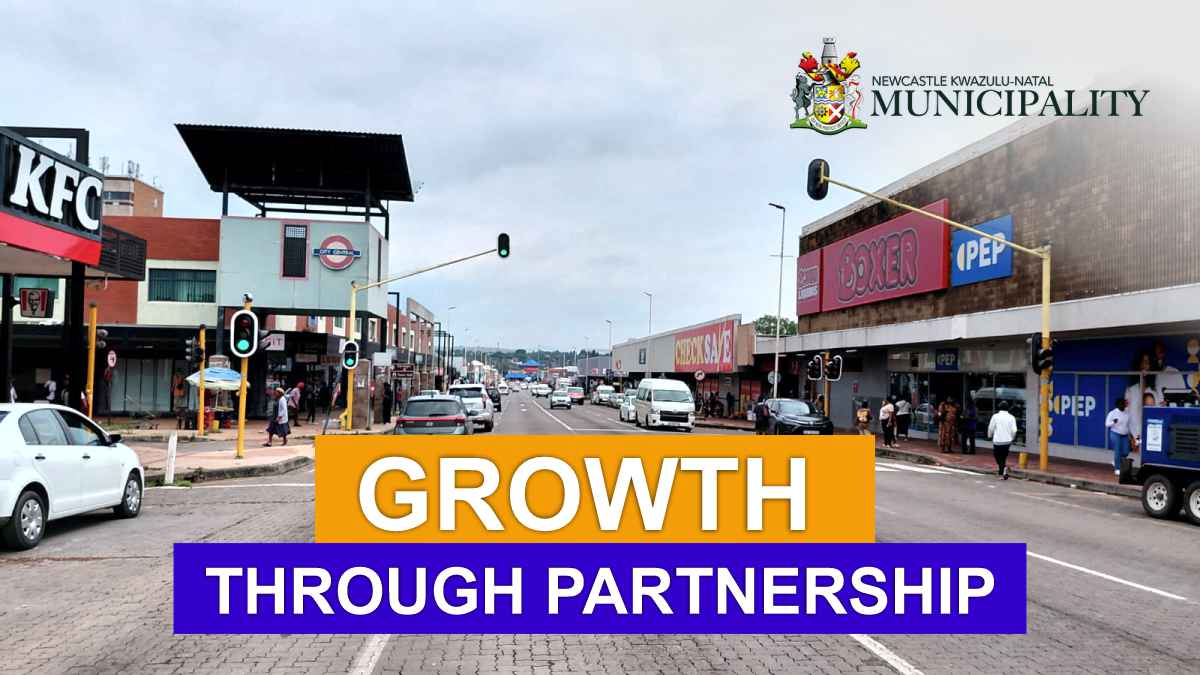
Newcastle’s economic story is not one of slogans or sweeping reforms.
It is built on practical cooperation between those who live, work, and invest in the region. While broader challenges remain, the local economy continues to move forward through partnerships that balance accountability with shared ambition.
A prime example is the revival of the Local Economic Development (LED) Forum in April 2025, which brings together municipal leaders, business stakeholders, and community representatives to navigate economic uncertainties and unlock growth opportunities. This platform has facilitated discussions on everything from supply chain resilience to skills development, fostering a proactive environment where challenges are met with collective solutions.
In recent years, Newcastle Municipality has recognised that genuine economic development isn’t achieved by working in isolation. Instead, it requires creating the conditions for collaboration—where the Municipality provides structure, and private enterprise and communities provide expertise and innovation.
This approach is reshaping Newcastle’s outlook, encouraging engagement over criticism and collective progress over passive expectation.

To build these foundations, the Municipality participated in the COMPACT Collaboration Tool workshop in August 2025, hosted by the Public Affairs Research Institute (PARI) in partnership with the South African Local Government Association (SALGA). The session equipped municipal teams with tools to enhance inter-departmental coordination and stakeholder alignment, directly supporting smoother project implementation across sectors.
Across Newcastle, collaboration is producing visible, real-world outcomes. Local industries have partnered with municipal departments to address logistical challenges and infrastructure needs, ensuring projects transition from concept to progress.
Furthermore, the Municipality’s Technical Services Department has reaffirmed its mission to deliver sustainable and affordable infrastructure—from water and sanitation to roads and stormwater systems—laying the foundation for broader economic activity.
Notable developments include the R160 million transformation of the former Monte Vista Casino site into a multi-purpose sports and recreation facility.
Once complete, the facility will include rugby and cricket fields, hockey and tennis courts, a 7-a-side soccer pitch, skateboard/BMX park, outdoor gym, indigenous games hall, change rooms, ablution blocks, guard houses, and spaces for events like tournaments, weddings, and community gatherings. It targets diverse sports codes, school programmes, and wellness activities to serve Newcastle and beyond.



At the same time, the Local Economic Development (LED) Unit continues to support small, medium, and micro-enterprises (SMMEs) through structured programmes that link training, compliance, and market access. Organisations working with the Municipality have helped create safer, more effective informal trading spaces and introduced mentorship initiatives that connect experienced entrepreneurs with emerging ones.
Click here to read more about this.
Building on this, the National Youth Development Agency (NYDA) partnered with the Municipality and the Osizweni Handcraft Centre in October 2025 to provide funding and business training to young entrepreneurs with disabilities. The initiative included a beneficiary handover at the centre, supporting participants in launching sustainable craft-based ventures and promoting inclusive economic participation within the local economy.
These developments are reinforced by the Newcastle Techno Hub, a strategic provincial initiative designed to drive technology, research, and innovation within the local economy.
Situated midway between Durban and Johannesburg, Newcastle is well positioned to meet investor needs, offering competitive industrial electricity tariffs, reliable water supply, and a skilled labour base—attributes highlighted by the Municipality as key to accelerated economic growth.
Each of these examples may seem modest in isolation, but together they reflect a maturing relationship between business, residents, and local government—one where cooperation replaces confrontation and results speak louder than rhetoric.
According to the Economic Development Unit, these engagements have improved predictability for investors, accelerated land-use application processes, and strengthened coordination between departments such as Planning, Electrical, and Water Services.
This responsiveness has helped revive investor confidence across key sectors, including logistics, construction, textiles, and energy supply.
In May 2025, the Newcastle Municipality formalised a progressive partnership with the local business sector, aiming to catalyse sustainable growth and generate employment opportunities through joint infrastructure and skills programmes.
As one local business owner, who wished to remain anonymous, observed:
“The Municipality is actively working to open doors for the development of Newcastle and the various sectors in the town. It’s not about grand promises anymore—it’s about getting practical things done.”
Furthermore, partnerships in Newcastle extend far beyond formal industry and investment.
Across Madadeni, Osizweni, and other surrounding areas, community-based organisations and small-scale entrepreneurs continue to engage with the Municipality on practical matters such as trading site allocation, compliance support, and access to basic infrastructure.
Additionally, through the Economic Development Unit, the Municipality has facilitated informal trader registrations, market site improvements, and capacity-building sessions in partnership with local business forums and development agencies.
To read about a local informal trader, click here.
These efforts illustrate what’s achievable when local initiative meets administrative support—where success is defined by community impact rather than scale.
Looking ahead, the IDP’s emphasis on tourism investment, including the relocation and refurbishment of key sites in the 2025–2026 cycle, promises to weave cultural heritage into economic narratives, drawing eco-tourists and investors alike.
Be sure to read more about this, by clicking here.
In Newcastle, growth isn’t a solo endeavour; it’s a shared journey—one partnership at a time.