AI in South Africa is no longer a distant concept — it’s rapidly becoming a national priority. But before smart apps, robotics, and machine learning can transform the economy, one fundamental step is needed: building the digital muscle to power it all.
That message was made clear in the National AI Policy Framework, released in October 2024. The document highlights that without supercomputers, modern data centres, and resilient connectivity, the promise of artificial intelligence will remain out of reach.
For South Africa, the challenge is simple: either invest now in infrastructure or risk falling behind global competitors already setting the pace.

Rather than treating AI as only a software revolution, the framework places infrastructure at the centre of progress.
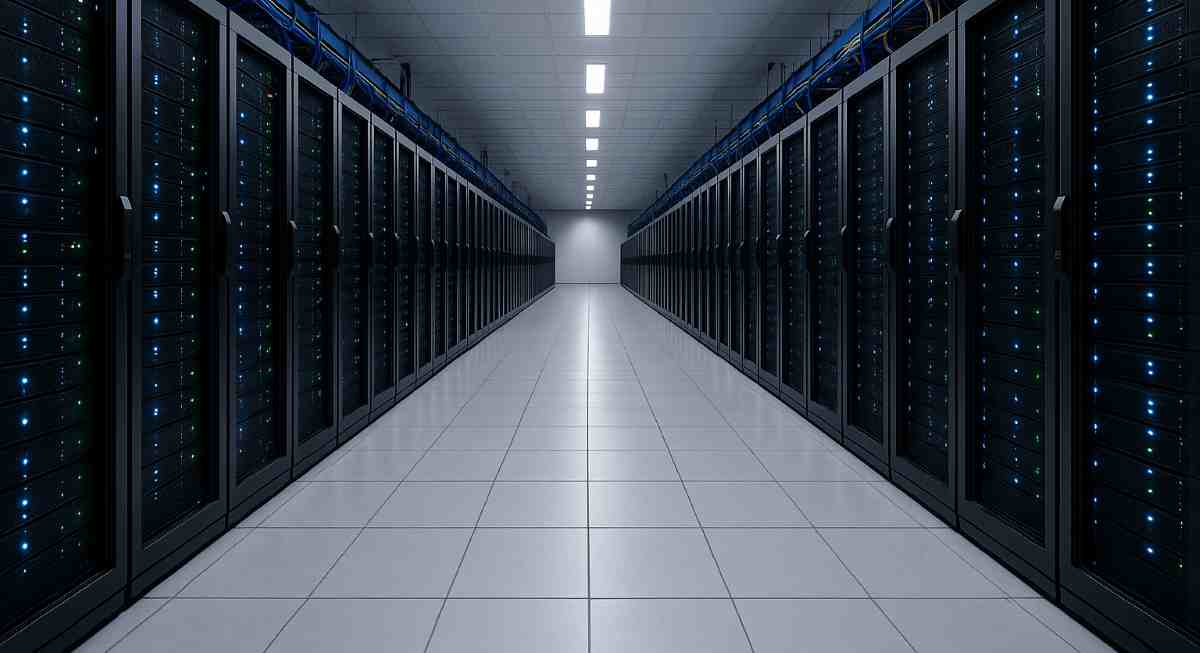
Training advanced models demands colossal computing power, while scaling real-world applications depends on high-capacity data centres. South Africa currently accounts for more than half of Africa’s total data centre footprint, but demand is growing at a pace that risks leaving existing facilities overstretched.
The AI data centre market in South Africa is set to grow from USD 78.85 million in 2025 to USD 483.5 million by 2030, reflecting an extraordinary 43.7% annual growth rate.
Whereas, the wider data centre industry is forecast to expand from USD 2.16 billion in 2024 to USD 3.4 billion by 2030.
At the same time, PwC estimates that AI could add up to R2.5 trillion (USD 136 billion) to the South African economy by 2030 — nearly 10% of GDP.
Private investment is surging in response to this opportunity. In March 2025, Microsoft pledged R5.4 billion (USD 297 million) to strengthen its AI infrastructure and cloud hubs in the country.Visa followed in July, opening its first African data centre in Johannesburg with a three-year spend of R1 billion (~USD 57 million).
Africa Data Centres is tackling the reliability issue head-on by constructing a 12 MW solar farm to keep operations running even during load shedding. Local heavyweights like Teraco and Vantage are also expanding capacity, reinforcing South Africa’s position as the digital gateway to the continent.
Additionally, the government is positioning itself on the global stage too.
While the AI Policy Framework is not yet binding law, it marks the first step towards a possible AI Act. At the same time, South Africa has used its 2025 G20 Presidency to push AI and digital public infrastructure as shared international priorities, showcasing its ambition to be seen as a thought leader in responsible technology.
Yet challenges remain. Critics argue that while the framework sets the right priorities, skills, governance, incentives and infrastructure, it lacks the detailed timelines and funding clarity businesses want.
Energy supply is another pressing obstacle. High-performance data centres require reliable power, and load shedding continues to undermine confidence. Sustainability pressures are also rising, as facilities consume significant water and electricity, forcing operators to explore renewable solutions.
Access to supercomputing power for researchers and start-ups is still limited, restricting innovation outside of the corporate sphere.
So, how do you start a Data Centre and take advantage of this developing industry in South Africa?
The data centre boom may sound like it belongs only to multinationals, but opportunities exist for local investors, entrepreneurs, and consortiums. Setting one up, however, is no small feat.
1. Capital and Planning
Building a facility requires heavy upfront investment — from land to servers to cooling systems. Costs can range from tens of millions to billions of rand, depending on the scale. Most investors start with feasibility studies to determine demand, location, and energy availability.
2. Location and Power
Electricity is the lifeblood of any data centre. With South Africa’s power challenges, many operators combine grid supply with renewable energy sources, such as solar or independent power producers. Locations near fibre backbones (Johannesburg, Cape Town, Durban) are favoured.
3. Compliance and Licensing
Operators must meet regulatory standards around safety, data protection, and often environmental approvals. Engaging with ICASA (communications regulator) and local municipalities early is crucial.
4. Building Clients — Chicken or Egg?
Do you get clients first, or build the centre first? In practice, anchor clients (banks, telecoms, cloud providers) are often secured before major construction begins. These contracts reassure investors and lenders that the facility will be profitable once operational.
5. Scaling and Differentiation
Once established, attracting clients depends on uptime guarantees, connectivity, and security standards. Partnerships with global players (AWS, Microsoft, Google) or regional telcos often define success. Smaller operators sometimes focus on niche markets like healthcare data, fintech, or government contracts.
Starting a data centre is not a small project, it demands capital, expertise, and strong client relationships. But for those willing to navigate the challenges, the payoff is clear: a seat at the table of one of South Africa’s fastest-growing industries.

(Remember: South Africa is fast becoming one of the world’s leaders in artificial intelligence adoption, with 93% of businesses already integrating AI into their operations, a figure that surpasses the global average of 88%, according to University World News. Click here to read more about this).
Nevertheless, despite the hurdles, the trajectory of AI in South Africa is promising.
The building blocks are beginning to align: strong private investment, a clear government policy direction, and growing awareness that infrastructure is as important as algorithms. If execution keeps pace with ambition, the next decade could see South Africa emerge as a continental AI hub, unlocking new industries, creating immense amounts of jobs, and driving a multi-trillion-rand economic transformation.
If you’re considering starting a data centre, what’s your biggest concern (cost, power, clients, regulation)? Let us know below.
Be sure to read, AMSA Newcastle Blast Furnace Explosion Raises Fresh Concerns Amid Looming Shutdown, if you missed it.
FAQ: AI in South Africa
It’s a national strategy released in 2024 to guide the development of AI, focusing on infrastructure, governance, skills, and responsible adoption.
PwC projects that AI could contribute up to R2.5 trillion (USD 136 billion) by 2030, equivalent to nearly 10% of GDP.
Microsoft, Visa, Africa Data Centres, Teraco, and Vantage have all announced large-scale investments worth billions of rand.
Energy reliability, limited access to supercomputing, sustainability concerns, and delays in policy implementation remain major hurdles.