


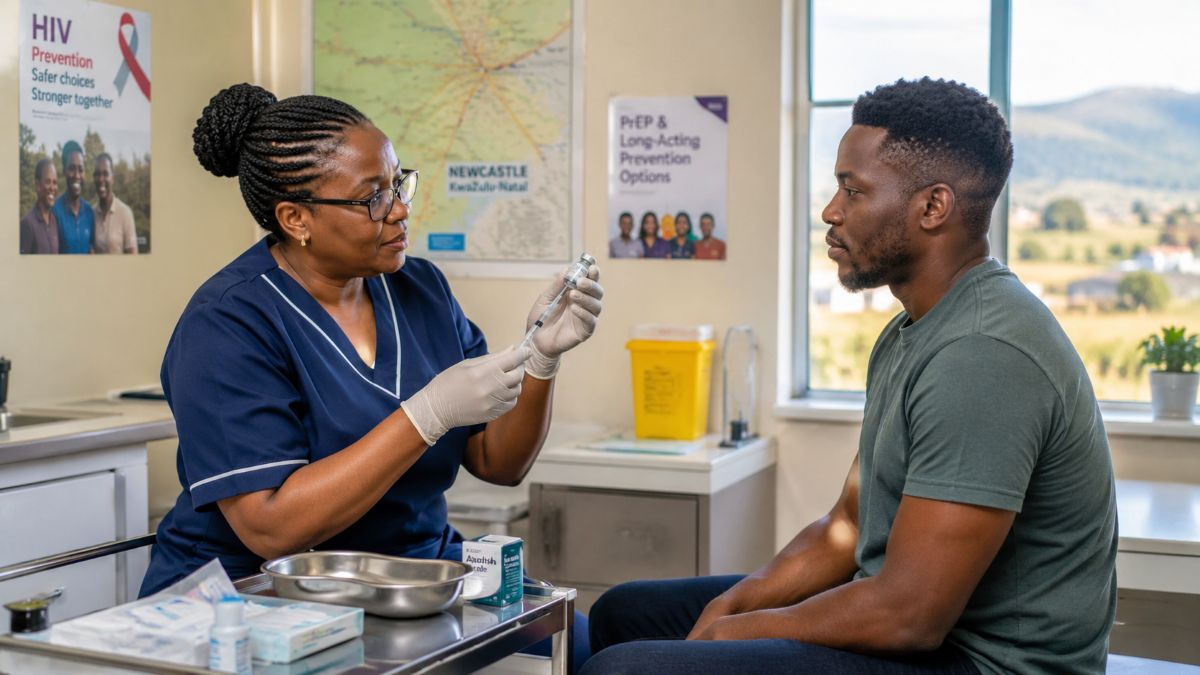
South Africa’s rollout of one of the most significant new HIV prevention tools in years has reached Newcastle, with five local clinics included among the first public healthcare facilities selected to provide the twice-yearly injectable Lenacapavir.
The development comes as early national rollout data indicates strong demand for the long-acting form of pre-exposure prophylaxis (PrEP), which allows eligible HIV-negative people to protect themselves against HIV without relying on a tablet taken every day.

According to the National Department of Health’s official Phase One Lenacapavir facility list, the five participating facilities within the Newcastle Local Municipality and Amajuba District are Madadeni 1 Clinic, Madadeni 5 Clinic, Osizweni 1 Clinic, Osizweni 2 Clinic and Rosary Clinic.
The local facilities form part of the first phase of a much larger national programme officially launched by President Cyril Ramaphosa on 5 June 2026.
At the launch, the Presidency confirmed that 360 public health facilities across six provinces and 24 high-burden districts had been selected for the initial rollout. Government aims to reach close to one million people with Lenacapavir by the end of 2027 and three million people over the following three years.
A combined investment involving government, the Global Fund and the Children’s Investment Fund Foundation is expected to contribute R1.3 billion towards the programme.
So, what exactly is Lenacapavir?
Lenacapavir is not an HIV vaccine and it is not a treatment intended to replace antiretroviral therapy for people already living with HIV.
Rather, it is a long-acting antiretroviral medicine used as pre-exposure prophylaxis, or PrEP, to reduce the likelihood of an HIV-negative person acquiring HIV.
The South African Health Products Regulatory Authority (SAHPRA) registered Lenacapavir for HIV prevention in October 2025. SAHPRA states that it is intended for adults and adolescents weighing at least 35kg who are HIV-negative and at risk of acquiring HIV.
Unlike conventional oral PrEP, which requires regular tablets, Lenacapavir is administered on a six-monthly basis. Starting the medicine also involves oral Lenacapavir tablets as part of the initiation regimen.
This long duration is one of the reasons health authorities see the medicine as potentially important. Daily medication can be highly effective when taken correctly, but maintaining a daily prevention routine can prove challenging for some people.
The World Health Organisation (WHO) formally recommended twice-yearly injectable Lenacapavir as an additional HIV prevention option in July 2025, stating that it had been shown to be highly effective at reducing the risk of acquiring HIV.
Furthermore, WHO specifically positioned the injection as another choice within a broader combination of HIV prevention measures rather than a replacement for all existing methods.
Clinical trials underpinning the recommendation produced exceptionally strong results. WHO subsequently described Lenacapavir as having prevented almost all HIV infections among people at risk in the trials, while international rollout programmes have generally referred to efficacy of at least 96% across the principal studies.
This distinction is important: the trial results demonstrate extremely high efficacy, but they should not be interpreted as a guarantee that an individual can never contract HIV after receiving Lenacapavir.
Early South African demand proves significant
While South Africa’s rollout is still in its early stages, the first national figures suggest considerable interest in the injectable.
According to an analysis by Bhekisisa of National Department of Health data presented at the 2026 International AIDS Conference, 31,297 people in South Africa had started Lenacapavir during the first six weeks of the rollout.
Of HIV-negative people who were reportedly offered a choice between daily oral PrEP and Lenacapavir, 98.5% selected the twice-yearly injection.
More than two-thirds of South Africa’s early Lenacapavir users were in Gauteng and KwaZulu-Natal, the two provinces containing the largest number of participating facilities.
The figures also suggest that the new option could be reaching people who have previously not used HIV prevention medication. Approximately one-third of the initial Lenacapavir users were reportedly new to PrEP, while 28% were men, a considerably higher proportion than historically reached through the country’s oral-PrEP programme.
However, the rapid uptake has created another challenge: ensuring that supply can keep pace with demand.
More recent reporting on 19 August 2026 found that some participating South African clinics had temporarily exhausted available Lenacapavir stock.
National Department of Health Deputy Director-General for HIV, Dr Fikile Ndlovu, subsequently explained that supply limitations were being managed as further stock became available and clarified that participating clinics should not require people to make appointments simply to access the programme.
There is currently no verified information indicating that the five Newcastle facilities have experienced shortages, and the national reports should therefore not be interpreted as evidence of a local stock problem.
Residents interested in the injectable would be best served by contacting or visiting one of the participating clinics to establish current availability and whether Lenacapavir is medically appropriate for them.
The scale of the rollout reflects South Africa’s continuing HIV burden.
According to UNAIDS’ assessment following the South African Lenacapavir launch, approximately 7.9 million people were living with HIV in South Africa, while the country recorded roughly 150,000 new HIV infections during 2024. Women and girls accounted for approximately 59% of those infections.
Consequently, expanding the number of prevention choices available to people at risk has become a significant component of the national HIV strategy.
Importantly, Lenacapavir is not intended to operate in isolation.
President Ramaphosa stressed during the June launch that the medicine was “not a silver bullet”, pointing out that it complements HIV testing, oral PrEP, treatment as prevention, condoms, voluntary medical male circumcision and other prevention interventions.
SAHPRA similarly advises that Lenacapavir should be used together with safer-sex practices, including condoms, which remain important because the injection does not provide protection against other sexually transmitted infections.
Testing is also fundamental. Lenacapavir PrEP is intended for people who are HIV-negative, and appropriate HIV testing is required when initiating and continuing long-acting injectable PrEP. WHO has specifically recommended rapid diagnostic testing approaches to support people starting or continuing Lenacapavir.
Furthermore, because Lenacapavir remains in the body for an extended period, maintaining the prescribed injection schedule is important.
SAHPRA’s approved product information warns that if a person acquires HIV while concentrations of Lenacapavir are present without receiving an appropriate HIV treatment regimen, drug resistance can potentially develop.
For Newcastle, the most immediate significance of the national programme is that access has not been limited to major metropolitan centres.
The inclusion of clinics in Madadeni and Osizweni places Newcastle among the communities participating in South Africa’s first phase of a medical intervention that WHO has described as potentially transformative for HIV prevention.
At the same time, inclusion on the national rollout list does not necessarily mean unlimited stock will be available at every facility at all times, particularly while the programme is being expanded nationally.
People considering Lenacapavir should therefore speak to a healthcare professional at one of the participating clinics, undergo the required HIV testing and discuss the different PrEP options available to determine which approach is appropriate for them.
As South Africa moves beyond the initial launch and into the practical realities of delivering Lenacapavir at scale, the coming months will show whether the striking early demand can be matched by sustainable supply and continued access.
For residents of Newcastle, however, one element is already clear: one of the newest HIV prevention options available globally has officially reached local public healthcare facilities.
What are your thoughts on all of this? Let us know below.
Do not forget to read: Sugar Strike Adds New Pressure to Industry as Imports Surge











One Response
Visited Madadeni Section 1 facility and they did not have Lenacapavir injection, even spoke to district director who promised to come back to me.