


For nearly three decades, acid mine drainage has been flowing from the abandoned Ballengeich Colliery into the Horn River outside Newcastle.
Every day, approximately 1,000 m³ — equivalent to around one million litres — of highly acidic, iron-laden water decants from the flooded underground mine workings directly into the river.

The brand-new Newcastillian News Advertising Shop is live.
No meetings. No quotation ping-pong. Pick your spot. Book it. Get seen.
With mining operations at Ballengeich having ceased in the early 1990s without formal environmental closure, the resulting pollution has developed into a longstanding environmental liability.
Now, after decades of uncontrolled discharge, a formal rehabilitation strategy aimed at treating the water and restoring the affected site has been placed before the public.
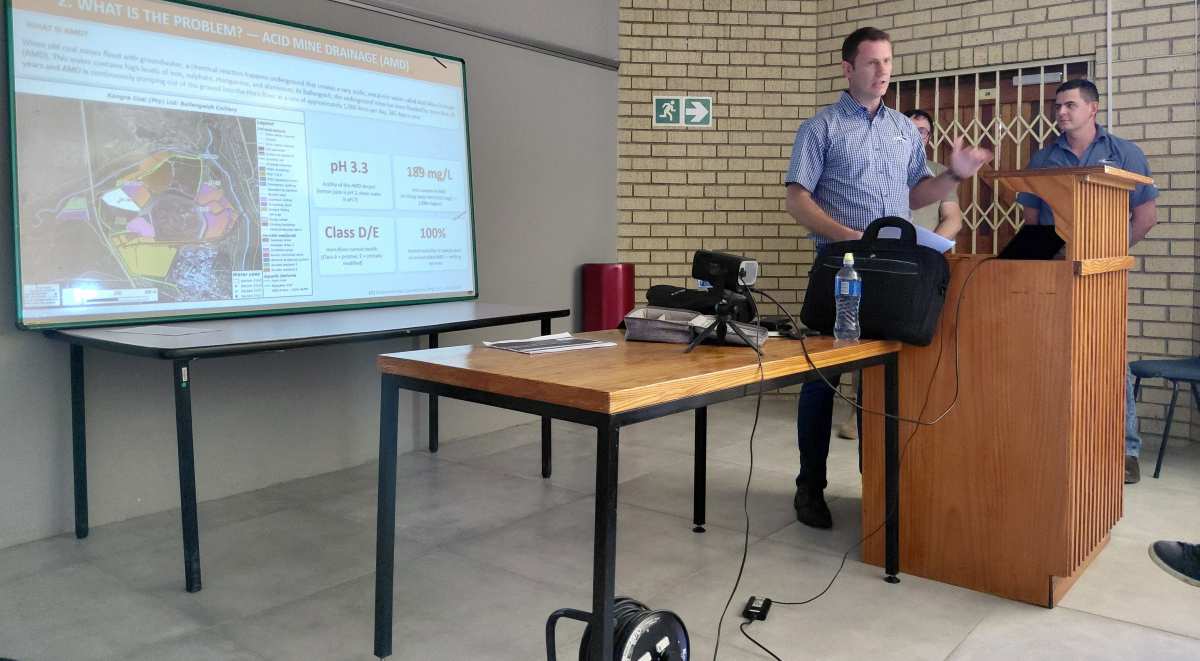
Addressing community members at the Newcastle Library on Tuesday, 18 August 2026, environmental consultancy M2 Environmental Connections (Pty) Ltd (MENCO) presented details of the proposed Ballengeich Colliery Rehabilitation Project.
The meeting formed part of the formal Public Participation Process associated with a Water Use Licence Application (WULA) submitted to the Department of Water and Sanitation (DWS).
MENCO is acting as the appointed environmental consultant on behalf of Kangra Coal, which acquired the Ballengeich Colliery and inherited the environmental liability associated with the abandoned workings.
During the presentation, residents from Newcastle and Ballengeich were given an overview of the condition of the site, the proposed treatment system and the environmental consequences should rehabilitation not proceed.
Outlining the history of Ballengeich, MENCO Operations Manager Hanjo Fourie explained that the colliery operated from the 1960s until mining ceased in the early 1990s.
“The Ballengeich Colliery operated under Natal Cambrian Collieries back in the 1960s, all the way to the 1990s when mining operations were closed. It was an underground mine, with some opencast areas as well, and during the time they closed the mine, proper rehabilitation did not take place, and this has led to a few accumulating effects in the environment.”
Following closure, groundwater continued entering the abandoned underground workings.
With nowhere for the accumulated water to escape other than through natural decant points, acid mine drainage eventually began flowing into the Horn River.
“The water quality is in very bad condition, and there is no where for the water to go, so it decantes out straight into the Horn River, and this is a major problem for many decades, and finally we have come to a point where there is movement in the project,” Fourie said.
According to MENCO, the acid mine drainage currently leaves the workings at approximately 1,000 m³ per day and has a pH below 4.5.
MENCO’s presentation further described the Horn River downstream of the site as highly toxic, classified as Hazard Class IV, stating that the affected stretch currently supports no fish or aquatic life.
Residents were also advised that livestock should not drink from the Horn River downstream of the site.
The presentation noted that orange or rust-coloured water associated with the acid mine drainage can be observed within the Horn and Ngagane river systems.
Chemical analysis presented during the meeting showed iron concentrations of approximately 189 milligrams per litre, further illustrating the extent of the contamination.
While the contamination originates from mining activities that predate Kangra Coal’s ownership of the property, MENCO stressed that the company inherited responsibility for addressing the site’s environmental condition.
According to information presented at the meeting, the Department of Water and Sanitation issued a Section 19 Directive relating to the Ballengeich site in August 2013.
MENCO’s presentation stated that, under the current situation, Kangra Coal remains non-compliant with the DWS Section 19 Directive while the acid mine drainage continues to discharge untreated into the Horn River.
The presentation further warned that without intervention, the AMD would continue flowing into the river indefinitely, the discard dump would continue eroding, the risk to groundwater quality would grow and the Department of Water and Sanitation could pursue further enforcement measures.
Importantly, however, specialist groundwater investigations conducted as part of the rehabilitation planning found that groundwater at the site currently flows away from the rivers.
According to MENCO, hydrogeologists drilled boreholes and tested groundwater across the site, finding that the Horn and Ngagane Rivers are not presently contaminating the surrounding groundwater. The rehabilitation strategy is therefore intended to treat the pollution at its source while preventing the environmental risk from increasing over time.
To accomplish this, MENCO and a team of specialists have designed a multi-stage passive acid mine drainage treatment system.
The first stage would see acidic water channelled through an anoxic limestone drain, consisting of buried pipes surrounded by crushed limestone rock. This process is intended to begin neutralising acidity within the water.
The water would then move through an alkalinity-producing system, where it would pass through layers of organic compost and additional limestone designed to further neutralise acidity and assist with removing dissolved metals.
From there, the water would enter a dedicated sedimentation pond, where it would remain for approximately 24 hours. During this period, metallic particles would settle to the bottom before the accumulated sludge is removed.
The partially treated water would then flow into an aerobic wetland planted with indigenous vegetation, reeds and other plant material. Natural biological processes within the wetland would provide a final treatment stage before the water is discharged into the Horn River.
According to MENCO, the proposed constructed wetlands would cover approximately 5.7 hectares.
The rehabilitation project extends beyond treating the mine water.
MENCO’s presentation listed several additional interventions planned for the Ballengeich site, including:
- Rehabilitation of the approximately 12.2-hectare historical discard dump, including reshaping, capping and replanting the area with grass.
- Upgrading existing pollution control dams and constructing one additional pollution control dam.
- Constructing a flood-protection berm along the Horn and Ngagane Rivers.
- Installing instream weir structures within the Horn River.
- Monitoring the biological health of the Horn River every six months using standardised assessment methods.
- Conducting monthly water-quality monitoring once the treatment system is operational.
However, the presentation also revealed a significant component of the proposed project which extends beyond environmental rehabilitation.
MENCO’s presentation lists the refurbishment of the Ballengeich siding for coal screening, with a proposed operational period of 15 years at approximately 95,000 tonnes per month.
This means that while no new coal extraction is proposed from the Ballengeich workings themselves, the broader project does envisage renewed coal-related activity at the site through the screening of coal.
Fourie addressed concerns during the meeting regarding whether commercial mining would restart at Ballengeich, stressing that the rehabilitation project does not involve reopening the abandoned workings for coal extraction.
The distinction is therefore important: the underground colliery is not proposed for renewed mining, but infrastructure at Ballengeich is intended to be refurbished for coal-screening operations.
The WULA submitted for the project is extensive.
According to MENCO’s presentation, Kangra Coal is applying for 60 individual water-use registrations across five categories under the National Water Act.
Specialist work informing the application has included water-quality studies, engineering design, river and wetland assessments, groundwater investigations and an assimilative capacity study examining how much treated water the receiving river system can safely accommodate.
MENCO said water-quality specialists tested river water and acid mine drainage at multiple points and concluded that the proposed treatment system is capable of reducing contamination to acceptable levels.
An assimilative capacity assessment also concluded that the receiving river system has sufficient capacity to accommodate the treated AMD discharge while maintaining a Class C ecological health status.
River and wetland specialists assessed the health of affected aquatic systems, while professional civil engineers designed the treatment system, pollution control dams, flood-protection berm and stormwater infrastructure.
According to MENCO, these engineering designs have been professionally certified.
The rehabilitation remains subject to approval by the Department of Water and Sanitation.
MENCO’s presentation indicates that the project is currently within the public participation and technical submission stages, after which the application will proceed to formal DWS review before a Water Use Licence can be granted.
Once the required regulatory approvals are obtained, Fourie said implementation of the rehabilitation programme is expected to take approximately two years.
MENCO projects that following treatment, the Horn River’s water quality could improve from its present Class D/E condition towards Class C.
Aquatic life, including fish, invertebrates and reeds, is expected to gradually re-establish over a period of approximately three to seven years.
The characteristic orange discolouration associated with the acid mine drainage is also expected to disappear once the treatment system is fully operational, while the constructed wetlands would provide new habitat for birds and aquatic species.
Speaking to Newcastillian News, Kush Singh of the non-profit organisation Save, Serve and Protect Newcastle (SSPN), which monitors mining-related matters in the region, welcomed the proposed rehabilitation but stressed that community oversight would remain important.
“Save, Serve and Protect Newcastle welcomes the proposed rehabilitation of the Ballengeich site and fully supports efforts to address its longstanding environmental legacy. As a community, however, we will continue to watch the project closely to ensure that it is properly implemented and that the interests of Newcastle’s communities, water resources and environment remain protected. We appreciate the transparency and cooperation shown by the EAP, MENCO, throughout the consultation process and look forward to continued constructive engagement.”
Interested stakeholders can access and review the full Ballengeich Colliery Rehabilitation Project documentation through MENCO.
Residents wishing to participate in the public process may submit written comments or register as Interested and Affected Parties (I&APs) by no later than 16:00 on 31 August 2026 via email to [email protected].
Correspondence must include the formal reference:
WU33839 — PPP Comment — [Your Organisation Name]
The proposed rehabilitation now places a decades-old environmental problem before regulators, Kangra Coal and affected communities.
Approximately one million litres of acidic mine water continue to leave the abandoned Ballengeich workings and enter the Horn River every day. MENCO’s own assessment describes the affected river as highly toxic and incapable of supporting aquatic life in its current state.
At the same time, the proposal extends beyond environmental remediation, with plans for a 15-year coal-screening operation at the refurbished Ballengeich siding handling approximately 95,000 tonnes of coal per month.
For residents, the Department of Water and Sanitation’s eventual decision will therefore determine not only how one of Newcastle’s longstanding mining-related environmental liabilities is addressed, but also the conditions under which renewed coal-related activity at the Ballengeich site may proceed.
With the public participation process still underway, the focus now turns to the regulatory review and whether the proposed rehabilitation system can deliver the ecological recovery MENCO says is achievable while ensuring that future activity at Ballengeich does not create a new environmental burden.
With all of this in mind and a wealth of information on the subject, what are your thoughts?
Be sure to let us know below and do not forget to read: Riverside Industria’s Damaged Roads Hit Businesses and Emergency Services










One Response
It is a pity that the Public Participation done yesterday at the library, was very important especially for those who are the proximity of the area to be rehabilitated, but the people of Ballengeich where not involved. Why they public participation did not happen at Ballengeich?
Why the residents of Ballengeich where not involved?
I believe first people to be considered to this, should be the community host and directly affected of these acid dams.