


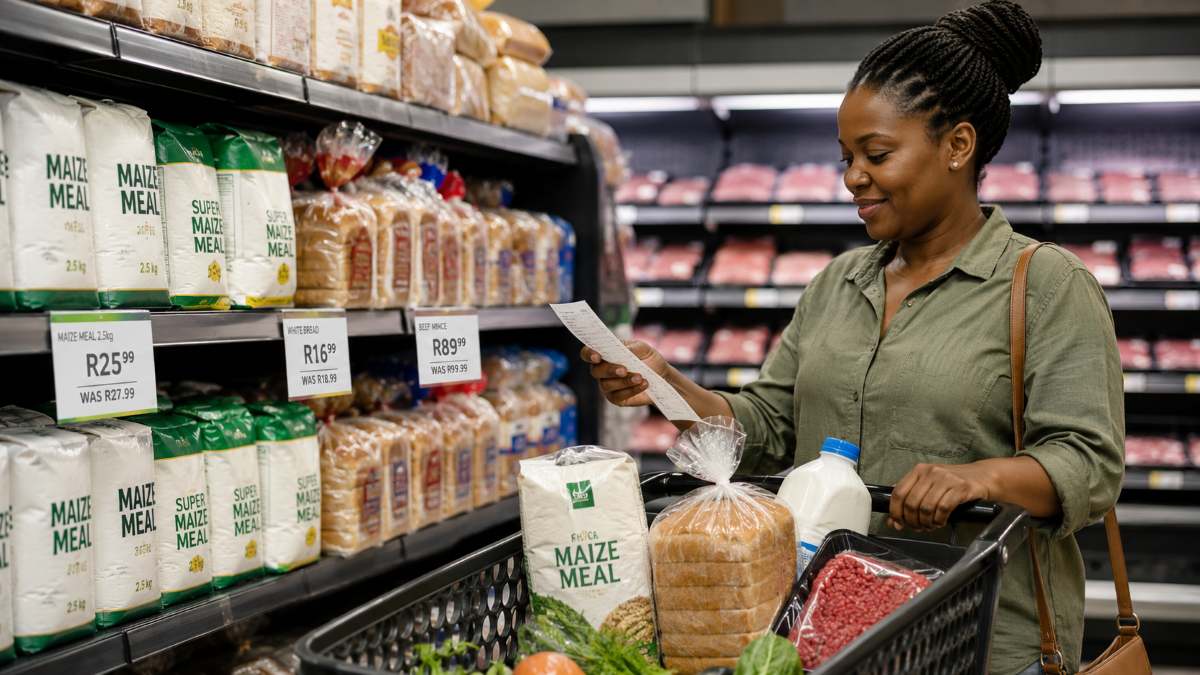
South Africans accustomed to watching grocery prices steadily climb have finally been handed some welcome news, with food inflation falling to its lowest level in more than 16 years.
According to the latest Consumer Price Index figures released by Statistics South Africa (Stats SA), annual inflation for food and non-alcoholic beverages slowed to just 0.9% in July 2026.

The brand-new Newcastillian News Advertising Shop is live.
No meetings. No quotation ping-pong. Pick your spot. Book it. Get seen.
The last time the rate was lower was in June 2010, when it stood at 0.7% — the same month South Africa was hosting the FIFA World Cup.
The latest figures do not mean that groceries across the board have suddenly become cheaper.
Rather, they show that the pace at which food prices are increasing has slowed dramatically, with several everyday products actually recording price decreases.
Among the more noticeable monthly declines was maize meal, which became 3.1% cheaper in July.
Macaroni prices declined by 0.7%, while white bread fell by 0.6%.
Cereal products as a broader category were also 2% cheaper than they were a year earlier.
Beef provided another area of relief.
Annual meat inflation slowed sharply from 5.1% in June to just 1.5% in July, with several unprocessed beef products costing less than a year ago.
Furthermore, Stats SA recorded annual price declines of 7.9% for stewing beef, 6.1% for beef steak and 5.8% for beef mince.
For households that have spent years adjusting shopping habits to cope with steep increases in basic food costs, the figures represent a significant change in direction.
However, the relief is far from universal.
Processed meats have moved the other way, with corned meat prices increasing by 11.8% compared with a year ago. Meat patties rose by 7.8%, Russians by 7.7% and sausages by 6.2%.
Stats SA also recorded higher annual inflation across several other food categories, including fruit and nuts, vegetables, fish and seafood, oils and fats, cold beverages, and milk, dairy products and eggs.
Fish products were among those showing particularly strong monthly increases.
Battered or crumbed fish portions rose by 3.5% during July, fish fingers increased by 2.3%, hake by 2.1% and canned fish, excluding tuna, by 2%.
The food figures formed part of a broader slowdown in consumer inflation during July.
South Africa’s headline inflation rate dropped from 5% in June to 4.3% in July, while consumer prices increased by only 0.2% during the month compared with the 0.7% monthly increase recorded in June.
Stats SA attributed the improvement primarily to softer food inflation, lower municipal tariff increases and falling fuel prices during July.
Even here, however, the numbers illustrate why many consumers may not yet feel dramatically better off.
Municipal electricity tariffs increased by an average of 8.1% in 2026, while water tariffs climbed by 10.2%. Those increases were lower than the respective 10.4% and 12.1% increases recorded in 2025, but they nevertheless represent additional pressure on household budgets.
Fuel provides a similar example.
Petrol prices declined by 7.1% between June and July, while diesel fell by 11.7%. Despite those monthly decreases, petrol remained 19.3% more expensive than a year earlier, with diesel still 28.8% higher.
This distinction is important when interpreting the latest inflation figures.
An inflation rate of 0.9% does not mean food prices have returned to levels last experienced 16 years ago. Instead, it means the overall annual rate at which food and non-alcoholic beverage prices are rising has slowed to a level last seen in 2010.
For consumers, the more tangible benefit can be found in individual products such as maize meal, bread and several cuts of beef, where actual price declines are now being recorded.
With 144 food and beverage products included in Stats SA’s consumer inflation basket, individual households will experience the improvement differently depending on what they buy.
The complete list is published in Stats SA’s 2026 Consumer Price Index: Sources and Methods report, with the food and non-alcoholic beverage basket set out in Annexure 1 from pages 29 to 35.
It includes products ranging from maize meal, bread, rice and beef to dairy products, cooking oils, fruit, vegetables, coffee, tea, bottled water and soft drinks.
Nevertheless, after years in which food inflation became an increasingly painful part of household budgeting, the figures offer South Africans something relatively unfamiliar at the supermarket checkout: a little breathing room, unless you are buying coffee.
What are your thoughts on this? Let us know below.
Do not forget to read:
Food and non-alcoholic beverage inflation slowed to 0.9% in July 2026, according to Statistics South Africa.
The rate was last lower in June 2010, when food and non-alcoholic beverage inflation stood at 0.7%.
Recent Stats SA data showed declines in products including maize meal, white bread, macaroni and several beef products such as stewing beef, steak and mince.
Not necessarily. Lower inflation means prices are increasing more slowly. Some individual products have become cheaper, while others continue to rise.
Several processed meats, fish products, fruit, vegetables, dairy products and oils have continued recording price increases.











2 Responses
maybe you could expose the total list of 144 products that is used by stats sa to calculate the food inflation
Hi. Thanks for raising this. We’ve updated the article with a direct link to Stats SA’s 2026 CPI methodology report, where the full food and non-alcoholic beverage basket is listed in Annexure 1 on pages 29 to 35.