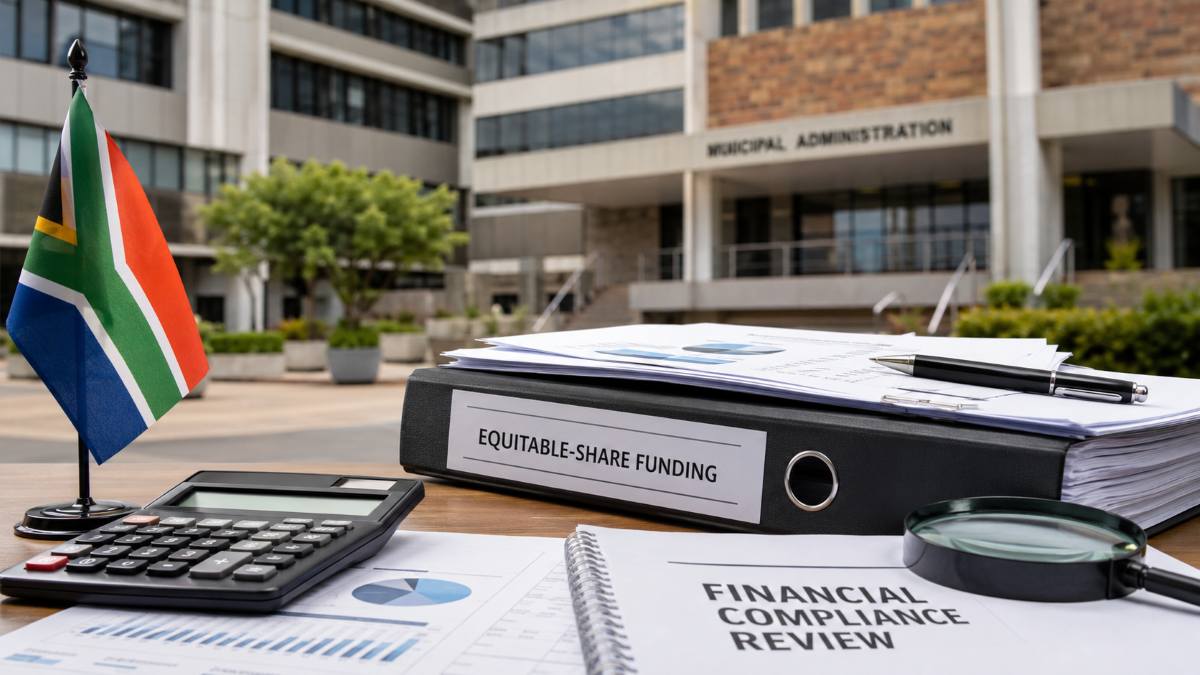


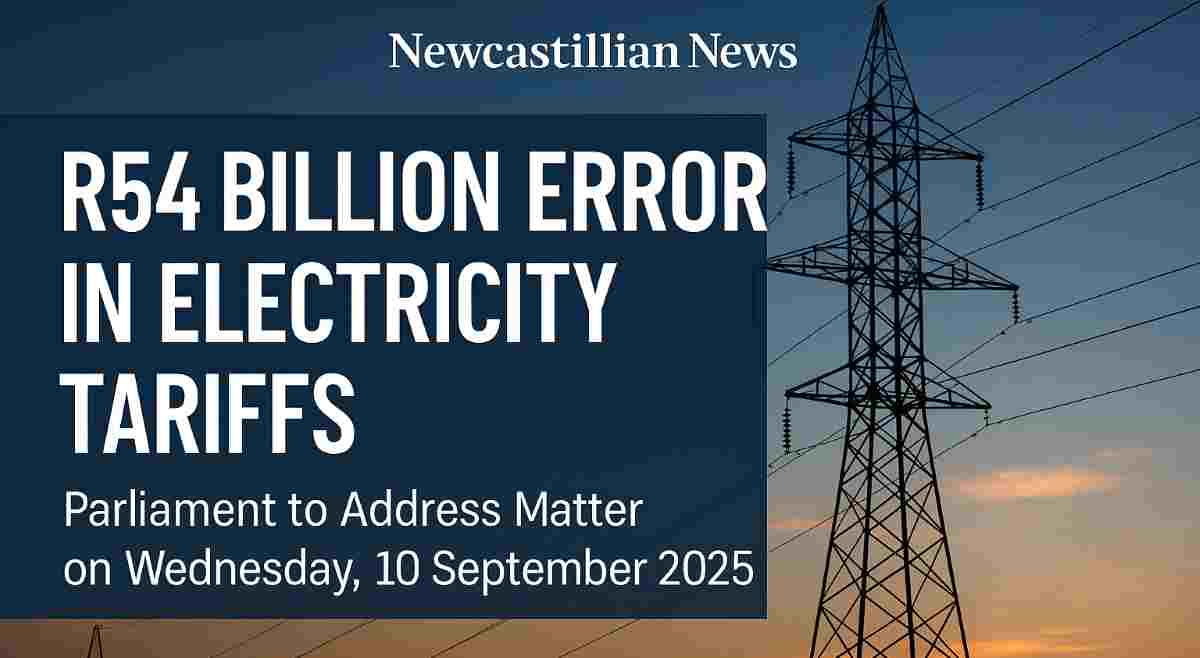
South Africans, already under economic pressure, were confronted with a major revelation when the National Energy Regulator of South Africa (NERSA) admitted to a R54 billion miscalculation in its Sixth Multi-Year Price Determination (MYPD6) for Eskom’s electricity tariffs.
The scale of the R54 billion miscalculation has raised serious questions about governance at the highest level. For many, it seems unthinkable that such an error could go unnoticed in an organisation tasked with regulating billions in public money.
Don’t have time to read the full story? Here are the Key Takeaways:
- NERSA Error: A R54 billion miscalculation in Eskom’s electricity tariffs was revealed in August 2025.
- Impact on Consumers: Tariffs will rise by an extra 3.4% in 2026/27 and 2.64% in 2027/28. For a household paying R2,000 a month, that’s about R121 more over two years.
- Political Fallout: The DA calls it a “catastrophic blunder” and will press for accountability at the 10 September parliamentary hearing.
- Civil Pushback: OUTA and AfriForum are considering legal action; SALGA warns of non-payment, illegal connections, and unrest.
- Eskom’s Position: The utility says the error was NERSA’s alone but will still recover the R54 billion shortfall.
- Future of Power: The mistake fuels calls to speed up competition from Independent Power Producers (IPPs), offering South Africans cheaper and cleaner alternatives.

Disclosed in August 2025, the error will result in additional tariff increases over the coming years, as Eskom seeks to recover the shortfall.
NERSA has now been summoned to appear before the Portfolio Committee on Energy and Electricity on Wednesday, 10 September 2025, to explain how the mistake happened and what will be done to prevent a repeat.
Furthermore, NERSA confirmed that two errors were found in its calculations. A mistake in depreciation values created a R14.5 billion shortfall, while an asset transferred for commercial operation was incorrectly factored into revenue projections. Correcting these errors meant Eskom was entitled to R54 billion more across the three-year MYPD6 cycle, down from the R107 billion the utility had originally claimed. The settlement was finalised on 30 July 2025, pending court ratification. Because the process is judicial in nature, the public was not consulted — a decision that has drawn widespread criticism.
The correction means electricity tariffs will rise by an additional 3.4% in 2026/27, taking the increase to 8.76%. In 2027/28, a further 2.64% increase will push the overall rise to 8.83%.
While the current year is unaffected, the hikes will add strain to households, businesses, and municipalities.
For an average household paying R2,000 per month for electricity, the adjustment will add about R68 more in 2026/27 and another R53 in 2027/28. Families already struggling with food and fuel costs may be forced to cut back further. Small businesses face higher operating expenses that could lead to price increases, job losses, or closures. Municipalities, which rely heavily on electricity sales, warn of lower payment rates, more illegal connections, and potential unrest as communities push back against rising costs.
NERSA has defended the phased approach as a balance between Eskom’s financial stability and consumer affordability. Still, the admission has drawn sharp criticism.
The Democratic Alliance (DA) has been at the forefront of the political response, calling the error a “catastrophic blunder” and proof of “gross incompetence.” At the end of August 2025, DA Spokesperson for Electricity and Energy, Kevin Mileham MP, wrote to the Chairperson of the Portfolio Committee on Energy and Electricity, demanding an urgent review of the settlement.
The DA argued that the hikes expose “systemic failures within NERSA’s processes” and called for a parliamentary inquiry into how the error persisted and how similar mistakes can be avoided.
In early September, the DA also wrote to NERSA Chairperson Thembani Bukula, demanding a full explanation, accountability for those responsible, and measures to ensure transparency. They condemned the “quiet settlement” with Eskom as a “slap in the face of every citizen.”
On 4 September 2025, Bukula acknowledged “multiple, shocking errors” in MYPD6 calculations — a response the DA described as a “victory for transparency.” The party has pledged to use the 10 September hearing to push for sanctions against officials and reform of NERSA’s systems, warning that “South Africans cannot be used as an ATM to fund the incompetence of Eskom and NERSA.”
Civil society organisations have echoed the anger. The Organisation Undoing Tax Abuse (OUTA) criticised the lack of transparency, with CEO Wayne Duvenage saying: “We’re not happy with this, and we need the reasons that informed this decision from NERSA. We will be engaging with them accordingly.” OUTA has begun consulting lawyers to challenge the settlement. Executive Director Advocate Stefanie Fick noted: “Increased tariffs mean a person has less cash available to buy groceries, and in some instances, it becomes a bread-and-butter issue: electricity or food.”
Building on this, AfriForum described the settlement as “a serious breach of trust and gross negligence.”
Its Manager of Local Government Affairs, Morné Mostert, said the group is exploring a legal challenge on constitutional grounds, stressing that “decisions on electricity tariffs must be lawful, fair, and transparent.” The South African Local Government Association (SALGA) also issued a warning. President Bheke Stofile said the hikes risk “pushing many households further into hardship and deepening the crisis of affordability.”
He also cautioned that municipalities could see reduced compliance, more illegal connections, and community unrest, all of which would undermine service delivery. SALGA has called for urgent engagement with NERSA and the Minister of Electricity.
Eskom has stressed that the error was NERSA’s alone.
The utility confirmed it will recover the R54 billion over several years to protect its financial position. The announcement has renewed debate on whether Eskom should continue as the country’s main supplier, or whether competition from private producers should be expanded to give consumers more choice.
The government has been pushing for private-sector participation since 2003, with Independent Power Producers (IPPs) forming part of the mix. The Electricity Regulation Amendment Act (ERAA), which came into effect on 1 January 2025, is opening the market further by simplifying licensing for small-scale generation and creating a wholesale electricity market.
Through the Renewable Energy Independent Power Producer Procurement Programme (REIPPPP), more than 6,000 MW has been procured since 2011, with 4,201 MW already operational. Momentum is building.
In the first quarter of the 2025/26 financial year, NERSA registered 111 new generation facilities, mostly solar and wind. Companies like Stratek Global and X-Energy are pursuing nuclear projects, while JUWI Renewable Energies, Wetility, and POWERX are investing heavily in solar and battery projects.
For now, most households and small businesses remain tied to Eskom and municipal distributors, as private trading frameworks are still limited. Large industrial clients, however, are already signing power purchase agreements with IPPs. International examples, such as the deregulated electricity markets in the United States, show how competition can reduce prices and improve service quality.
The 10 September parliamentary hearing represents an important test for NERSA. For households and small businesses, the outcomes will go beyond numbers on a balance sheet. South Africans are being asked to pay more for Eskom’s power while cheaper and more efficient alternatives are starting to take shape.

The question is whether this moment will bring real accountability, and whether it will open the door to a more competitive, affordable electricity future.
What are your thoughts on the above? Share your views in the comment section below.
Be sure to read, KZN Emergency Medical Services in Crisis: Ambulance Shortages, Staffing Gaps, and Systemic Failures, if you missed it.