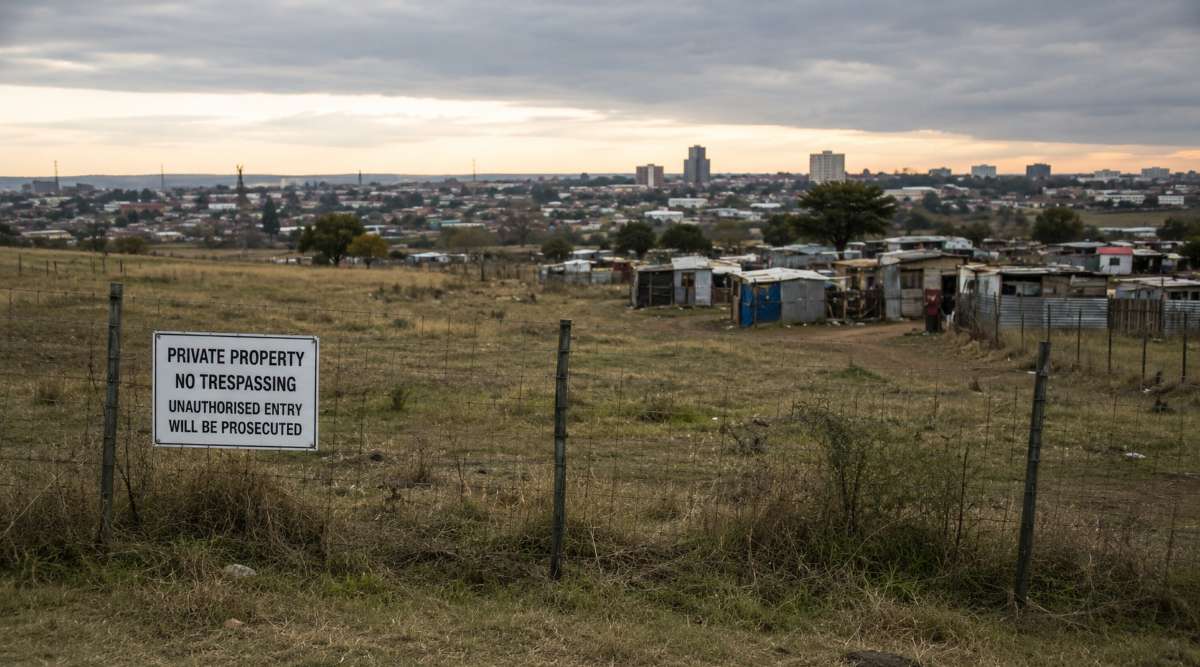
The draft Bill, which is now open for public comment, does not remove the court-centred nature of eviction proceedings.
PAID ADVERTISING – Tap the advert to read all about this
However, it seeks to close several gaps in the existing Prevention of Illegal Eviction from and Unlawful Occupation of Land Act of 1998, commonly known as the PIE Act, by giving courts, municipalities, state entities and property owners clearer legal tools when dealing with unlawful occupations.
For property owners, developers, farmers, landlords and municipalities in KwaZulu-Natal, the proposed amendments could have far-reaching implications.
Unlawful occupations do not only affect major metros. They also influence local planning, investment confidence, housing delivery, municipal enforcement, private land security and the cost of protecting property from organised occupation attempts.
Announcing the release of the Bill for public comment, Human Settlements Minister Thembi Simelane said the amendments were aimed at making the PIE Act more effective, easier to interpret and simpler to enforce.
According to the Minister, unlawful occupations continue to place a heavy financial and administrative burden on both government and the private sector.
“The proposed amendment seeks to empower municipalities, State entities, and private property owners to respond more decisively to illegal occupations and evictions. It will strengthen our ability to address individuals and organised groups who are responsible for orchestrating these invasions,” Simelane said.
The Minister identified inconsistent interpretation of the existing legislation as one of the central problems, noting that this often results in lengthy court processes and rising legal costs.
“As part of this process, we have reviewed key provisions of the current Prevention of Illegal Eviction from and Unlawful Occupation of Land Act of 1998. The new bill aims to close these gaps, thus providing greater clarity for everyone involved,” she stated.
One of the most prominent proposed amendments is the introduction of an additional offence targeting those who incite or organise unlawful occupations, even where no money changes hands.
The Bill also proposes a fine of up to R2 million, imprisonment not exceeding two years, or both, for individuals who incite people to unlawfully occupy land or buildings, whether the property is owned by government or a private owner.
The draft legislation further proposes that courts may order the forfeiture of assets or money acquired through the proceeds of such offences. This is aimed at those who unlawfully sell land or property that does not belong to them, as well as people or groups who organise occupations for financial or other gain.
According to Simelane, the Bill is intended to take a firmer stance against criminal elements involved in unlawful occupations while still preserving constitutional protections for vulnerable people who may require alternative or temporary accommodation after an eviction.
“It targets those who unlawfully sell land or property that does not belong to them, and those who incite unsuspecting people to unlawfully occupy land. It proposes stronger measures, including the forfeiture of assets acquired through such illegal means and hefty fines,” Simelane said.
The proposed amendments also expand the definition of a “person in charge” of land.
This would enable municipalities to apply for urgent interdicts in certain cases, even where they are not the owners of the land being occupied. This change could become particularly important where municipalities need to act quickly to prevent unlawful occupations from escalating, but ownership or administrative responsibility is not straightforward.
Another proposed change gives courts greater discretion when dealing with alternative accommodation. The Bill provides that courts may stipulate the period for which alternative accommodation or land must be made available to an unlawful occupier.
It also allows a court that grants an eviction order to make further orders regarding the retention, demolition or removal of structures on the land.
This means the courts would remain central to the process, but with clearer authority to deal with the practical issues that often delay eviction matters or create uncertainty after an order is granted.
The Bill also introduces mandatory involvement of relevant municipalities, provincial human settlements departments, organs of state or landowners in matters where alternative accommodation must be provided. In cases where a municipality owns the land, the draft legislation provides for mandatory mediation processes.
According to the Minister:
“These measures are intended to promote fairness and reduce lengthy and expensive court processes. It provides clearer guidelines on alternative accommodation arrangements,” Simelane said.
Furthermore, the Bill has already drawn sharply different reactions from political and civil society stakeholders.
The Democratic Alliance has welcomed its publication, saying several of the proposed changes reflect reforms it previously advanced through a private member’s bill in 2023.
The party pointed to provisions aimed at criminalising the incitement and organisation of unlawful occupations, strengthening criteria used by courts when granting eviction orders, and introducing clearer conditions and timeframes for alternative accommodation.
However, the South African Federation of Trade Unions has strongly rejected the draft legislation, describing it as “a dangerous, regressive and unconstitutional attack on the working class and the poor.” SAFTU argues that the Bill risks criminalising grassroots organising around land and housing, while failing to address the deeper causes of unlawful occupations, including unemployment, poverty and the national housing backlog.
The federation has called for the Bill to be withdrawn and redrafted in a manner it believes is more closely aligned with constitutional protections against arbitrary evictions.
Legal analysis from Dr Samantha Smith of national law firm STBB suggests that the Bill does not replace the central purpose of the PIE Act, but rather seeks to make the existing framework more workable.
“Critically, the Bill does not purport to replace the core purpose of the PIE Act. Instead, it seeks to make the law more effective, easier to interpret, and simpler to enforce,” Dr Smith explained.
According to Dr Smith, the proposed amendments respond to the growing number of unlawful land and building occupations, which impose heavy costs on both the state and private property owners.
Moreover, she said one of the most notable changes is the introduction of new offences targeting those who incite unlawful occupation, organise or permit land invasions, or receive payment linked to such occupations.
“In its draft form, the Bill provides for fines of up to R2 million, a maximum of two years’ imprisonment, and the court-ordered forfeiture of proceeds and assets derived from such activities,” Dr Smith said.
She further added that the amendments extend liability to people who facilitate, organise or benefit from unlawful occupation, creating a stronger deterrent against organised invasions.
Dr Smith also noted that the Bill broadens the definition of “person in charge” and requires municipalities and other state organs to be joined in eviction proceedings.
This, she said, could improve coordination and reduce delays in cases where government involvement is necessary.
Building on this, the law firm further noted that the Bill clarifies the factors courts must consider when deciding whether an eviction is just and equitable. On the issue of alternative accommodation, Dr Smith said the Bill now expressly defines it and gives courts clearer discretion on when to order it and for how long.
According to STBB, the Bill also allows courts ordering an eviction to make orders on the retention, demolition or removal of structures, as well as compensation for improvements.
“Where compensation is ordered, the eviction may not be carried out until the compensation has been paid or adequately secured,” Dr Smith explained.
She also described the introduction of mandatory mediation, particularly where a municipality owns the land, as a notable amendment that could help reduce drawn-out court battles.
Dr Smith concluded that the proposed revisions strengthen property rights while maintaining constitutional protections for occupiers. She said the amendments address procedural weaknesses and should lead to greater legal certainty for private property owners, municipalities and organs of state.
“Introduced to strengthen property rights, the draft amendments to the PIE Act represent a targeted and much-needed recalibration of the existing legal framework,” Dr Smith said.
With the Bill now open for public comment, Simelane has called on South Africans, civil society organisations, property owners, community members and interested stakeholders to study the document and submit their views.
The Department of Human Settlements has allocated 60 days for public submissions, with comments to be submitted by 15 June 2026.
“We intend to return to Cabinet with the revised bill by July 2026. This will pave the way for the bill to be tabled before Parliament by late July or early August 2026,” Simelane said.
She added that consultation has already included stakeholders such as the South African Local Government Association, provincial human settlements departments, affected national departments and other government institutions.
“In developing this bill, we have and continue to consult key stakeholders such as the South African Local Government Association (SALGA), Provincial Departments of Human Settlements, affected National Government Departments and other government institutions,” she said.
Members of the public can submit comments to [email protected] by 15 June 2026.
Written submissions can also be sent to the Department of Human Settlements for the attention of Lisa Masilo.
Submissions may be emailed to [email protected], hand delivered to 240 Justice Mohammed, Sunnyside, Pretoria, 0001, or posted to the Department of Human Settlements, Private Bag X644, Pretoria.
While the Bill is still far from becoming law, its publication signals a serious attempt to recalibrate the balance between property rights, municipal enforcement, organised unlawful occupation and the constitutional duty to protect vulnerable people from arbitrary eviction.
For property owners and municipalities, the proposed amendments could provide stronger legal mechanisms to respond to organised occupations.
For civil society and housing-rights groups, the public participation process will be a key opportunity to challenge or refine provisions they believe could negatively affect poor and vulnerable communities.
The final shape of the legislation will therefore depend on whether government can produce a framework that deals firmly with unlawful occupation and organised land selling, while still preserving the constitutional protections at the heart of South Africa’s eviction law.
What are your thoughts on this? Let us know in the old comment section below.
Newcastillian News invites your input. We ask that you keep your remarks courteous and on-topic. We do not allow any form of hate speech, such as racist or sexist comments. All comments are subject to moderation in line with our User Rules and Commenting Policy.