



South Africa’s youth hold the country’s greatest promise — and its greatest vulnerability. According to Statistics South Africa (Stats SA), people aged 15–34 make up around 21 million citizens, forming the backbone of the country’s long-term economic potential.
Yet, the latest data shows that this demographic stands at a critical junction: large in number, digitally driven, and increasingly educated, but locked out of meaningful economic participation on a large scale.
Population data makes the stakes clear. With youth representing over a third of the national population, South Africa has what many economists call a “demographic window” — a period during which a nation can accelerate growth if its working-age population is effectively employed.
But the employment picture tells a sobering story. The official youth unemployment rate remains above 45%, while the expanded definition, which includes discouraged work-seekers, keeps rising. In practice, this means the majority of young people cannot secure work in the formal economy, and many have lost hope of doing so.
The labour absorption rate mirrors this trend. Only about a quarter of South Africans aged 15–34 are currently employed — an unusually low figure for a developing, democratic country and well beneath what is required to stabilise household incomes, municipal revenue bases, and national economic performance. This is regardless of decades of government initiatives and youth focused programs.
Nevertheless, education statistics reveal a similar pattern of strain. While school attendance is high, only a portion of learners complete matric, and an even smaller percentage achieve a university degree.
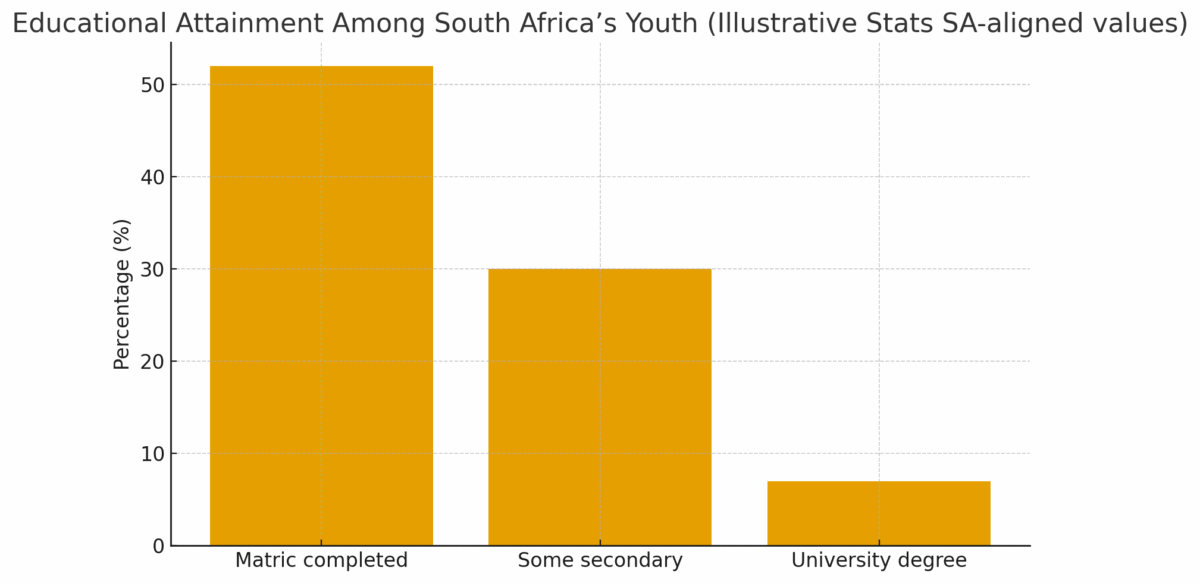
According to the General Household Survey, roughly 7% of youth achieve a tertiary qualification, reflecting both financial barriers and capacity constraints across the higher-education sector.
Even for those who do graduate, the transition into employment is not guaranteed, with many employers reporting a mismatch between qualifications and practical work-readiness.
Furthermore, the NEET rate — young people Not in Education, Employment, or Training — paints the clearest picture of systemic distress.
South Africa records approximately 3.4 million NEET youth, one of the highest ratios in the world.
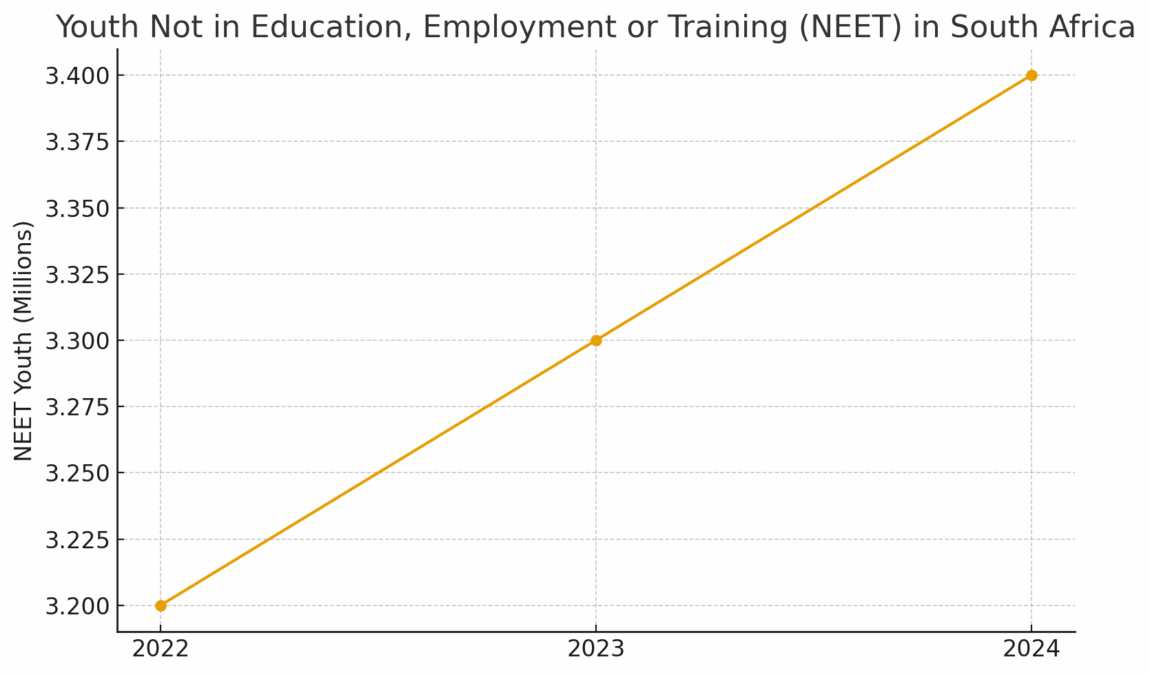
Young women make up a disproportionately large share of this group, reflecting the gendered impact of childcare responsibilities, inequality, and limited access to economic support structures.
Beyond economic indicators, the social statistics deepen the concern. Youth experience higher-than-average rates of poverty, exposure to violence, substance abuse, and mental-health strain. Crime data suggests that young men are especially vulnerable, with the youth age bracket overrepresented in both victim and perpetrator categories. Public health reporting shows increasing cases of anxiety and depression among young people — a trend echoed globally, but intensified locally by unemployment and community instability.
Yet the story is not without its points of progress. Youth-led entrepreneurship has grown, particularly in informal and digital sectors.
Although often born out of necessity, this shift demonstrates resourcefulness and adaptability. Internet penetration among young people far exceeds that of older demographics, enabling access to online learning, remote freelance work, and digital microbusinesses.
If supported correctly through policy reform, skills development, and financial accessibility, these areas hold potential to shift outcomes.
Taken together, the statistics portray a generation that is ambitious and technologically connected but constrained by structural barriers far beyond their control. South Africa’s youth are not failing; they are being failed by an education-to-employment pipeline that no longer functions as intended.
Jointly, South Africa’s education system adds another layer of complexity to the challenges facing young people.
While the Department of Basic Education routinely announces high matric pass rates — most recently above 80% — these headline figures mask a far deeper structural problem. When learner attrition is taken into account, the picture changes dramatically. Analyses comparing Grade 1 enrolments with the number of matric passes indicate that only around half of the learners who begin school ultimately complete matric.
This means that the high pass rate does not reflect the true performance of the schooling system, but rather the survival of those who remain in the pipeline.
A central point of contention is the low pass-mark threshold, where learners can achieve a matric certificate with marks as low as 30% in certain subjects.
Moreover, education analysts, civil-society groups, and Members of Parliament have repeatedly argued that such thresholds dilute academic standards and entrench long-term inequality.
A recent parliamentary debate calling for the base pass mark to be lifted to 50% highlighted these concerns, although the proposal was ultimately rejected. Critics argue that maintaining a 30% threshold may boost national pass rates, but does little to ensure that learners possess the literacy, numeracy, or subject competency needed for tertiary study or employability.
These concerns are amplified by the widening gap between well-resourced schools and the majority of public schools. At former Model C and private schools, the matric certificate often reflects rigorous teaching, stable infrastructure, and meaningful academic readiness.
In contrast, learners from under-resourced township and rural schools frequently emerge with the same certificate, but under vastly different instructional conditions. Education specialists warn that this dual system produces two parallel realities: one in which matric signifies opportunity, and another in which it offers little more than symbolic progression.
As a result, the labour market increasingly treats the matric certificate as a minimum requirement rather than evidence of competency.
Employers consistently report that many school-leavers lack foundational skills, particularly in mathematics, science, digital literacy, and communication. The lowering — or perceived lowering — of academic standards has further eroded employer confidence, deepening the mismatch between school outputs and the skills required in a modern economy. For millions of young people, this disconnect becomes the first barrier they encounter on the path to employment.

The country’s future stability — economic, social, and political — will depend heavily on whether this generational pressure is relieved through meaningful reform and investment.
If South Africa’s youth are given space to participate, they have the potential to transform the nation. If not, the numbers already warn of the consequences.
Do not forget to read, Newcastle, KwaZulu-Natal, Set for Major Gold Roasting Revival with US$1.8 Million Investment, if you missed it.
FAQs: South Africa’s Youth
Young people aged 15–34 make up roughly a third of the national population, representing a major share of the country’s long-term economic potential. Their ability to access education, skills, and meaningful employment will directly influence South Africa’s growth trajectory.
A combination of factors contributes to the elevated unemployment rate among young people, including limited job creation, slow economic growth, inadequate skills development, and structural barriers that make it difficult for first-time jobseekers to enter the labour market.
The labour absorption rate reflects the proportion of working-age people who are actually employed. Among youth, this figure is notably low in South Africa, indicating that only a small share of young people manage to secure jobs. A low absorption rate signals weak economic integration of new entrants into the workforce.
While school attendance is high, many learners do not complete matric, and even fewer progress into tertiary education. Employers also report gaps in foundational skills, which affects employability. When educational outcomes do not align with labour-market requirements, young people struggle to find work, regardless of how many matric certificates are issued.
South Africa’s current pass-mark thresholds allow learners to pass certain subjects with marks as low as 30%. Critics argue that this undermines educational standards and does not guarantee readiness for higher education or employment. Parliamentary debates have called for the base pass mark to be increased, but no changes have been implemented.
NEET refers to young people who are Not in Education, Employment, or Training. A high NEET rate indicates that large numbers of youth are disengaged from both learning and work, placing long-term pressure on the economy and increasing the risk of persistent unemployment.
South Africa’s schooling system remains deeply unequal. Learners at well-resourced schools typically receive higher-quality teaching and support, while those in under-resourced township and rural schools face overcrowded classrooms, limited materials, and inconsistent instruction. This results in vastly different levels of readiness despite holding the same matric certificate.
Many employers report that matriculants lack essential competencies — including numeracy, literacy, communication, and digital skills. This mismatch between schooling outcomes and job requirements makes it harder for young people to enter the workforce and contributes to ongoing unemployment.
Some young people are turning to informal and digital entrepreneurship as a way to generate income, especially in the absence of formal job opportunities. While promising in certain sectors, these ventures often require access to capital, mentorship, and infrastructure — support that is not consistently available across communities.
Improving youth prospects requires reforms across education, skills development, and job creation. Strengthening school quality, aligning training with labour-market needs, investing in digital access, and expanding economic opportunities are seen as key interventions that could shift outcomes over time.












2 Responses
This is once again this bee nonsense there are people that have higher qualifications as they were educated in better schools like curro who gives these youngsters better opportunities to open businesses to employ and train . These undereducated youth in IT skills etc this problem is just getting worse every year but no one listens
How is this related to BEE? Sounds like you’re describing a broader wealth disparity.