



In a move that could breathe fresh life into South Africa’s dormant refractory gold sector, AIM-listed Metals One PLC has agreed to inject up to US$1.8 million (approximately R30.8 million) into Lions Bay Resources (LBR), a newly formed private company targeting the establishment of a centralised gold concentrate roasting and cogeneration facility in the industrial heartland of northern KwaZulu-Natal.
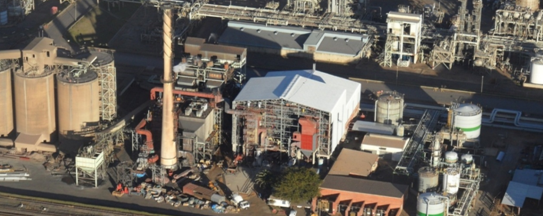
The deal, announced on the London Stock Exchange this week, centres on a mothballed 6 MW cogeneration plant in Newcastle’s Karbochem Industrial Park – an asset that Metals One believes can be transformed into a regional hub capable of unlocking value from the province’s abundant refractory gold resources.

LBR was incorporated earlier this year as a joint vehicle between TSX-V-listed Lions Bay Capital Inc (in which Metals One already holds a 19.1 % stake) and the experienced Salamander Mining team. Leading the venture are two heavyweight figures from South Africa’s gold industry: Graham Briggs, former chief executive of Harmony Gold and now non-executive chairman, and Lloyd Birrell, founder and ex-CEO of ASX-listed Theta Gold, who takes the helm as LBR’s chief executive.
At the core of the transaction sits an option – exercisable for US$1.36 million – over a substantial power-and-steam plant that has lain idle but remains remarkably intact. As Metals One told investors: “Research and planning has commenced around modifying the Plant to produce power and steam whilst also roasting refractory gold concentrates, common to mines in the region.”
Independent engineers from Terravista Solutions inspected the facility in October 2025 and placed a replacement value of US$39.6 million on the asset.
Restarting steam and power generation, the company estimates, will require around US$4.5 million – a figure to be confirmed by an imminent competent person’s report funded from the new financing.
Perhaps more significantly, early talks are already under way with a large neighbouring chrome smelter that needs both electricity and process steam, paving the way for an offtake agreement that could provide immediate cash flow once the plant is recommissioned.
Yet the longer-term vision extends far beyond simple power generation. Subject to further technical studies, LBR plans to install a modern gold-roasting circuit alongside the boilers – creating a toll-treatment facility for the refractory concentrates that dominate much of the Witwatersrand-style mineralisation within trucking distance of Newcastle.
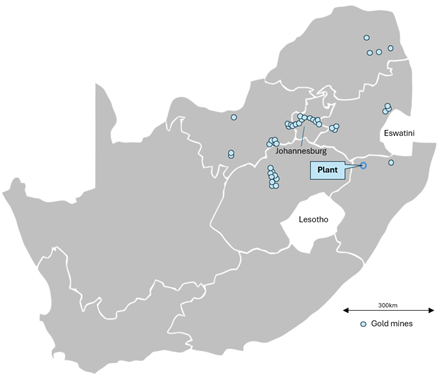
Metals One highlighted in its statement that, within a 300 km radius of the site, lie numerous multi-million-ounce gold deposits and tailings dams, many producing concentrates that currently have to be shipped to smelters in Asia. Smaller operators, unable to justify the capital cost of their own roasters, would gain a viable processing route for the first time.
The financing itself takes the form of convertible loan notes issued in tranches, with the bulk – US$1.625 million – expected to follow once LBR secures outright ownership of the plant and first-ranking security is granted.
Should Metals One convert in full, it would emerge with at least a 30 % stake in what could rapidly become a significant vertically integrated South African gold player.
Dan Maling, Metals One’s managing director, did not hide his enthusiasm. “South Africa is historically the world’s largest gold producer,” he said, “and we believe it has the perfect ingredients of abundant resources, infrastructure and mining expertise to become a leader once again. With the acquisition of the gold roaster and associated infrastructure, alongside the experienced mining team at Salamander, LBR has the foundations to be a significant, vertically integrated South African gold company.”
With more than £9 million still sitting in cash and liquid investments, Metals One appears well placed to support further downstream acquisitions as the Newcastle project gathers momentum. Investors, and indeed the wider South African gold sector, will be watching closely for the next updates from this emerging partnership.
For a country whose gold output has fallen by more than 80 % since its 1970 peak, the re-emergence of a domestic roasting capability would mark a rare piece of genuinely new processing infrastructure.

If LBR can deliver on its timeline, it may not only revive an under-utilised industrial site but also help a new generation of junior miners and tailings retreatment companies turn long-stranded refractory ounces into payable gold.
At a time when South Africa is actively courting foreign mining investment to offset chronic power shortages and regulatory uncertainty, the Newcastle project serves as a tangible reminder that, with the right combination of capital, expertise, and existing brownfield assets, the country’s legendary gold province still has chapters left to write.
What are your thoughts on this? Let us know below.
Be sure to read, Conveyor Belt Splicing and Field Services by AME Amajuba | Newcastle, KwaZulu-Natal, if you missed it.
Frequently Asked Questions (FAQS)
Most gold dissolves nicely in cyanide — but refractory gold is stubbornly trapped inside sulphide minerals like pyrite or arsenopyrite. Without breaking those sulphides apart, recoveries can collapse below 20 %. Roasting blasts the ore with heat and oxygen, burns away the sulphides, and finally sets the gold free for normal cyanide leaching — often pushing recovery above 90 %.
Roughly US$4.5 million to fire up the boilers and turbines for power and steam, plus whatever extra is needed for the new roasting circuit (a figure that will be pinned down by the upcoming technical studies). For a plant independently valued at US$39.6 million to replace from scratch, that’s a bargain entry ticket.
AIM-listed Metals One is putting in up to US$1.8 million through convertible loan notes. If everything goes to plan and they convert, they walk away with at least 30 % of LBR, a 10 % coupon in the meantime, and a front-row seat in what could become a serious South African gold processor.
Absolutely — it will churn out 6 MW of electricity and industrial steam from day one. A large chrome smelter next door is already in talks for an offtake deal, so the lights (and the revenue) could come on long before the first gold concentrate even arrives.
No hard date yet, but the financing is structured to move fast: the big tranche drops once LBR owns the plant outright. If due diligence and permits fall into place, meaningful work could start in 2026 — and South Africa could have its first new gold-roasting facility in decades before the end of the decade.








One Response
How are we citizens from Newcaste benefit in terms of employment. Which opportunities are available and how do we apply?