



Newcastle Local Municipality, burdened by R2.3 billion in unpaid rates and services, has intensified its Revenue Enhancement Drive in Newcastle East — the region responsible for the overwhelming majority of arrears. While the administration has, for years, promised firm action against chronic non-payment, the key question remains: is the municipality making measurable progress?
According to the municipality’s Communications Unit, residents in Osizweni have attended outreach sessions in significant numbers.
These engagements have allowed account holders to query statements, seek assistance, and enter repayment agreements aimed at reducing long-standing debt.

Mayor Dube welcomed the participation but warned that the challenge remains substantial. “Our goal is to work closely with residents, identify sustainable solutions to their debt challenges, and ensure that no one is left behind, especially the most vulnerable,” he said.
As previously reported by Newcastillian News on 13 November 2025, non-payment has pushed the municipality into severe financial distress. Large parts of Madadeni and Osizweni continue to receive water, sanitation and, in many cases, electricity (supplied directly by Eskom) without corresponding payment. Arrears from these two areas alone approach R2 billion — effectively shifting the funding burden to compliant ratepayers in Newcastle West.
It’s the equivalent of stopping at a petrol station and being forced to pay for everyone’s fuel — without having any say in the matter.
This lopsided structure has left many Newcastle West residents furious, as they are expected to carry others financially while struggling to pay their own bills.
Yet at the launch of the latest drive, senior officials again emphasised their commitment to recovering outstanding revenue. The municipality is owed R2.3 billion by households, businesses, and government departments, creating a monthly shortfall of more than R40 million — a gap that directly weakens maintenance, upgrades, and service delivery, especailly in paying suburbs in Newcastle West.
On this note, Newcastle West residents continue to question why infrastructure and development budgets are being directed toward Newcastle East when that region contributes comparatively little to the municipality’s revenue base.
This comes at a time when Newcastle West itself requires significant improvements, maintenance, and upgrades.
However, during the session on Wednesday, 19 November 2025, water interruptions in Osizweni dominated discussions. Municipal technical staff confirmed that repairs are ongoing but acknowledged that supply reliability remains a priority. Additionally, construction of a new uMzinyathi-area pump station is expected to begin shortly. “This project will greatly improve the water supply in the area,” Dube said.
Furthermore, the non-payment problem is long-standing.
Eskom’s direct supply to large sections of Newcastle East removes a major enforcement tool, a limitation previously highlighted by Newcastillian News in October 2025. Meanwhile, the municipality itself owes Eskom R311 million and uThukela Water more than R225 million. Nearly 99% of the R1.7 billion in consumer debt originates in Newcastle East.
Findings from the Auditor-General have repeatedly sounded alarms. Reports published by Newcastillian News for the period ending January 2024 recorded an impairment provision exceeding R1 billion, late payments to creditors, and “material uncertainty” over the municipality’s going-concern status. Water losses were valued at R58.9 million — 37% of total supply.
The Special Investigating Unit’s 2024/2025 findings, presented to SCOPA in October 2025, identified 15 unresolved disciplinary matters and 28 NPA referrals involving Newcastle officials, with no convictions due to evidentiary shortcomings.
CoGTA continues to classify Newcastle as a distressed municipality, citing low collection rates, governance weaknesses, and persistent non-compliance in eastern townships.
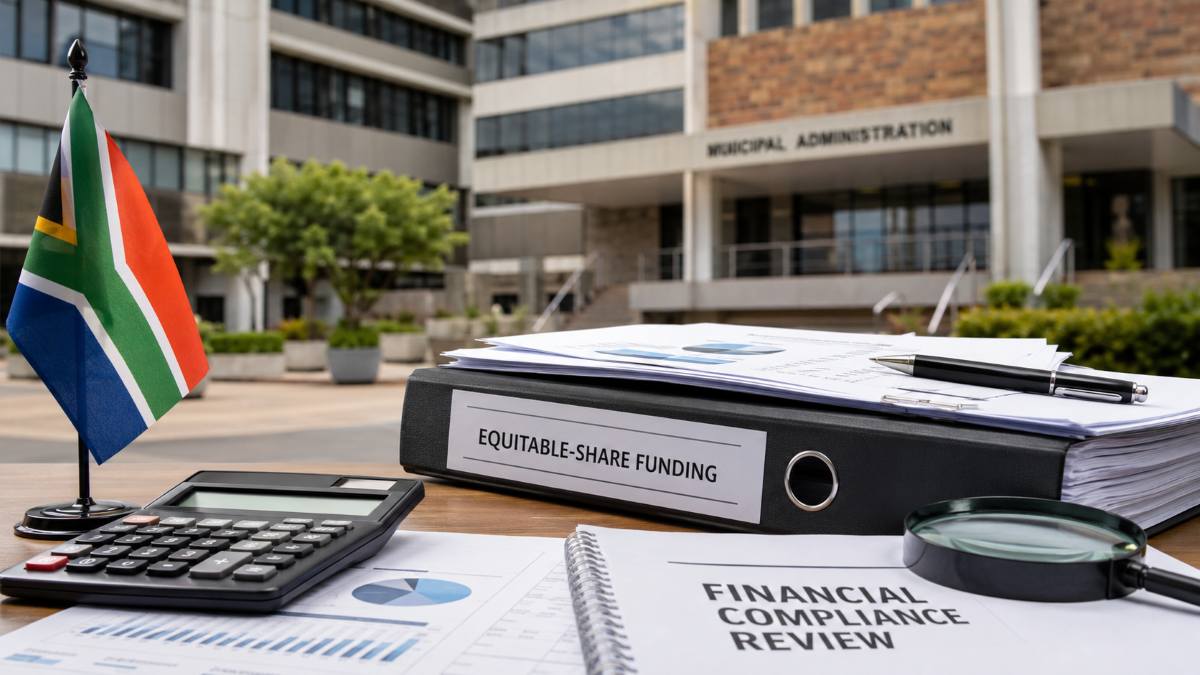
In April 2025, KZN Treasury suspended grants to Newcastle — one of 25 affected municipalities — in line with the Division of Revenue Act.
These structural constraints mean that while current initiatives are encouraging, they do not resolve the underlying governance, compliance, and financial challenges that threaten Newcastle’s long-term viability.
Premier Thami Ntuli, addressing the National Council of Provinces on 18 November 2024, emphasised that municipal recovery across KZN is “non-negotiable”. He cited provincial departmental debts exceeding R64 billion, long-standing water reliability failures, and ageing infrastructure undermined by illegal connections and under-investment.

Newcastle’s Revenue Enhancement Drive therefore operates within a framework of entrenched systemic issues — from Eskom supply limitations to an unfunded budget and suspended grants. Without structural reform at provincial and national level, local campaigns will struggle to stabilise finances or restore consistent service delivery.
What are your thoughts on this? Be sure to let us know below?
Do not forget to read, Newcastle Motorist Faces Multiple Charges After Drunk Driving Arrest Turns Violent At Police Station, if you missed you.
FAQs for the Article: Newcastle’s Municipal Debt
Newcastle Local Municipality is owed approximately R2.3 billion in unpaid rates and service charges by households, businesses, and government departments.
The majority of arrears originate in Newcastle East, particularly Madadeni and Osizweni, where long-standing non-payment has been recorded.
The municipality faces a monthly revenue shortfall of more than R40 million, reducing funding for maintenance, infrastructure upgrades, and reliable service provision.
It is a municipal initiative aimed at recovering outstanding revenue by engaging residents, verifying account information, and establishing repayment agreements for overdue accounts.
Yes. According to the municipality’s Communications Unit, residents in Osizweni have attended outreach sessions in significant numbers to query statements and seek assistance.
Large parts of Newcastle East receive electricity directly from Eskom, which limits the municipality’s ability to enforce disconnections for non-payment.
The municipality has introduced 50% and 70% discount schemes, as well as debt write-off options for qualifying households, including indigent families, pensioners, the unemployed, and deceased estates.
The municipality itself owes approximately R311 million to Eskom and more than R225 million to uThukela Water, according to official disclosures.
Reports from the Auditor-General, CoGTA, and KZN Treasury have highlighted issues such as impaired consumer debt, water losses, unfunded budgets, governance weaknesses, and delayed corrective actions.
No. The non-payment challenge in Newcastle East is long-standing, with entrenched patterns documented over several years.








2 Responses
Sell the debt to a collection company for half the outstanding debt . That will put newcastle municipality back in the driving seat . This can pay of both eskom and Uthukela debt and have half a billion left for infracture issues in the cbd . I have told the MM and mayor about this for the past w years
Good idea Faizil