


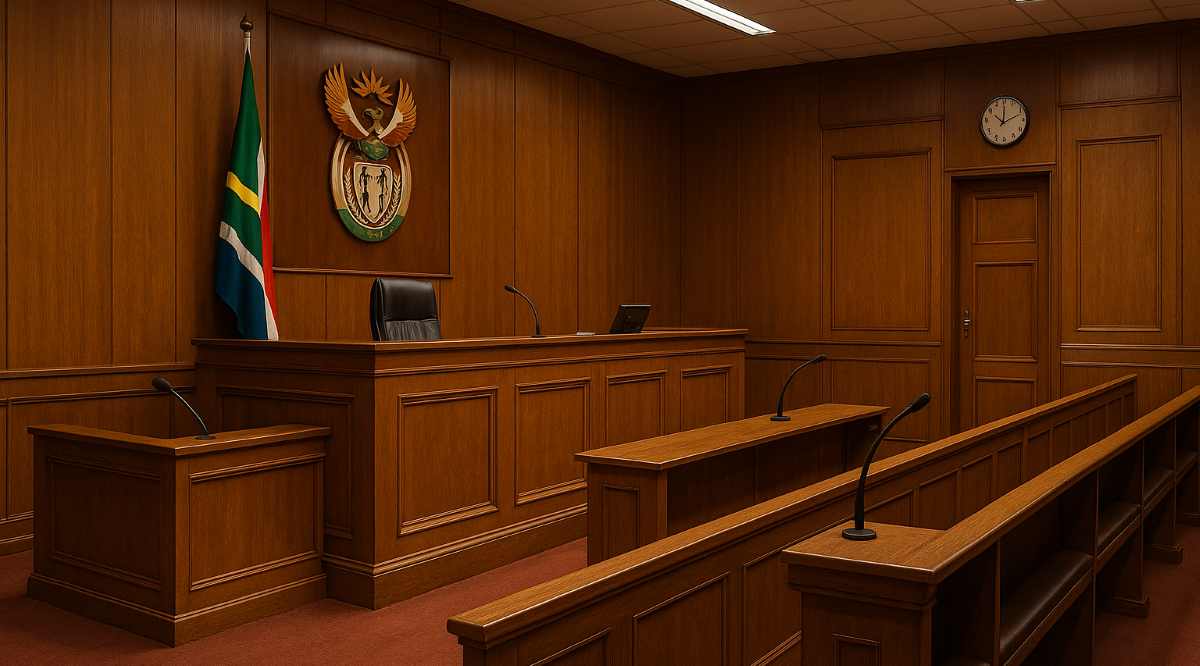
For well over a year, a heavy burden of accusation has rested on the shoulders of four former Newcastle Community Policing Forum members – Ismaeel Dhalech, Ebrahim Adams, Mahomed Ashraf, and Yaseen Mohamed – following their arrest for a fatal mob assault.
Now, on 26 November 2025, the Newcastle Regional Court will deliver a ruling that could either clear them entirely or force them to face a full trial.
The case reached a decisive turning point on Monday, 17 November 2025, when Warrant Officer Henning de Meyer, the investigating officer, took the stand.

Furthermore, the public gallery was packed with relatives, neighbours, and residents, all intent on showing support for the accused and on scrutinising the testimony.
When State Prosecutor Mazibuko asked de Meyer to recount the origins of his investigation into the death of Khulekhani Hlathshwayo, the officer painted a picture of a docket that initially offered almost nothing to work with. “When I was first handed the case, there was no information about what had happened, nor were there any witnesses available. No one came forward with information at all,” he testified.
In the absence of a police photographer, de Meyer personally attended the post-mortem and captured the necessary images. Because the victim’s identity remained unknown for some time, the matter began as an inquest; only in 2024, after an informant directly implicated the four former CPF members, was it converted into a murder investigation.
Acting on that information, de Meyer gathered several witness statements that purportedly placed Dhalech, Adams, Ashraf, and Mohamed at the scene.
He typed the statements himself – owing to his illegible handwriting – and the Senior Public Prosecutor then interviewed each witness individually before authorising arrest warrants. The arrests in September 2024 provoked intense public anger, both over the original incident and over what many saw as systemic failures in local policing. Bail was refused in October 2024, although Dhalech, Adams, and Mohamed were eventually released in December 2024.
Yet, under cross-examination by defence advocate Ravindra Maniklall, the foundation of those witness statements began to crumble. Maniklall highlighted that multiple witnesses, including ADT Security employee Mr Dludlu, had already told the court they never supplied the accuseds’ names and insisted those names were absent from the statements they signed.
“Mr Dludlu from ADT claimed that he did not know any of the suspects’ names and he did not put their names down in his statement. And he was not the only witness to say this during their testimonies in court. Did you add the names after typing the statements down?” Maniklall pressed.
De Meyer insisted he had merely transcribed what was said and that any irregularity would have been detected by the Senior Public Prosecutor. Nevertheless, further inconsistencies rapidly surfaced: witnesses denying they had seen certain accused at the scene; the complete omission of any reference to ADT personnel allegedly handcuffing the victim; and de Meyer’s admission that he had never obtained the official ADT incident report – a lapse he described as an oversight.
Moreover, questions arose about two uniformed officers who responded to the initial emergency call in Paradise but left after instructing ADT to deliver Hlathshwayo to the police station. De Meyer was unable to produce statements from either officer.
The officer also maintained that he had secured DVR footage showing an ambulance collecting the victim shortly before death. However, the defence countered that earlier evidence had confirmed the recording system contained no relevant material whatsoever.
In a further damaging admission during questioning by advocate Zubair Chothia, de Meyer conceded that he had withheld certain witness statements during the bail application – statements that could have materially affected the outcome.
Chothia argued forcefully that these omissions, combined with multiple witnesses alleging alterations to their original accounts, pointed inescapably to a flawed and potentially biased investigation.
Following a day of unrelenting cross-examination, the State closed its case. Thereafter, the defence launched an application under Section 174 of the Criminal Procedure Act 51 of 1977, contending that no prima facie case had been established against any of the four accused.
This provision, enshrined in South African criminal law, empowers a magistrate or judge to discharge an accused at the close of the prosecution’s case if the evidence presented fails to disclose any offence with which the accused has been charged or if there is no evidence that a reasonable court could convict on.
In essence, it serves as a critical safeguard against unwarranted prosecutions, compelling the State to demonstrate at least a preliminary case before forcing the defence to respond – thereby upholding the presumption of innocence and preventing the needless prolongation of trials on flimsy grounds.

The magistrate reserved judgment until 26 November 2025.
Throughout 2025 – in hearings during June, August, and October – repeated cross-examinations have exposed inconsistencies in witness testimony, with several individuals retracting or heavily qualifying their earlier statements. Taken together, these developments have placed both the thoroughness of the police investigation and the reliability of the evidence under scrutiny.
As the Newcastle Regional Court prepares to decide whether the four former CPF members should be discharged or if the matter should contiune, this trial lays bare the complex nature of each and every case.
What are your thoughts on the above? Be sure to let us know below.
Do not forget to read, Newcastle Motorist Faces Multiple Charges After Drunk Driving Arrest Turns Violent At Police Station, if you missed it.










One Response
The investigating officer Henning de Meyers “investigation” was at the best extremely amateurish, shoddy and grasping at straws and at the worst malicious. In any event, it is a very poor reflection on the South African Police. It is to be hoped that the magistrate will draw attention to the dismal police investigation and reprimand de Meyer and the State Prosecution for proceeding with a thoroughly flawed and seemingly compromised case. De Meyer must be reported to the Internal Police Investigation Directorate to get to his motives for proceeding with the investigation in the absence of reliable and credible witnesses.