


For millions of South Africans, inflation is more than an economic term—it’s the rising grocery bill, the higher petrol price, and the rent increase that squeezes the household budget. Over the past year, social media has reflected this frustration, with #InflationHell trending as users voiced anger over a 6.2% rise in food and fuel costs. Likewise, #TaxThieves rants have climbed by 40% since February’s national budget.
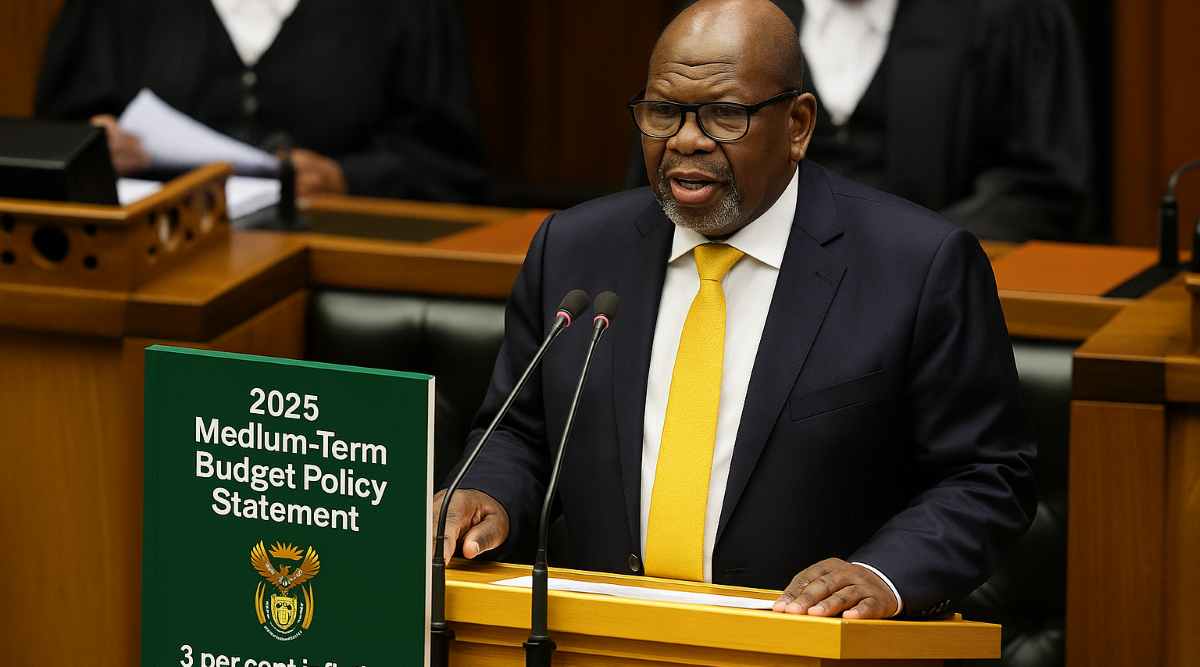
Against this backdrop, Finance Minister Enoch Godongwana delivered the Medium-Term Budget Policy Statement (MTBPS) on Wednesday, 12 November 2025, outlining a renewed fiscal strategy to curb inflation, restore stability, and safeguard vulnerable households.

Central to this was the announcement of a new inflation target of 3%, with a tolerance band of ±1%, replacing the long-standing 3–6% range. The phased implementation over two years aligns with the South African Reserve Bank (SARB) and global benchmarks such as the European Central Bank’s 2% target.
“Today, I announce a new inflation target for South Africa of 3 per cent with a 1 percentage point tolerance band,” said Godongwana. “This decision follows agreement with the Governor of the South African Reserve Bank and consultations with the President and Cabinet. The 1 percentage point band provides flexibility to accommodate any unexpected inflationary shocks. This new target immediately replaces the previous target range of between 3 and 6 per cent and will be implemented over the next two years.”
The goal, according to Treasury, is to anchor inflation expectations—preventing price spirals while creating scope for lower interest rates that could reduce household borrowing costs and encourage private investment.
Furthermore, a joint Treasury–SARB statement explained that, “Over time, the lower target will decrease inflation expectations and inflation, creating room for lower interest rates. This supports household spending and business investment, boosting economic growth and job creation.”
In the short term, the fiscal cost of this decision will be felt through slower nominal GDP growth and reduced revenue collections. The government anticipates public debt will peak at 77.9% of GDP in 2025—marking the first stabilisation since 2008.
“The short-term fiscal costs of a lower target, which include lower nominal GDP and revenue growth, will make achieving fiscal targets more challenging,” Godongwana acknowledged. “But the long-term benefits of taking this step far outweigh these costs.”
The MTBPS forecasts real GDP growth of 1.2% in 2025, averaging 1.8% through 2028. While this growth is supported by energy and logistics reforms, it remains constrained by global volatility and domestic inefficiencies. For the poorest 60% of South Africans—who depend on grants making up 61% of non-interest expenditure—price stability is critical to preserving social protection programmes ranging from child support to flood recovery initiatives in KwaZulu-Natal.
Another key announcement was the pause on the proposed R20 billion tax increase for 2026, made possible by stronger-than-expected tax receipts totalling R19.7 billion above forecasts.
This gain was driven by robust household consumption, improved corporate profitability, and stricter SARS refund controls. “The better-than-estimated tax revenue is due to stronger household expenditure, improved corporate tax receipts, and dividend tax inflows,” the Minister explained.
Rather than increasing VAT or fuel levies, R4 billion was allocated to SARS to intensify enforcement against illicit trade, procurement fraud, and tax evasion—issues that have cost the country over R40 billion since 2020 through cigarette smuggling, fuel syndicates, and other black-market activity. This funding forms part of a R7.5 billion anti-corruption package, which Treasury believes could raise R20–R50 billion annually in recovered revenue.
Fiscal discipline remains a priority. The primary surplus is projected to reach R68.5 billion (0.9% of GDP) this year, increasing to R224 billion by 2028/29, while the deficit narrows from 4.7% to 2.9% of GDP. Debt-service costs, which currently absorb 21.4% of revenue, are expected to decline by R4.8 billion annually. Expenditure savings of R6.7 billion will come from closing underperforming programmes and removing ghost workers, with a further R3.5 billion saved annually through payroll adjustments.
Additional allocations this year total R15.8 billion, including funds for the reconstruction of Parliament, preparations for the 2026 elections, and improvements in the health sector.
Provinces will receive 42.4% of consolidated revenue for education and healthcare, while municipalities will receive 9.7% for essential services.
Still, the MTBPS cautions that the medium-term outlook remains vulnerable. Despite improved tax compliance, revenue shortfalls of R15.7 billion are expected over the next two years. Treasury emphasised that sustainable growth depends on reforms such as Operation Vulindlela Phase 2, addressing Eskom and Transnet inefficiencies, and simplifying visa processes to boost tourism and investment.
For households, the narrower 3% inflation target could gradually ease cost-of-living pressures. Slower increases in food, fuel, and transport costs are expected to stabilise budgets and preserve purchasing power. Lower interest rates could also translate to bond repayment savings of R500–R1,000 per month for the average homeowner. Combined with the paused tax hikes, these changes may leave families with more disposable income.
However, the fiscal room for new social programmes remains limited. Slower wage growth and modest revenue gains mean the government must prioritise efficiency and enforcement.
However, if SARS underperforms, planned tax relief could still be reversed in the 2026 Budget.
For businesses, the predictable inflation environment offers advantages such as stable pricing and reduced borrowing costs, though muted GDP growth implies modest job creation. Godongwana reaffirmed government’s commitment to protecting the vulnerable, stating, “Our commitment to support low-income and vulnerable households through education, health, and social protection remains. The lion’s share of consolidated non-interest spending—approximately 61 per cent over the next three years—continues to fund the basket of government-provided services and benefits that reduce the cost of living for our citizens.”
The MTBPS reinforces a flexible approach to inflation targeting, emphasising gradual, sustainable adjustment. “This is in line with South Africa’s approach to inflation targeting, which has always been a flexible one, looking beyond short-run deviations in inflation,” Treasury stated.

While much remains to be done, the 2025 MTBPS signals a cautious turn toward stability.
Inflation is moderating, tax hikes are on hold, and debt growth is flattening for the first time in years. But execution will determine success. SARS must deliver on enforcement, reforms must advance beyond paper, and the economy must grow faster than 2% by 2030 for these gains to hold.
For now, the government’s “principles-led fiscal anchor” offers cautious optimism: a foundation for renewed confidence—if discipline and delivery stay on course.
What are your thoughts on this? Let me know below.
Do not forget to read, Dunlop Tyres Ladysmith: Business restructure strengthens operations and sustainability, if you missed it.
The new target is 3% with a ±1% tolerance band, replacing the previous 3–6% range. It will be phased in over two years in coordination with the South African Reserve Bank.
The lower target aims to anchor inflation expectations, reduce price volatility, and create room for lower interest rates that support household spending and business investment.
Slower inflation could ease the cost of essentials like food, fuel, and transport, and potentially lower home loan repayments by R500–R1 000 per month if interest rates fall.
Lower nominal GDP growth may reduce government revenue, making it harder to meet fiscal targets while maintaining social spending and infrastructure investment.
The budget allocates 61% of non-interest expenditure to education, healthcare, and social grants, alongside R4.1 billion for flood recovery and a 7.3% increase in capital investment.








One Response
South Africa will bounce back if you look at all the countries sa is still the best country to live in I am here to stay and I am a pensioners get rid of bee and we will be fine