



Newcastillian News recently conducted a poll to understand how the ArcelorMittal South Africa (AMSA) Newcastle Works closure is impacting local sentiment, livelihoods, and long-term confidence in the region. The responses provide a sobering but insightful snapshot of a town navigating uncertainty.
See charts below for each question’s visual breakdown.
Nearly 30% of Residents, Who Responded, Say They Are Leaving – But Most Will Stay For Now
In response to whether residents are planning to leave Newcastle due to the AMSA plant shutdown, 45.9% said they are staying, while 29.8% confirmed they are leaving, and 24.3% are undecided.
This mix reflects both resilience and hesitation. While nearly half of respondents are committed to remaining, the fact that almost a third have made up their minds to leave is significant. It suggests that Newcastle is already experiencing the early signs of a demographic shift due to economic pressure.

Employment Impact: One in Three Have Already Lost Their Job
When asked about job losses, 30.9% of respondents indicated they had already lost their jobs, while 25.8% feared they may soon, and 43.3% claimed to be unaffected.
This result highlights how widespread the shockwaves are: more than half of those surveyed are either already unemployed or fearful that they could be next. The broader implication is a severely weakened labour market and growing financial strain among working-class households.

The Blast Furnace Explosion Deepened the Crisis
The blast furnace explosion at AMSA Newcastle appears to have had a measurable impact on public perception. When asked if the incident influenced their decision to stay or go, 51.6% said yes, and 48.4% were unsure. Strikingly, not a single respondent said it didn’t affect them.
The explosion, while not fatal, seems to have symbolised the broader instability at the plant. For many, it was the final confirmation that AMSA’s situation is dire — and possibly irreversible.

Many Only Learned About the Explosion Through the Report from Newcastillian News
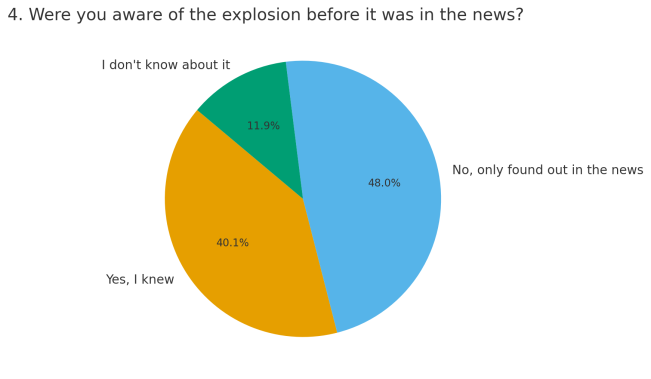
Interestingly, 48% of respondents said they only became aware of the explosion through the media, while 40.1% already knew about it. The remaining 11.9% were unaware of the incident entirely.
This points to a significant communication gap between AMSA and the community. It also reinforces the critical role local news plays in disseminating vital information.
Most Fear Newcastle Will Become a Ghost Town
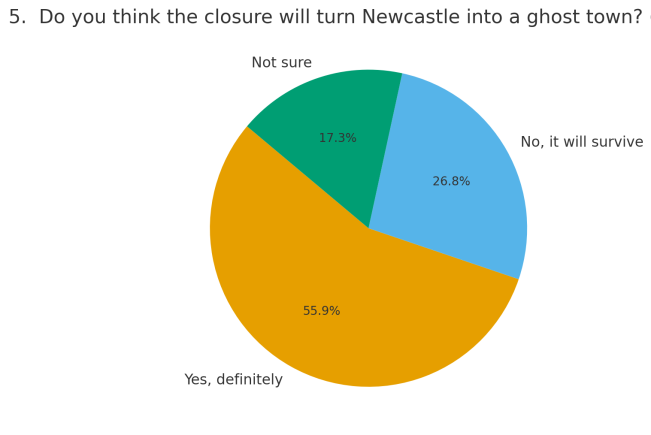
A majority — 55.9% of residents — believe the closure of AMSA will turn Newcastle into a ghost town. Only 26.8% said the town would survive, while 17.3% were uncertain.
This response underlines the scale of the psychological and economic blow. It suggests residents fear not just job losses, but a collapse of the local economy and an exodus of both skilled labour and consumer spending.
Hope Remains — But It’s Cautious
Despite the challenges, 31.6% of respondents believe Newcastle can bounce back through community and business efforts, while 44.6% are uncertain, and 23.7% do not believe recovery is possible.
This is perhaps the most telling metric of all. It reflects a community that, while bruised, has not entirely lost faith in its ability to reinvent itself. But the high level of uncertainty shows just how fragile that hope is — and how urgently leadership, investment, and cooperation are needed.

The Crossroads of Industry and Identity
These results tell the story of a town standing at a crossroads. Newcastle has long been economically tied to AMSA, and with the plant’s decline, the psychological impact is as severe as the economic one.
Yet within the data is a thread of possibility — a population still willing to stay, still open to rebuilding, and still engaging with each other through platforms like Newcastillian News.
The question now is whether government, private enterprise, and civil society can harness that cautious hope and redirect it into tangible progress.
What Now? Practical Advice for Residents and Businesses
As Newcastle adjusts to life after AMSA, the path forward must be proactive, not passive. This isn’t the time to retreat — it’s the time to adapt and evolve.
For local businesses:
Now is the moment to increase visibility, broaden your market, and innovate. Whether through digital marketing, service diversification, or community partnerships, those who step forward boldly may gain the ground others abandon. Marketing efforts should not scale down — they should scale up. In times of uncertainty, visibility equals survival.
For residents:
Use this transition to upskill and reskill. Free and affordable online courses, trade certifications, and entrepreneurial knowledge are now more accessible than ever. The more versatile the workforce becomes, the more attractive Newcastle remains to future investors and employers.
The future of the town will not be rebuilt by a single entity — it will be shaped by the collective response of its people. Whether you’re a business owner or jobseeker, the next move matters.

Leave your thoughts and comments below. Be sure to read, Eye care breakthroughs: the technology helping doctors save sight sooner, if you missed it.
FAQs: AMSA Shutdown
According to the poll, nearly 30% of respondents confirmed they are planning to leave, while 24.3% are still deciding.
Over 30% of respondents reported already losing their jobs, and an additional 25.8% fear losing theirs.
Yes — 51.6% said the explosion influenced their decision on whether to stay in Newcastle.
While 55.9% fear the town could become a ghost town, 31.6% believe recovery is possible with collective effort.
Businesses are encouraged to scale up their marketing efforts, while residents should focus on upskilling and diversifying their expertise.






One Response
SASSA is also affected by the polling stations made in the country for elections.