


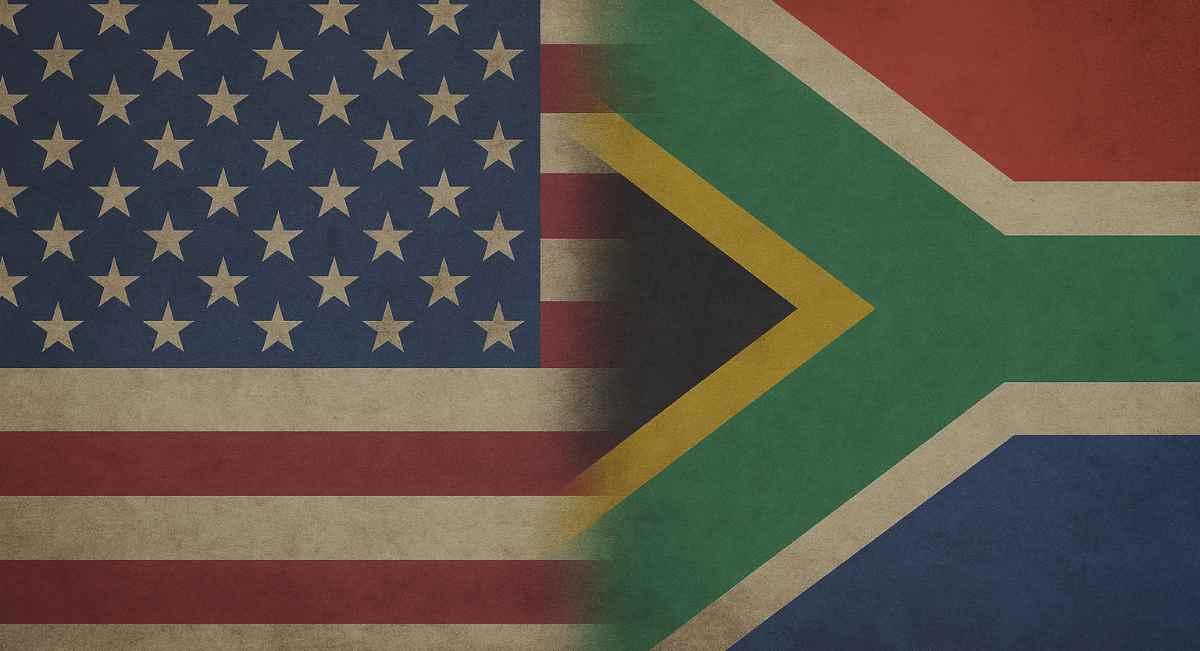
The relationship between South Africa and the United States has taken another sharp turn as US legislators introduce a The relationship between South Africa and the United States has entered a new phase of tension as US legislators introduce a second bill targeting the African National Congress (ANC) and reassessing bilateral ties.
On 15 September 2025, Senator John Kennedy (R-LA) tabled the U.S.–South Africa Bilateral Relations Review Act in the Senate. The legislation mandates a comprehensive review of the US–South Africa relationship, including a presidential certification on whether South Africa’s actions undermine US national security interests.

This marks a significant escalation of Washington’s scrutiny, building on earlier concerns over Pretoria’s foreign policy alignments with Russia, China, and its rhetoric on Israel.
House Precursor: Setting the Stage
The Senate bill follows the U.S.–South Africa Bilateral Relations Review Act introduced in the House (H.R. 2633) by Congressman Ronny Jackson. Originally tabled in April 2025, the House version advanced through the House Foreign Affairs Committee on 22 July by a 34–16 vote. It calls for targeted sanctions on South African officials and a review of Pretoria’s eligibility for preferential trade benefits under the African Growth and Opportunity Act (AGOA).
Together, the House and Senate bills highlight bipartisan frustration in Washington, portraying South Africa as a partner whose policies increasingly diverge from US strategic interests.
What the Kennedy Bill Proposes
The Senate version contains three core provisions:
- Presidential certification: Within 120 days of enactment, the President must determine whether South Africa’s policies undermine US national security.
- Classified list: The bill requires the creation of a confidential list of South African government officials and ANC members potentially eligible for sanctions under the Global Magnitsky Act.
- Trade benefits under review: Unlike early reports suggesting automatic termination, the bill does not immediately revoke AGOA access. Instead, it mandates a review of South Africa’s eligibility for trade benefits such as AGOA, with revocation possible if national security concerns are confirmed. South Africa remains eligible through 2025, though the bill signals pressure to cut access, particularly in sectors like automotive and textiles — worth an estimated $3–4 billion in exports annually.
Moreover, Senator Kennedy underscored the rationale behind his proposal:
“America’s foreign policy should always put American interests first. The South African government has chosen to cosy up to Russia and China while making shameful, antisemitic attacks against our ally Israel. This bill holds South Africa accountable and ensures our relationship is serving U.S. national security — not undermining it.”
Implications for Trade and Jobs
South Africa is among the largest AGOA beneficiaries, with duty-free access underpinning exports worth roughly R50–60 billion annually — about 2% of GDP. Key industries include automotive manufacturing, textiles, and agriculture. If South Africa were to lose eligibility, exporters could face tariffs of 10–20%, cutting competitiveness and jeopardising tens of thousands of jobs.
This risk lands against a brutal domestic backdrop. Eskom’s persistent loadshedding — often at Stage 4 to 6 — continues to cripple productivity. AGOA-supported factories in hubs like Gauteng, KwaZulu-Natal, and the Eastern Cape are already battling high energy costs. Stripping AGOA benefits could idle assembly lines, shrink textile orders, and deepen inequality, hitting workers and their families hardest.
The knock-on effect would extend to investment. US funding plays a critical role in South Africa’s renewable energy transition. Strained ties could slow projects under the Just Energy Transition Partnership, further delaying grid upgrades and piling pressure on households and businesses “fighting to keep the lights on” with diesel generators, inverters, and solar panels.
ANC Response: Silence and Defiance
As of 18 September 2025, the ANC and South African government have not issued a direct response to Senator Kennedy’s bill. This mirrors their silence in July when the House bill advanced; both the foreign ministry and the presidency declined to comment, according to Reuters.
Nonetheless, ANC Secretary-General Fikile Mbalula has previously bristled at threats of sanctions. In August, responding to the House bill, he dismissed such measures as “imperialist coercion”:
“If they want to bring sanctions on us, let them bring them. We will never back imperialists to subvert our democracy, to subvert our sovereignty.”
This defiance may appeal to some, but risks boxing the ANC into a corner where rhetoric collides with economic realities.
A Clash of Geopolitics and Economics
At its heart, the Kennedy bill is about more than trade. It reflects a decisive shift toward a tougher US posture — linking potential sanctions not only to economic relations but also to governance standards, foreign policy alignments, and concerns raised under global human rights frameworks.
The US is wielding trade leverage as a blunt instrument to enforce alignment in a multipolar world. South Africa, meanwhile, clings to its post-apartheid tradition of non-alignment, emphasising ties with BRICS while navigating Western partnerships.
If the bill passes, its effects could accelerate AGOA’s potential sunset in 2026, forcing Pretoria to try pivot further to BRICS markets. While diversification might carry long-term benefits, the short-term shock to exports, jobs, and energy investment could be the a massive blow to the average South African, already dealing with so much.
For ordinary South Africans, already battered by a poor economy and slow growth, it would be another hit in an unforgiving cycle.
What Happens Next
Both the House and Senate bills must clear further hurdles: committee votes, floor debates, reconciliation, and presidential approval. With a GOP-led Congress, passage odds are higher — perhaps 60–70% — though much will depend on White House enforcement.

For Pretoria, silence may buy time for backchannel diplomacy, but defiance alone cannot shield the economy. With AGOA sustaining roughly 100,000 jobs and foreign investment critical to South Africa, the cost of miscalculation — or of approaching the crisis with a closed mind — could prove severe.
But, what are your thoughts on this? Let us know below.
Be sure to read, Update: 3‑Year‑Old Shows Signs of Recovery After Mother’s Attack in Newcastle, if you missed it.










One Response
What is going to happen to the average south African if the government doesn’t act now they are so stubborn they do not care for the average people it’s only about themselves I truelly hope with the next election we get rid of these people and get a party in that is there for all the people of south africa