

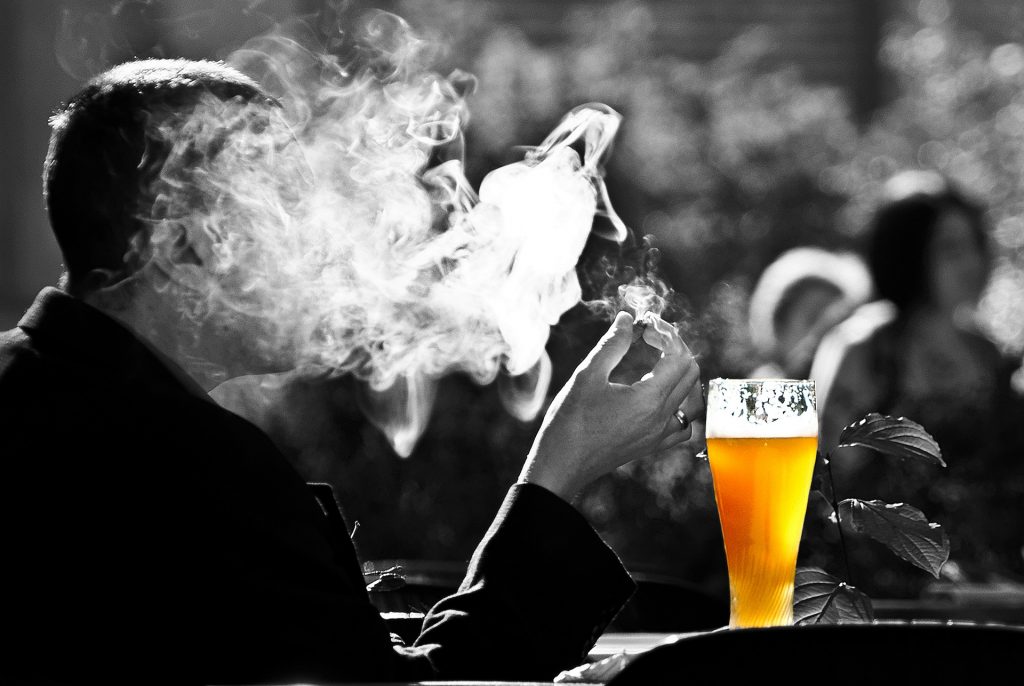

The nonsensical ban on cigarette and alcohol sales has transformed from a trending topic of discussion to a massive issue within South Africa.
Smoker or not, drinker or not, these revenue-generating, age-old companies are pillars within the South African economy, who empower more people than you realise.
Not only do they employ vast sums of people and generate billions in tax revenue. They empower many “off-shoot” businesses. Such as; advertising agencies, media companies, accounting firms, logistic companies and many more. Businesses who are all now suffering, pillaging their reserves to keep their heads above water, while they sit around, waiting for the Government to decide their fate.
This impactful decision which the Government says is in the best interest of South Africans, has sadly transformed from concern into an illogical quest, only supported by a few, yet condemned and questioned by many.
So what impact does the ban on alcohol and cigarettes have on the economy? What about the employees who work for companies such as South African Breweries (SAB) and cigarette manufacturers?
Zoleka Lisa, Vice President of Corporate Affairs at SAB, explains that SAB fully supports appropriate and sustainable measures taken to curb the spread of COVID-19, and ease the pressure placed on the public health system.
“However, we do not believe that banning alcohol is an appropriate or sustainable approach for the economy nor employment rates,” Lisa explains.
Not only does Lisa state the alcohol ban is not sustainable; but adds that the alcohol industry value chain lost an astounding 117 000 jobs during the last ban.
Furthermore, Lisa explains the abrupt ban on alcohol puts a staggering, 1 million jobs at risk across the industry’s value chain.
Looking at SAB specific value chain numbers, provided by Lisa, we get a better understanding of the situation.
SAB Specific Value Chain Numbers:
- SAB direct employees – 5700
- SAB supplier and retailer employees – 250 000
- SAB farmers – 1300 farmers (800 emerging farmers)
- 35 000 taverns provide economic opportunities for black entrepreneurs, with an estimated 54% of those being women-owned businesses (National Liquor Traders Council).
- The alcohol industry supports more than 10 000 retail businesses that sell alcohol for off-site consumption, as well as more than 22 500 labour-intensive businesses (restaurants, bars, clubs and hotels) that sell alcohol for on-site consumption.
- The tavern industry is estimated to be worth between R40 and R60 billion as an industry (DTI, 2018).
- 15% of township liquor outlets who could not reopen as they had not financially recovered from the initial alcohol ban which commenced on 26 March.
Lisa further explains, stopping the sale of alcohol products has resulted in an R18 billion loss in revenue across the alcohol industry, all due to the last ban.
Furthermore, the estimated Excise Tax, which the Government wrote off just from the alcohol industry, due to the illicit trade during the last ban, was R3.4 billion.
Over and above, Lisa explains the job losses will deprive the Government of an important source of revenue, in the form of Tax contributions from the alcohol industry.
“SAB’s pays R 1.2 billion in Excise Tax contributions per month, we are one of the largest Tax contributors in our country. Our Excise Tax contribution amounted to R 14.4 billion last year alone.”
However, Lisa enthuses that SAB’s priority is and continues to be the safety and well-being of their communities.
“We certainly share the South African Government’s concern regarding the increase in COVID-19 infections and the need to further improve our country’s preparedness to safeguard our people.”
In light of the growing number of infections, Lisa explains that SAB supports the Government’s strategy to limit social activity through the introduction of a night curfew, as it limits the unnecessary movement of people and plays an important role in reducing the pressure on the ICUs.
“Many countries around the globe have effectively and significantly reduced trauma cases through curfews and placing restrictions on movement, whilst still allowing alcohol to be consumed in people’s homes. We believe that there is a more balanced solution to the issue of reducing pressure on the ICUs that would allow for a similar outcome whilst protecting the livelihoods of the 1 million people that are being impacted by the alcohol ban.”
She further enthuses SAB wants to be part of a responsible solution in partnership with the Government and all industry stakeholders.
“We have proactively produced a comprehensive plan that addresses the challenges of combatting the spread of the virus, while ensuring responsible alcohol consumption. SAB, along with the industry, will continue to engage with the Government and propose measures that can have a meaningful impact in this public health crisis and support our country’s much needed economic recovery.”
Currently, SABS has developed a job retention plan to reduce the likelihood of retrenchments.
According to Lisa, part of this plan includes a reduction for an 18-month period of the base salary across all employees and freezing salary increases.
“The ban is having a devastating impact on the profitability and liquidity of SAB as we are earning zero income whilst still having to pay our employees and suppliers. Unfortunately, this is not sustainable.
Lisa says this new ban on the sale of alcohol is further crippling the company’s supply chain, as they no longer require raw materials (farmers), packaging materials and other supplies.
The suspension is threatening an estimated one million livelihoods that depend on the beer industry’s value chain, this includes SAB’s employees and their families.
“If the current restrictions on the trade continue, then additional decisions may be required. The uncertainty around the length of the ban on the sale of alcohol may also force companies to make decisions that could otherwise be avoided.”
What are SAB’s plans for the future and for after the lockdown?
Lisa says that SAB, along with the industry, will continue to engage with the Government and propose measures that can have a meaningful impact in this public health crisis and support our country’s much needed economic recovery.
SAB proof points that support its plans:
- SAB spent over R 60 million on COVID-19 contributions and responsible drinking communications, including a donation of R7 million donation to the Solidarity Fund (by Castle Lager).
- Furthermore, SAB also donated 150 000 litres of hand sanitiser in efforts to lower the COVID-19 spread/ flatten the curve.
- Adequately prepared taverns with care packs for the re-opening of trade (34 000 targeted outlets were equipped with care kits to open trade safely)
- Recycled beer crates to produce 100 000 face shields
- Developing and implementing a “Click ’n Collect” system called Firsti to maximise social distancing. This went on to enable 33 000 taverns to operate during lockdown, while getting 1 522 customers signed up.
- Developing and implementing a WhatsApp line for Gender-Based Violence, widely promoted across popular media platforms.
“Moving forward, as an industry we want government to engage with the industry. We want to review the science and explore solutions together with government,” Lisa enthuses.
Furthermore, Lisa states the liquor industry’s proposal for curbing the spread, sees the industry focusing their efforts on the following measures:
- Combatting Underage drinking- Strict identification protocols (Industry and SAB)
- Eliminating Drunk driving- supporting 0% BAC (blood alcohol content)
- Support Department of Transport with expediting the implementation of the BAC 0% through sharing global insights and partnering on execution (SAB)
- Partner with retailers for interventions in high-risk areas to address drinking and walking (Industry)
- Continuing to invest in social marketing campaigns aimed at reinforcing responsible consumption messages
- Partner with Government to capacitate law enforcement, in order to expedite driving under the influence arrests and convictions (including taking blood tests) through a team of Prosecutors/Magistrates that will be dedicated to prosecuting all driving under the influence cases.
As SAB works tirelessly to safeguard South Africans and restore the alcohol industry to its former glory, the tobacco industry is also facing overwhelming challenges.
According to the South African Tobacco Transformation Alliance (SATTA), the ban on the sale of tobacco products has had a devastating impact across the entire value chain.
“It has affected everyone from farmers to retailers, and as things stand now there are 296 000 livelihoods at risk. These include farmers and processors, who are unable to plant and process tobacco; because they don’t know when manufacturing will resume again. It includes manufacturers and retailers, who have been unable to sell any products for more than 120 days. We honestly do not know how much longer we can last like this and are genuinely concerned that the entire sector will collapse if the ban isn’t lifted soon,” SATTA emphasises in a statement.
Does SATTA feel the ban on the sale of tobacco products is justified?
“Not at all. The Government has chopped and changed positions since the national lockdown was announced. It gives different explanations every time it holds a press conference or fights battles in court. In the meantime, it has given a massive boost to people who make and sell illicit tobacco products – who don’t pay taxes – and crippled legitimate, law-abiding and tax-paying businesses.”
But has the illicit tobacco market truly blossomed during the lockdown?
“We have no doubt that the illicit cigarette market has blossomed. There’s scientific evidence to back this up,” says SATTA. All one needs to do, is refer to the recent report from UCT’s Research Unit on the Economics of Excisable Products (RUEEP).
SATTA explains that among other things, the research showed that illicit cigarette traders are raking in enormous profits, as the average price of some illicit brands increased by 457% during the lockdown.
“That is money that is lost in the fiscus,” SATTA emphasises.
SATTA adds that interestingly, the researchers argued that the ban on cigarette sales should be lifted immediately.
“They point out that the longer the ban continues, the harder it will be to get rid of criminal cigarette networks. This is why we say the Government’s arguments for banning cigarette sales have been destroyed by research. Plain and simple.”
The Government claims it wanted to stop people sharing cigarettes as it believed this would contribute to the spread of COVID-19.
“But the research reveals that more and more smokers are sharing cigarettes now – in some cases, the figure has gone up 430% in two months. So that is a failure,” SATTA adds.
Government also claimed that banning cigarette sales would stop people from buying cigarettes.
However, SATTA says the report reveals that 91% of smokers were found buying illegal cigarettes in May, but the figure now stands at 93%. Another failure.
How has the ban affected the economy?
According to SATTA, the impact is there for all to see, emphasising that every day that has passed since the lockdown was introduced, the Government has lost out on R36-Billion in tax revenue and counting.
“That means more than R4-billion since the lockdown was declared – money which the Government could definitely have used to address the real challenges of COVID-19.”
Furthermore, apart from the loss of tax revenue, the ban has put an end to almost all economic activity across the sector.
SATTA says farmers and processors are losing out on income, manufacturers are losing out on sales and revenue, as are shopkeepers.
“Small retailers – like spaza shop owners – have been particularly hard hit. Cigarettes are a big money-spinner for them, but they are unable to make a living.”
Once the ban on tobacco sales is lifted, what steps will SATTA be taking in ensuring the market flourishes again?
SATTA explains they will only be able to answer that question once the ban is lifted. “Right now, we are focused on trying to survive and trying to get the Government to listen to reason before we all go out business,” it concludes.
The ban on tobacco and alcohol sales has the South African economy and people by the throat, with limited air remaining. If they do not loosen their grip and begin resuscitating these power-house industries, our economy and country will not bounce back from the ripple effect.