

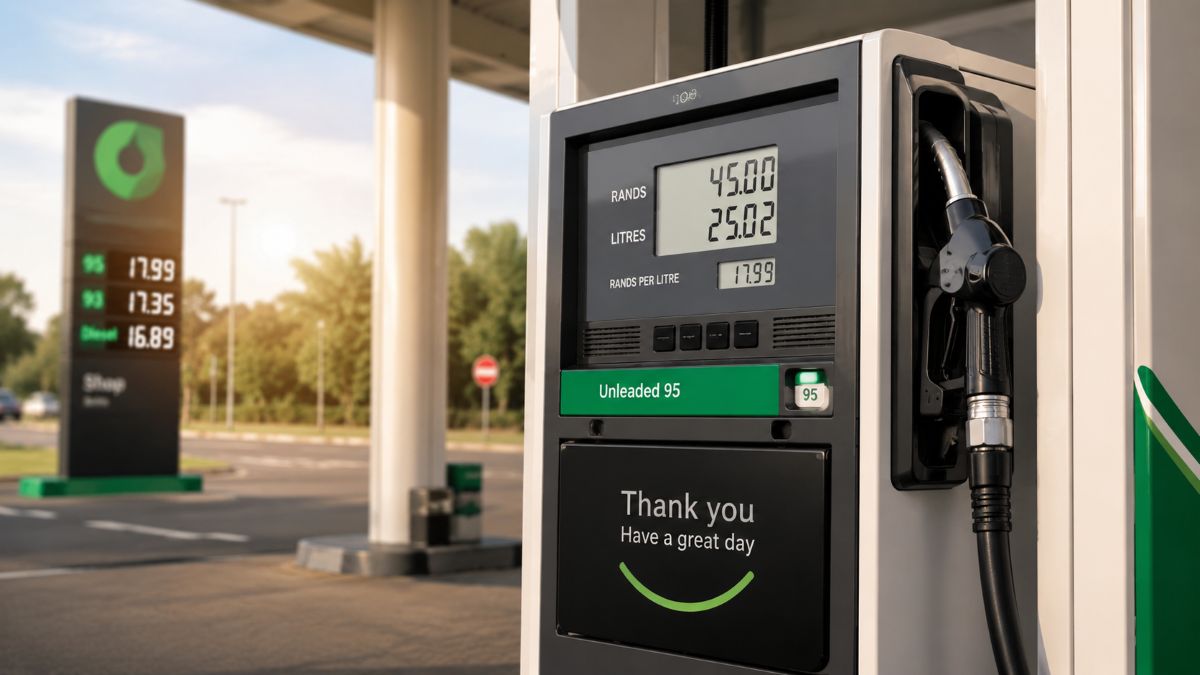
Following months of sustained fuel price increases, financially constrained South Africans are finally set to see relief at the pumps.
This follows confirmation from the Department of Mineral and Petroleum Resources (DMPR) that fuel prices will decrease on Wednesday, 1 July 2026.
Over the years, we’ve heard every version possible.
Some close.
Some creative.
Some completely dangerous.
But however you say it, you know who we are.
Newcastillian News
Say it wrong. Read it right.
According to the Department, and in light of prevailing local and international factors, fuel prices for July 2026 will be adjusted as follows:
- Petrol 93 (ULP & LRP): R2.01 decrease.
- Petrol 95 (ULP & LRP): R1.96 decrease.
- Diesel (0.05% sulphur): R3.14 decrease.
- Diesel (0.005% sulphur): R3.59 decrease.
- Illuminating Paraffin (wholesale): R5.23.
In outlining the basis for these adjustments, the Department, which released the updated fuel price structure on Tuesday, 30 June 2026, pointed primarily to developments in the global oil market.
Specifically, the decreases, which take effect on Wednesday, 1 July 2026, are largely attributed to a sustained decline in the average Brent Crude oil price.
Over the period under review, prices fell from 104.59 US Dollars (USD) to 86.53 USD.
“This is due to the signing of the Memorandum of Understanding (MOU) between the US and Iran, which has improved the global supply outlook,” the Department stated.
Building on this, the Department noted that international refined petroleum product prices moved in tandem with the downward trend in crude oil.
As a result, and as explained by the DMPR, these shifts translated into lower contributions to the Basic Fuel Price for petrol, diesel and illuminating paraffin, decreasing by 295.97 cents per litre (c/l), 498.47 (c/l) and 510.51 (c/l), respectively.
However, in contrast to this broader pattern, the prices of Propane and Butane increased during the period under review.
In addition to oil price movements, currency dynamics also played a supporting role in shaping the final adjustments. In this regard, the Department explained that the Rand appreciated on average against the US Dollar, strengthening from 16.52 to 16.38 Rand per USD during the period under review when compared to the previous cycle.
Consequently, this appreciation contributed further to the downward pressure on the Basic Fuel Price, resulting in additional decreases of 11.27 c/l for petrol, 13.75 c/l for diesel and 13.37 c/l for illuminating paraffin.
For consumers, the latest fuel price reductions are expected to provide some welcome, albeit measured, financial relief.
However, the positive movement in the fuel price is seen as “minor shift”, according to a Newcastle business owner, who wished to remain anonymous.

Explore Pixelfish’s free tools and downloads today.
“You cannot send fuel prices through the roof because of the country’s inability to develop, produce and store its own fuel at scale, let alone build healthy trade relationships with the Western world, then bring prices down by a few rand and expect people to celebrate it as some major achievement. We all see what is happening, yet government appears to think it is pulling off some great trick and that South Africans are simply buying into it. The price of fuel in South Africa is destroying everything, from industry to households. While the reduction is appreciated, it is nowhere near enough to assist SA’s near-lifeless economy.”
With these strong words and the adjustments in mind, what are your thoughts?
While you are here, be sure to read: Newcastle Set to Host KZN’s First Wind Farm as R8 Billion Energy Project Moves Forward