


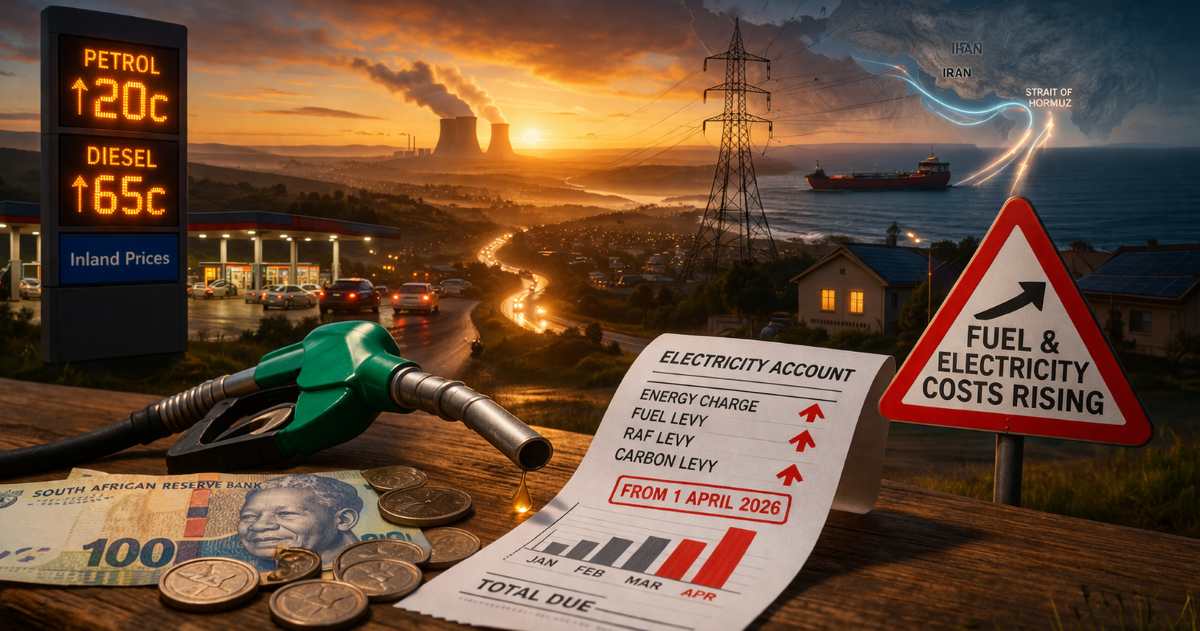
On paper, South Africa’s inflation picture has improved. Statistics South Africa says headline consumer inflation cooled to 3.0% in February 2026, down from 3.5% in January, while the monthly change in the consumer price index came in at 0.4%.
Yet for households across Newcastle, Ladysmith, Vryheid and the wider Northern KwaZulu-Natal region, that softer headline number should not be mistaken for a cheaper month ahead.

Stats SA made it clear that February’s lower inflation reading was helped by a mix of temporary and specific factors. Fuel prices fell 3.1% month on month, contributing to an annual decline of 10.1% in the fuel index.
Furthermore, food and non-alcoholic beverage inflation also eased to 3.7%, down from 4.4% in January. In addition, some medical aid increases were delayed, which helped keep the February print lower than it might otherwise have been.
That is why April is likely to feel very different at household level.
In the 2026 Budget, National Treasury confirmed that from 1 April 2026 the general fuel levy will rise to R4.10 per litre for petrol and R3.93 per litre for diesel.
The Road Accident Fund levy will increase to R2.25 per litre, while the carbon fuel levy will rise to 19 cents per litre for petrol and 23 cents per litre for diesel.
Furthermore, in his Budget Speech, Finance Minister Enoch Godongwana said the levy adjustments amount to 9 cents per litre on petrol and 8 cents on diesel for the general fuel levy, 5 cents on petrol and 6 cents on diesel for the carbon fuel levy, and 7 cents per litre for the RAF levy.
Taken together, those changes mean a further 21 cents per litre is being added to both petrol and diesel through fuel-related levies alone, before any separate monthly fuel-price movement is taken into account. That matters in a region such as Northern KZN, where long travel distances, daily commuting and road-based freight remain part of ordinary life for many households and businesses.
The pressure is also arriving on top of increases that already took effect this month.
The Department of Mineral and Petroleum Resources announced that from 4 March 2026, both grades of petrol increased by 20 cents per litre, while diesel rose by 62 cents and 65 cents per litre, depending on sulphur content.
Electricity adds a second layer of cost pressure. NERSA has approved an average tariff increase of 8.76% for Eskom direct customers and 9.01% for municipalities for the 2026/27 period.
As previously reported, the regulator confirmed that the 8.76% increase will be implemented from 1 April 2026 for Eskom direct customers, while the 9.01% municipal increase will be implemented from 1 July 2026 in line with the Municipal Finance Management Act.
This distinction is important for readers. Not every household in Northern KZN will feel the electricity increase at exactly the same time, particularly where supply is through a municipality rather than directly through Eskom.
Even so, the direction is clear: electricity costs are moving upward again, and for municipal customers the impact is still approaching in the new financial year.
For ordinary consumers, this is where the official inflation story and lived reality begin to diverge.
Another factor that could still influence the fuel outlook is the current conflict involving Iran and the wider Gulf region.
There have been some tentative signs of possible de-escalation. Reuters reported on 24 March 2026 that markets initially rallied after U.S. President Donald Trump delayed a planned bombing of Iran’s power grid and added five days to his ultimatum for Iran to reopen the Strait of Hormuz, citing what he called “productive” talks.
However, Reuters also noted that uncertainty remains high, with Iran denying it was engaged in negotiations with the United States, and with shipments through the Strait of Hormuz — a route that carries about one-fifth of global oil and liquefied natural gas flows — still described as curtailed. Brent crude was trading at about $98 a barrel after reversing part of the previous session’s sharp fall.
In addition, Japan has also started tapping oil stockpiles in response to the supply shock, underlining how seriously the current disruption is being treated internationally.
Building on this, South Africa’s Department of Mineral and Petroleum Resources has already said it is closely monitoring developments in the Middle East and their potential impact on global oil markets and local fuel prices.
For consumers in Northern KZN, the implication is that while there may be early signs of possible diplomatic movement, the risk to oil supply has not disappeared. If disruption in the Gulf persists, or if talks fail to produce a meaningful breakthrough, global oil prices could remain elevated and place further pressure on future South African fuel prices
In a region where households and businesses rely heavily on road transport, any sustained rise in international oil prices could place additional strain on commuting costs, deliveries and, ultimately, the wider cost of living.

February’s inflation number was lower, and that is real. But it was also helped by falling fuel prices and delayed medical aid adjustments, while March has already delivered fuel increases and April brings fresh levy hikes.
Add the next round of electricity increases to that picture, and many households are likely to feel renewed pressure in the months ahead, even as the national inflation rate appears more comfortable on paper.
In short, inflation may be down, but that does not automatically mean life is getting cheaper. For families already balancing transport costs, electricity bills, food prices and the wider cost of getting through the month, April may serve as a reminder that a softer economic headline does not always translate into relief at street level.
What are your thoughts on this? Let us know below.
While you are here, be sure to read:










One Response
Trumps talks with the middle east look promising so I believe petrol and diesel prices will come down soon