


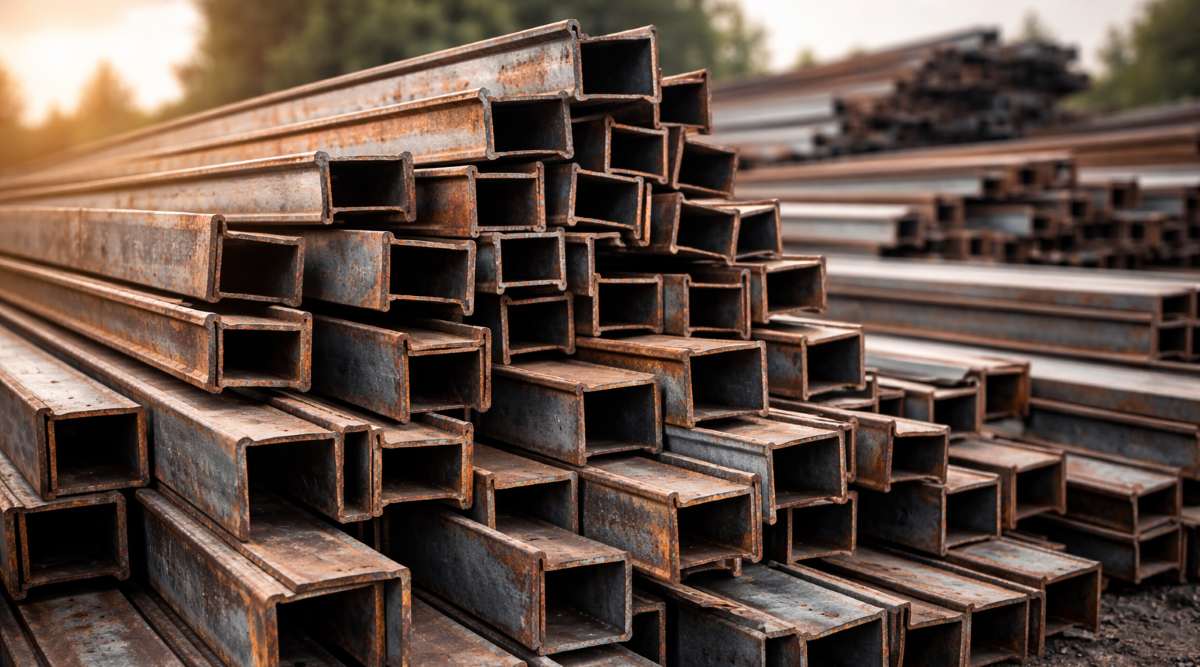
The International Trade Administration Commission of South Africa (ITAC) has imposed definitive anti-dumping duties on structural steel imports from China and Thailand, in a decision that could offer relief to ArcelorMittal South Africa’s long-steel operations, including its AMSA Newcastle Works in KwaZulu-Natal.
The ruling follows an ITAC investigation which found that U, I and H sections of iron or non-alloy steel, excluding H-sections greater than 200 mm, were being dumped into the Southern African Customs Union (SACU) at prices that materially undercut domestic producers.

According to the Commission, 28 863 681 kg of these structural steel products entered the market during the 2023/2024 financial year, with China accounting for 65% or 22 994 812 kg, and Thailand 17% or 5 868 869 kg.
In response, ITAC imposed definitive duties of 74.98% on imports from China and 20.32% on imports from Thailand. The Commission confirmed that these measures came into effect on Thursday, 19 March 2026, marking a significant intervention against what it found to be unfair trade practices.
In a related development, ITAC also introduced five-year duties on certain aluminium-zinc coated flat-rolled products from China, Japan and Taiwan, further strengthening protective measures for parts of South Africa’s domestic steel industry.
As outlined by ITAC on Friday, 20 March 2026, the structural steel investigation was initiated after ArcelorMittal South Africa announced on 6 January 2025 that it intended to wind down its Longs Business.
Despite that announcement, ITAC’s final determination found that the SACU industry still existed, as ArcelorMittal Rail and Structures Ltd (Pty) (AMRAS), a division of AMSA, remained operational and continued producing the subject product.
The Commission recorded that AMRAS had advised it that operations were expected to continue well beyond the first quarter of 2025, at least into the fourth quarter of 2025, and potentially longer depending on circumstances. ITAC further noted AMRAS’s position that it was, at that stage, fully operational and continuing to supply the market.
This formed an important part of the Commission’s assessment.
Building on this, AMSA’s own earlier public statements had already identified the influx of low-priced steel imports, particularly from China, as one of the pressures weighing on its domestic long-steel business.
Against that backdrop, importers and NEASA argued for the withdrawal of provisional payments, contending that the products would no longer be available locally once the Newcastle closure took effect.
However, ITAC rejected those submissions.
In its report, the Commission noted that the calls were opportunistic, pointing out that the SENS announcement had not been practically implemented due to ongoing engagements between Government and AMSA.
The Commission also recorded a letter from AMRAS stating that, while AMSA could not produce additional volumes until further notice, the company reserved the right to terminate the validity of that position in respect of future orders should the Newcastle Works mills restart.
As the sole SACU-based manufacturer of these structural steel products, AMRAS brought the application before the Commission.
Following consideration of stakeholder submissions, ITAC found that the dumped imports were directly linked to the injury suffered by the domestic producer.
The Commission further noted AMRAS’s view that the duties would enable fuller utilisation of its Emalahleni plant and could create more than 1 000 jobs in and around that region.
Beyond the immediate trade implications, the ruling also highlights the strategic importance of structural steel production within the broader South African economy. ITAC noted that these products are key inputs in fabrication, construction and mining, while also being used in rail, renewable energy, infrastructure development and general engineering.
For Newcastle, the decision introduces a significant new dimension to the AMSA and AMRAS story. While the anti-dumping duties place the domestic structural steel sector within a more protected regulatory environment, the determination does not clarify the operational future of AMSA Newcastle Works, nor does it indicate any immediate resumption of production at the site.
As a result, uncertainty remains around the future of the Newcastle plant and the wider supply chains linked to steel production in the region.
In an effort to establish what the ruling may mean for the company and for Newcastle, Newcastillian News approached both ArcelorMittal South Africa and the Industrial Development Corporation for comment on possible next steps and whether any further clarity could be provided. At the time of publication, neither organisation had responded.

For now, what is clear is that ITAC’s decision has created a stronger legal shield for the domestic structural steel industry against unfairly priced imports. What remains unclear is whether that protection will translate into any operational or economic benefit for Newcastle, where the future of the AMSA site is still unresolved.
What are your thoughts on this? Let us know below.
Do not forget to read:










2 Responses
Is Accelomital going to open again?
ArcelorMittal Newcastle works is shutdown completely. Trust it because we know and see what is happening there. End of story.
Thank you