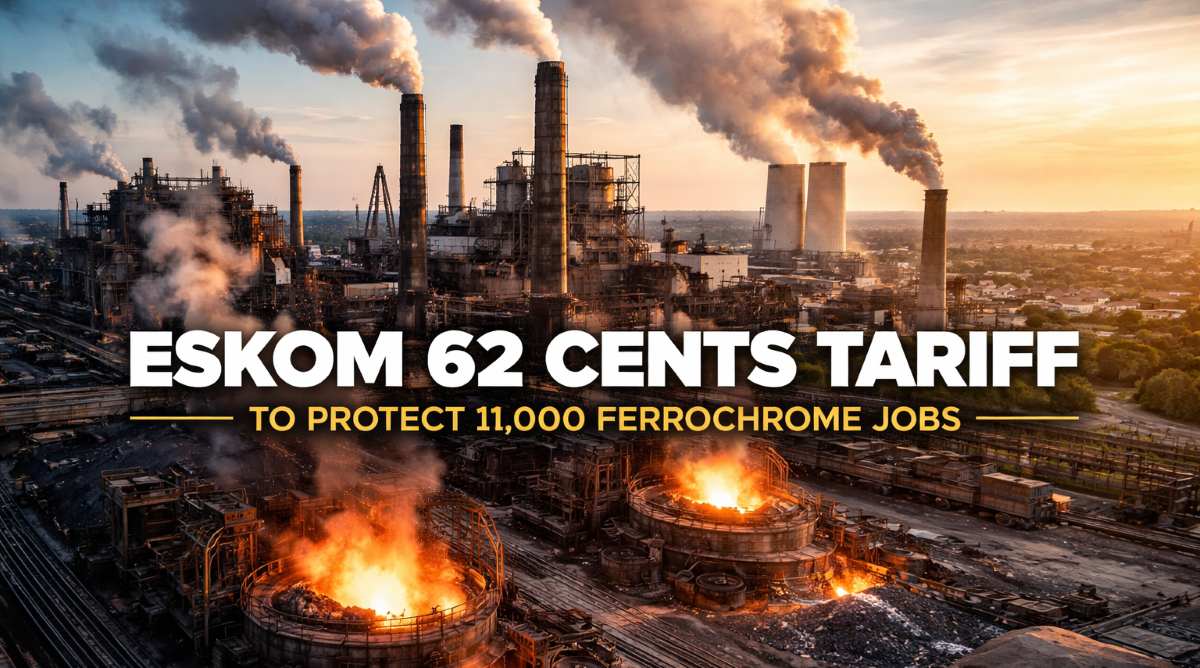
The South African government has announced a preferential electricity tariff of approximately 62 cents per kilowatt-hour (kWh) for the ferrochrome industry, in a move aimed at safeguarding more than 11,000 direct jobs and preventing further industrial shutdowns.
The framework was introduced on Friday, 27 February 2026, during a media briefing in Pretoria led by Electricity and Energy Minister Kgosientsho Ramokgopa, alongside leadership from Eskom and industry stakeholders.
The intervention follows sustained warnings from ferrochrome producers that escalating electricity prices had rendered operations increasingly unviable. Over recent years, multiple furnaces have been idled across the sector, with several companies initiating retrenchment procedures.
Eskom had previously implemented an interim tariff of 87.74 cents per kWh from January 2026 as a temporary stabilisation measure. That arrangement stemmed from a December 2025 Memorandum of Understanding concluded with the Glencore–Merafe joint venture after hardship clauses in existing Negotiated Pricing Agreements were activated.
While the interim pricing structure provided short-term relief, government acknowledged that a longer-term structural solution was required to preserve competitiveness and prevent further closures.
Under the proposed framework, leading ferrochrome operators — including Samancor Chrome and Glencore-Merafe — would benefit from the adjusted 62c/kWh tariff, subject to defined contractual conditions and approval by the National Energy Regulator of South Africa (NERSA).
Minister Ramokgopa described the measure as essential to stabilise an industry central to South Africa’s mineral beneficiation objectives. He emphasised that the intervention would not involve new fiscal allocations nor result in costs being transferred to household electricity users, but would instead operate within the existing pricing framework.
“We are not asking for new money. We have no intention of socialising this cost,” the Minister said, adding that electricity remains the “first mover” in enabling beneficiation at source.
Eskom Group Chief Executive Dan Marokane confirmed that the utility’s board had supported the framework in principle.
“Eskom’s priority remains balancing industrial support with our responsibility to ensure a sustainable electricity supply,” Marokane said. He noted that the proposed contract aims to provide stability to the ferrochrome sector while Eskom identifies viable long-term pricing pathways for industries under distress.
Eskom Board Chairperson Mteto Nyati added that the initiative reflects the utility’s mandate to power growth sustainably while maintaining financial discipline.
Labour representatives have stressed the urgency of the intervention. Solidarity Deputy General Secretary Willie Venter warned that thousands of families in Mpumalanga face hardship should further shutdowns occur.
According to figures cited during engagements, the following facilities remain exposed to electricity pricing pressures:
Samancor operations in Witbank and Middelburg (approximately 1,000 jobs)
Glencore’s Witbank plant (around 130 employees)
Transalloys (approximately 600 jobs)
Columbus Stainless in Middelburg (around 2,000 employees)
Ferroglobe operations in Witbank
When combined with indirect employment across suppliers and logistics networks, more than 12,000 livelihoods could be affected.
Government projections indicate that, if implemented successfully, the tariff could enable:
45 smelters to return to operation by December 2026
49 smelters by December 2027
Restoration of approximately 74% of national installed capacity
The intervention is expected to preserve roughly 11,480 direct jobs and sustain an estimated 121,392 positions across the broader value chain.
Treasury modelling suggests the policy could generate:
R20 billion in additional mineral beneficiation expenditure
R5.5 billion in extra tax revenue
Approximately R76 billion in export earnings
Eskom anticipates roughly R17.9 billion in incremental electricity revenue from continuously operating smelters.
The Minister framed the intervention as a competitiveness measure intended to narrow the gap with global producers, particularly China, where lower electricity costs underpin strong market positioning.
He further characterised the tariff as part of a broader industrial policy shift aimed at retaining value-added processing within South Africa rather than exporting raw minerals.
The proposed tariff remains subject to regulatory approval and formal contractual arrangements. Government, industry, and organised labour have indicated ongoing collaboration to finalise implementation before further operational deadlines are reached.
The announcement represents one of the most significant electricity pricing interventions in recent years and signals a coordinated effort to stabilise South Africa’s energy-intensive industrial base while preserving employment in affected regions.
What are your thoughts on this? Let us know below.
Newcastillian News invites your input. We ask that you keep your remarks courteous and on-topic. We do not allow any form of hate speech, such as racist or sexist comments. All comments are subject to moderation in line with our User Rules and Commenting Policy.