


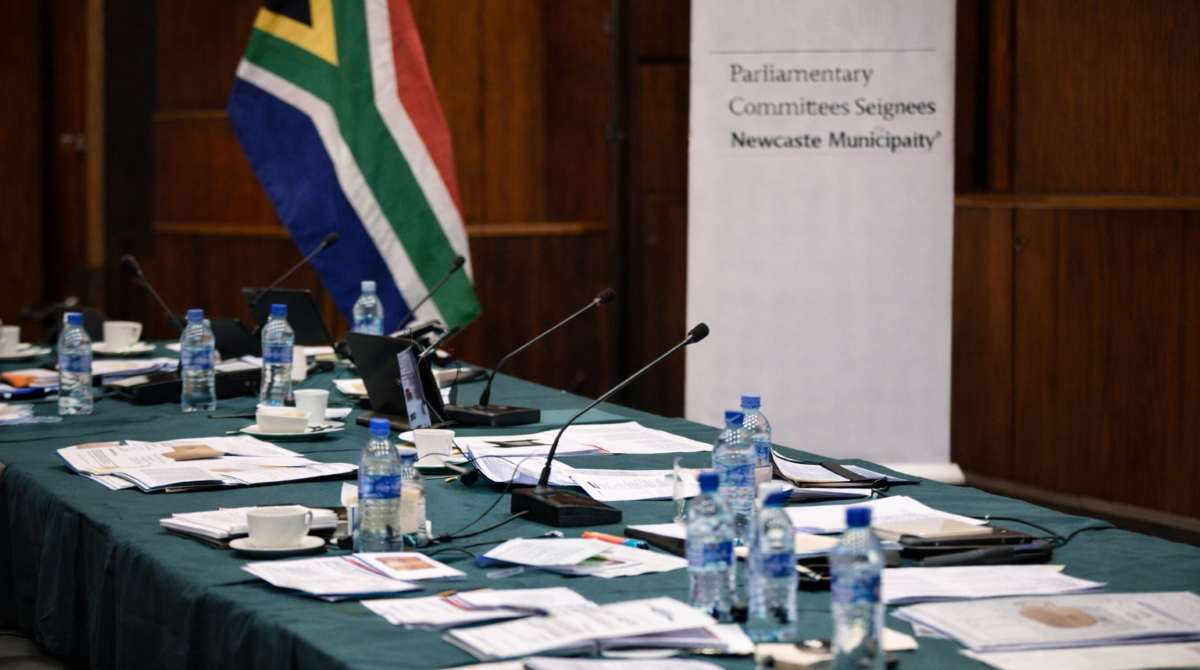
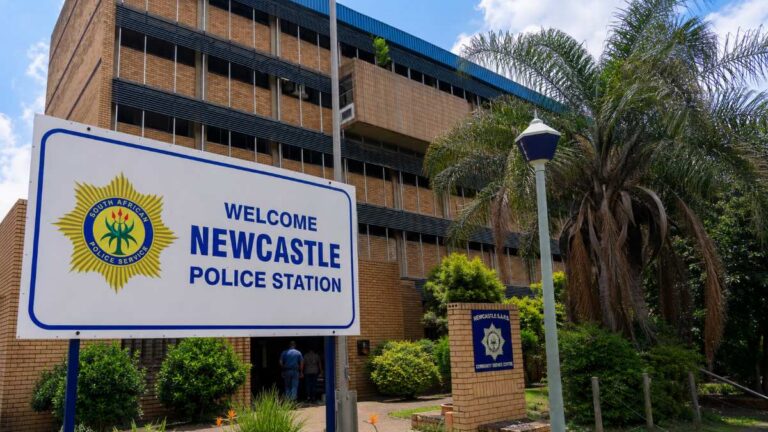
Two parliamentary committees — the Portfolio Committee on Cooperative Governance and Traditional Affairs and the Standing Committee on Public Accounts — subjected the Newcastle Local Municipality to intense scrutiny on Wednesday, 28 January 2026, exposing serious concerns over the management and oversight of public funds.
Officials were required to respond to allegations that R14 million had been spent on a 500-metre road, R28 million on VIP toilets (portable toilets), R65 million on plant hire equipment, including trucks from the Mayor’s company, and that additional plant and machinery had also been hired from external suppliers.

The session highlighted systemic governance challenges and the municipality’s ongoing accountability deficits.
The municipality, long grappling with operational and financial pressures, has previously seen former administrations criticised for their role in its precarious position. However, the current leadership now faces equally pressing questions, reinforcing that government accountability remains a central concern regardless of political tenure.
This scrutiny forms part of a joint parliamentary oversight visit to KwaZulu-Natal by the two committees. The visit, which began on Tuesday, 27 January 2026, and continues until Friday, 30 January 2026, engages directly with municipalities identified by the Auditor-General of South Africa (AGSA) as distressed or dysfunctional. Through these engagements, the committees aim to understand both the immediate and structural factors contributing to recurring governance failures in local government.
The oversight was prompted by the AGSA’s 2023–2024 local government audit outcomes, which revealed a persistent pattern of underperformance across municipalities.
Only 41 municipalities — representing 16% of the total — achieved clean audits, highlighting ongoing concerns about financial management, operational efficiency, and governance standards.
According to Parliamentary Communications Services:
“While 59 municipalities have shown improvement in their audit outcomes since the 2020–21 financial year, 40 municipalities have regressed. In addition, 13 municipalities failed to submit their financial statements and performance reports for auditing by the legislated deadline.”
Beyond these figures, the committees sought to identify the root causes of recurring failures in local government. In KwaZulu-Natal, the oversight visit was structured to assess the effectiveness of municipal interventions and support measures, scrutinise the role of provincial leadership in enforcing accountability, and explore how intergovernmental structures can be strengthened to assist municipalities in addressing operational deficiencies and improving service delivery.
Against this backdrop, Newcastle Municipality faced intense questioning, with scrutiny extending beyond individual expenditure items to broader systemic governance challenges that have long hampered effective service delivery.
During the session, the committees highlighted several major issues:
- For the 2023/2024 financial year, the municipality underspent on all housing grants by R65 million.
- Municipal liabilities now exceed assets by nearly R500 million, with a reported net deficit of R361.5 million.
- Only 1.2% of the capital budget allocated for infrastructure maintenance was spent during 2023/2024.
- Wasteful and fruitless expenditure in the 2024/2025 audit report was deemed irrecoverable, yet no investigations were conducted to substantiate this.
- The Director of Supply Chain employed by the municipality had previously been dismissed by Amajuba District Municipality and Eskom, with Eskom reportedly pursuing legal action against the individual.
- Municipal officials owe the municipality almost R1.2 million.
- Water losses remain at 37%, significantly affecting both service delivery and municipal finances.
- The municipality continues to rely on external law firms rather than its internal legal team.
- Excessive plant hire was noted, including involvement of the Mayor’s company alongside other suppliers. The AGSA reported over R60 million spent on plant hire, with some vehicles observed at a regravelling project in Ward 12.
- R28 million was spent on VIP toilets (portable toilets) during the 2023/2024 financial year.
- Eskom debt has again escalated to critical levels.
- Residents of Newcastle West have expressed growing frustration over deteriorating service delivery and infrastructure, with the Mayor allegedly ignoring a memorandum submitted in December 2025.
- Allegations were also raised that R14 million was spent on a 500-metre section of road construction.
Furthermore, the committees instructed the municipality to address entrenched governance weaknesses.
These include reliance on audit outcomes rather than proactive controls, acting appointments, infrastructure oversight failures, procurement irregularities, excessive use of consultants, and concerns regarding the municipality’s going-concern status. The committees emphasised that consequence management, strengthened internal controls, and sustainable service delivery are non-negotiable.
Building on this, Newcastle Municipality — along with other municipalities appearing before the committees — has been directed to submit detailed action plans and reports addressing audit findings, mismanagement of conditional grants, irregular and wasteful expenditure, infrastructure oversight failures, and persistent water and electricity losses.
These reports, to be submitted within three months via the MECs, will inform follow-up engagements in which officials will be required to account for corrective measures ahead of the next audit cycle.
Moreover, the Auditor-General of South Africa’s 2023/2024 audit outcomes for local government provided additional context to Newcastle’s challenges, placing them within broader systemic weaknesses identified across the sector.
Nationally, only 41 out of 257 municipalities achieved clean audits, indicating that the majority continue to struggle with financial management and compliance. This trend of underperformance underscores persistent weaknesses in internal controls, reporting accuracy, and effective oversight that reverberate through municipalities such as Newcastle.
In the AGSA’s consolidated findings, deficiencies were not confined to record-keeping alone. Auditors noted that a significant number of municipalities operated with unfunded budgets and material irregularities, both of which undermine financial stability and service delivery.
Furthermore, certain municipalities failed to submit their financial statements and performance reports by the legislated deadline, further eroding transparency and accountability.
Within this national audit framework, specific elements of Newcastle’s financial performance were brought into sharper focus. According to the Auditor-General, the municipality reported a net operating deficit for the year, indicating that expenditure exceeded revenue — a position aligned with broader concerns regarding liquidity and fiscal sustainability.
Although Newcastle received an unqualified audit opinion, this outcome was accompanied by findings pointing to weaknesses in financial discipline, including delayed payments to creditors beyond recommended timelines and substantial provisions for impairment of outstanding consumer debt.
The audit also highlighted ongoing challenges with revenue collection and asset management that are directly relevant to Newcastle’s operational context.
For example, the municipality disclosed substantial water losses — quantified as a high proportion of water supplied — which not only diminish service delivery but also exacerbate revenue shortfalls. Measured against National Treasury norms, these losses reflect inefficiencies in basic service infrastructure that directly impact municipal finances.
In addition, the Auditor-General flagged the municipality’s reliance on external consultants for financial reporting and specialised functions as part of a broader sectoral concern. While consultants can provide technical support in the absence of in-house capacity, their use has not consistently translated into stronger institutional capability and, in some instances, has masked persistent internal control weaknesses.
Taken together, the Auditor-General’s findings reinforce the committees’ assessment that Newcastle’s financial and governance weaknesses are symptomatic of wider structural issues in local government.
Consequently, without significant improvements in financial discipline, asset management, and accountability mechanisms, municipalities will continue to face recurring audit findings, operational deficits, and erosion of public trust.
The scrutiny faced by Newcastle Municipality underscores the broader challenge of embedding accountability and fiscal discipline within South Africa’s local government framework.
Persistent governance gaps, coupled with structural weaknesses in financial and operational management, signal that addressing these issues will require sustained oversight, rigorous consequence management, and strategic alignment between municipal leadership and provincial oversight structures.

Newcastle’s response to the Auditor-General’s recommendations and parliamentary directives will therefore serve as a key indicator of whether systemic reforms can translate into tangible improvements. It will also demonstrate whether strengthened governance, improved fiscal discipline, and enhanced service delivery performance can be realised in practice, thereby restoring credibility and public trust.
What are your thoughts on this? Let us know below.
Do not forget to read, KZN Municipal Failures Under Review After Audit Findings, Amajuba Again in Focus, if you missed it.
FAQs
Parliamentary committees raised concerns over plant hire spending, toilets, road costs and audit findings.
Over R65 million, including trucks linked to the Mayor’s company.
Audit findings pointing to financial, governance and service delivery weaknesses.
The municipality must submit action plans within three months addressing these issues.








6 Responses
Extremely sad, considering that in 1994 Newcastle Municipality was the RICHEST municipality in KZN, with massive investments and reserves in its coffers. It has been wasted and squandered by the politicians!!
This pure corruption on the part of our mayor
Easy solution,have a phone in approval for three days.Count the votes for and the votes against and act accordingly. If it’s yes make the councilors who approved this pay for the expenses and if if it’s not then they win the round.
Fire them all the people who actually deserve the jobs are side lined because of the so called employment ratio system safety but true Newcastle is going down hill and very very fast
Fire all top Management including the Mayor. They should be accountable for all the losses and mismanagement should be charge before a court and be sentenced as such. How could the Mayor’s business be allowed to tender and and do work as he the Mayor is part of Newcastle Municipality? Secondly Mayor tell us how are you involved in Memel?
….let’s be honest with each other here…is anyone surprised or shocked by this? Im not.