

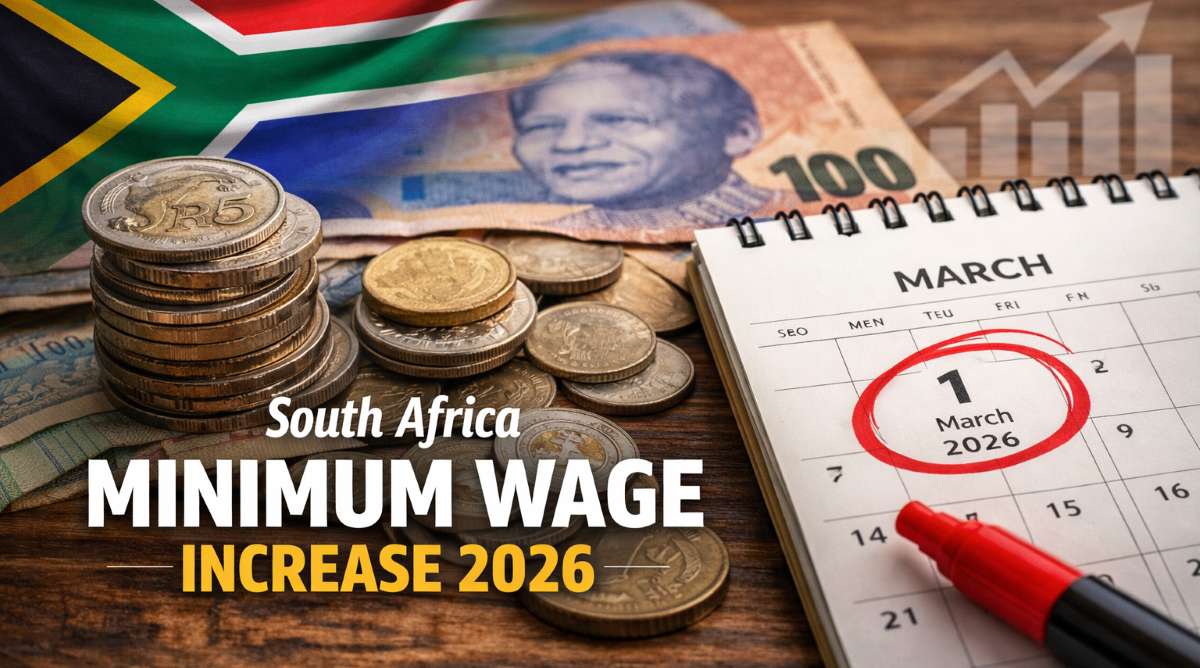
South Africa’s national minimum wage is set to rise again in 2026, following a formal recommendation by the National Minimum Wage Commission that links the adjustment to inflation.
The Commission has proposed that the minimum wage be increased by Consumer Price Index (CPI) plus 1.5 percentage points, continuing the formula applied in recent years.
While the final figure has not yet been gazetted, current inflation forecasts suggest that the adjustment could amount to an increase of around 5%.

If approved by the Minister of Employment and Labour and formally published in the Government Gazette, the new rate would come into effect on 1 March 2026, in line with the annual implementation cycle established under the National Minimum Wage Act.
The national minimum wage currently stands at R28.79 per hour, following an increase that took effect on 1 March 2025. Applying the Commission’s recommended formula to prevailing inflation data would raise the hourly rate to just over R30, although the exact figure will only be confirmed once the final CPI data is locked in and the Minister issues the official determination.
On a practical level, a minimum wage of approximately R30 per hour would translate to:
- Roughly R1 140 to R1 160 per week for a standard 38-hour work week
- Approximately R4 800 to R4 900 per month, depending on hours worked
These figures are indicative and subject to confirmation through the gazetting process.
The national minimum wage applies to the majority of workers in South Africa, including those employed in:
- Domestic work
- Agriculture
- Retail and services
- Hospitality and cleaning services
It is estimated that more than five million workers fall under the scope of the legislation.
Employers are legally required to comply with the national minimum wage unless a valid exemption has been granted under specific, regulated circumstances.
Certain categories, such as participants in the Expanded Public Works Programme (EPWP), are governed by separate wage determinations and are not automatically aligned with the national minimum wage rate.
At this stage, the proposed increase remains a recommendation, not a final decision. The National Minimum Wage Act requires that:
- The Commission submits its recommendation
- Public comments are considered
- The Minister of Employment and Labour makes a determination
- The final wage is published in the Government Gazette
Only once the gazette notice is issued does the new wage become legally enforceable. Historically, this process is completed in the first quarter of the year to allow implementation from 1 March.
The proposed increase comes against the backdrop of rising living costs, including food prices, transport expenses and electricity tariffs. Labour organisations have consistently argued that the minimum wage remains insufficient to meet basic household needs, even when both parents are employed.
At the same time, employer groups and small businesses have raised concerns about affordability, particularly in sectors operating on tight margins or still recovering from economic strain. The CPI-linked formula is intended to strike a balance by preserving workers’ purchasing power while limiting the risk of sharp wage shocks to employers.
Furthermore, the Department of Employment and Labour is expected to confirm the final national minimum wage early in 2026 following completion of consultations.

Once gazetted, employers will be legally required to adjust wages accordingly from the effective date.
Failure to comply with the national minimum wage carries penalties under labour law, including enforcement action by labour inspectors and potential fines.
Until the official notice is published, employers and employees are advised to treat the projected figures as indicative, not binding.
What are your thoughts on this? Let us know below.
Do not forget to read, Fueling entrepreneurship: Newcastle’s big drive to empower SMMEs, if you missed it.
Yes. The National Minimum Wage Commission has recommended a CPI-linked increase, which is expected to take effect from 1 March 2026 once gazetted.
No. The final rate will only be confirmed once the Minister of Employment and Labour publishes the determination in the Government Gazette.
It applies to most workers, including domestic and farm workers, except where specific exemptions or separate determinations apply.