


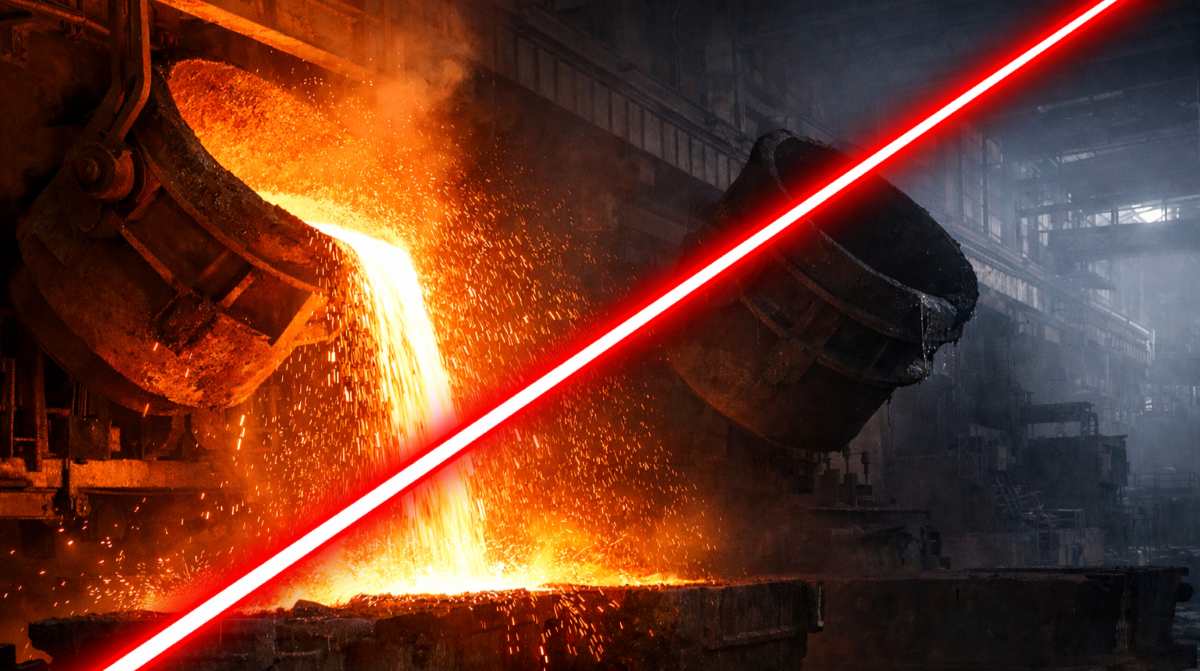
As 2025 draws to a close, thousands of South African steelworkers and their families face a grim start to 2026, with ArcelorMittal South Africa’s (AMSA) long-steel plants at Newcastle and Vereeniging now mothballed and no credible rescue plan in sight. Meanwhile, the National Union of Metalworkers of South Africa (NUMSA) has issued a blistering year-end rebuke to the government, accusing it of dithering while an industrial catastrophe unfolds.
In its year-end statement, the NUMSA Central Committee lambasted the government’s lethargic handling of the steel and engineering sector crisis.

Despite a full year of talks aimed at salvaging AMSA, the union underlined that no meaningful breakthrough has materialised.
“As a result, the Long steel plants in Newcastle and Vereeniging are closed, affecting not less than 3500 workers – this is a job loss bloodbath,” the union declared, adding that its core demands have remained unwavering from the outset: the nationalisation of AMSA, including the mothballed Saldanha Bay plant. NUMSA further explained, “This demand is made by the union due to the critical strategic importance of the primary steel to drive manufacturing and industrialization through localisation.”
Consequently, the union has refused to compromise on this position and has intensified pressure on the Presidency to address ongoing government delays, particularly the National Treasury’s failure to finalise the Public Procurement Act regulations, which NUMSA says are needed to support localisation through targeted procurement.
As reported by Newcastillian News throughout 2025, the problem erupted on 6 January 2025 when AMSA announced its decision to wind down its Longs Business at the Newcastle and Vereeniging Works, as well as its rail and structural subsidiary AMRAS. The company blamed entrenched structural problems, including sluggish domestic economic growth, soaring logistics and energy costs, depressed global steel prices, an influx of low-cost imports—particularly from China—global overcapacity, asset utilisation at just 50%, and inadequate policy interventions such as the Price Preference System and export scrap tax. CEO Kobus Verster expressed deep regret, noting that the decision followed insufficient progress in consultations with government and stakeholders.
As a result, the move jeopardised around 3,500 direct and indirect jobs—with significantly higher induced effects, especially in Newcastle—while production was slated to stop by late January and the full closure process targeted for completion within the first quarter, transitioning the facilities to care and maintenance and scaling back coke-making operations.
Just a day later, on 7 January 2025, NUMSA demanded urgent government-led collaboration with business, labour, the auto sector, and the broader components value chain to avert the shutdowns.
In doing so, it condemned failed negotiations throughout 2024 and warned of catastrophic consequences for downstream manufacturing, industrialisation, and vulnerable communities in Newcastle and Sedibeng amid South Africa’s already high unemployment.
Nevertheless, brief respite emerged in March 2025 as AMSA engaged stakeholders on potential funding solutions amid multiple inquiries into strategic alternatives, though none were firm at the time. This momentum culminated on 31 March 2025 in a critical six-month deferral until 31 August 2025, secured through a R1.683 billion repayable facility from the Industrial Development Corporation (IDC).
Under the agreement, AMSA committed to maintaining operations, safeguarding employment, optimising processes, and advancing localisation efforts.
The deal also paused Section 189 consultations, enabled IDC due diligence, and prompted government pledges for reforms on scrap pricing, export taxes, and safeguards—prompting Verster to describe it as a potential pathway forward for the industry.
Building on this, further support arrived on 2 May 2025 when temporary safeguard duties were imposed on hot-rolled steel imports used in engineering products such as pipes, containers, and mining equipment.
These measures followed ITAC findings of serious injury from unforeseen import surges, thereby providing essential breathing room for AMSA to stabilise amid its restructuring.
In addition, June 2025 saw public consultations open—until 7 July—on AMSA’s proposed six-year negotiated pricing agreements with Eskom for the Newcastle and Vanderbijlpark sites, amid widespread fears of 20,000 to 25,000 job losses across the value chain. The aim was to curb electricity costs and bolster competitiveness.
Despite these interventions, however, the measures ultimately proved inadequate. By 1 September 2025, an internal memo from Verster confirmed active preparations for permanent closure, citing unresolved issues such as rising imports, limited tariffs, high electricity costs, rail deterioration, and weak demand, alongside failed funding efforts. This triggered staggered Section 189 retrenchment notices, leaving workers in despair—one breadwinner stating he could not afford to lose his job, another fearing family collapse and forced relocation in his 50s.
As the situation worsened into October 2025, the Newcastle Municipality highlighted severe impending revenue losses from a shrinking tax base as workers, contractors, and suppliers departed, further exacerbating local unemployment—although it emphasised ongoing infrastructure upgrades and diversification efforts, such as reopening Ingagane Power Station and attracting mining investment.
Then, on 28 October 2025 (with the ruling dated 27 October), the Labour Court ordered AMSA to reinstate workers dismissed from 21 October, resume fair consultations within ten days, and pay full salaries, deeming the process unfair due to unilateral termination in March, lack of transparency on IDC talks, and ignored alternatives including an R8.5 billion purchase offer. NUMSA hailed the ruling as a victory and renewed calls for decisive intervention from the DTIC, Presidency, and IDC—or outright nationalisation.
Adding to the mounting setbacks, November 2025 brought more blows. The informal R8.5 billion IDC proposal—primarily comprising loans to cover debts and draw in new investment—collapsed after AMSA rejected it as inadequate, while the IDC showed reluctance to sweeten the terms. In response, the company promptly shifted focus to courting alternative investors, including international parties prepared to take on debt and modernise facilities, even as discussions with the IDC and DTIC persisted on potential phased takeovers.
Meanwhile, operations ground to a complete halt at Newcastle, directly idling the Khumani Iron Ore Mine in the Northern Cape and placing it under care and maintenance; although Vereeniging held potential to continue under a viable restructuring plan, broader supply chains faltered severely, jeopardising critical long-steel supplies to the automotive, mining, and construction sectors.
At the same time, AMSA sharpened its criticism of government-mandated scrap-metal discounts that favour recyclers over primary producers, arguing that the policy had weakened the sector for over a decade, and it formally appealed the Labour Court’s reinstatement ruling.
Most recently, on 11 December 2025, NUMSA escalated its demands through a memorandum to the IDC, calling for immediate financial relief for affected families, accelerated buyer searches with labour approval, independent asset verification to prevent alleged stripping (described as “daylight robbery”), and nationalisation of the formerly state-owned Iscor.
Furthermore, the union condemned AMSA for withholding salaries despite court orders, leaving hundreds of families destitute over the festive season, and accused management of effectively punishing workers amid the prolonged uncertainty.
As 2025 ends in deadlock, the protracted crisis at ArcelorMittal South Africa’s Newcastle and Vereeniging operations stands as a stark indictment of prolonged structural failures in the domestic steel industry, compounded by inadequate policy responses and unresolved funding challenges.
What began as a corporate wind-down announcement in January has, despite temporary deferrals, safeguard duties, and legal interventions, resulted in plant mothballing, disrupted supply chains, and severe job losses across direct and indirect employment.
The repeated failure of rescue proposals, alongside persistent issues such as import competition, high input costs, and logistical bottlenecks, has exposed deep vulnerabilities in South Africa’s primary steel sector.

The standoff between AMSA management, government entities, and organised labour highlights competing priorities: corporate viability versus worker security and strategic industrial retention. With operations halted, salaries withheld in defiance of court orders, and no immediate buyer or restructuring plan confirmed, the impasse risks broader economic fallout for dependent industries and local communities.
As the festive season passes under a cloud of uncertainty, the AMSA crisis underscores the urgent need for pragmatic, evidence-based solutions—whether through private investment, regulatory reform, or alternative models—to prevent further erosion of the country’s manufacturing capacity.
What are your thoughts on this? Let us know below.
Do not forget to read, Discover Newcastle’s Hidden Festive Gems: A Seasonal Guide to the Must-Do Experiences, if you missed it.







One Response
Goodday.wat happens to our shares at amsa.