



The Newcastle Municipality in KwaZulu-Natal has officially received its December Local Government Equitable Share (LGES) allocation, bringing to an end a tense standoff with the National Treasury that had threatened to withhold funding from Newcastle and 74 other municipalities across South Africa.
The resolution follows weeks of uncertainty surrounding the municipality’s financial stability and the continued delivery of essential services.
As reported by Newcastillian News on 15 December 2025, Newcastle narrowly avoided a potential High Court confrontation after Treasury confirmed that the December LGES allocation would proceed as scheduled.

The municipality had issued an ultimatum, warning that legal action would follow should confirmation not be provided.
The dispute escalated earlier this month when Treasury indicated that the December transfer could be withheld, citing concerns related to accountability and financial oversight.
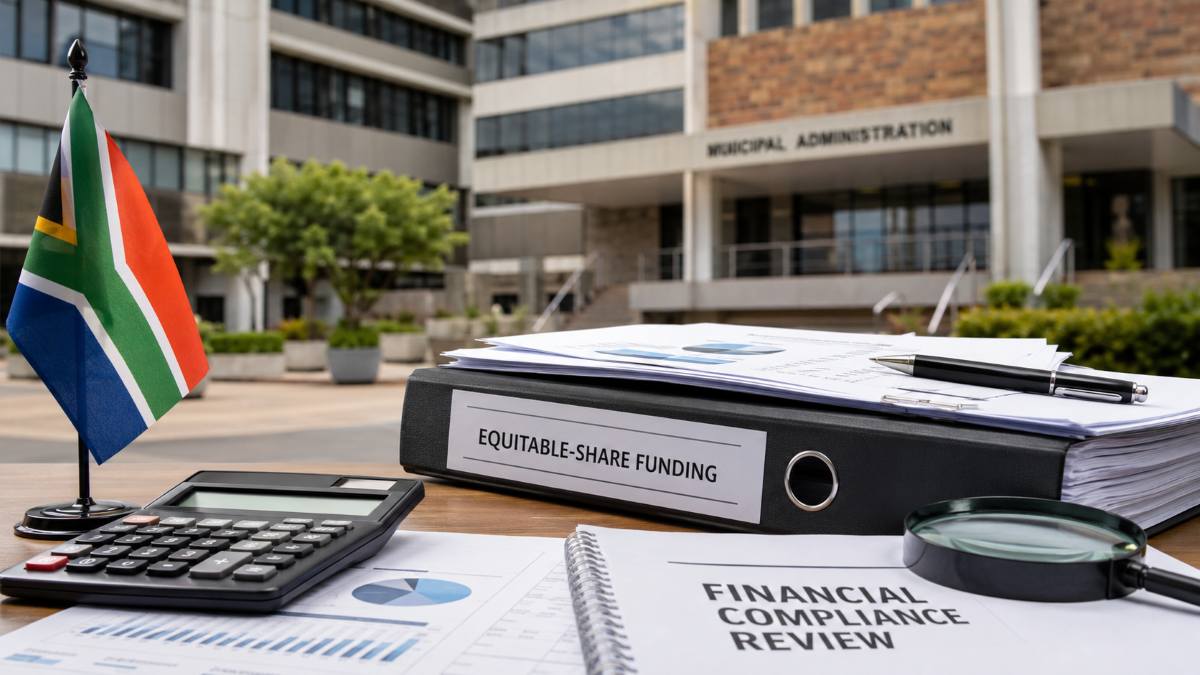
In addition, reports suggested that the tranche had been delayed due to a series of non-compliance issues, including outstanding budget funding plans, matters raised by the Auditor-General, pension fund submission backlogs, South African Revenue Service compliance issues, and unpaid water board debts.
Such interventions are grounded in Section 216(2) of the Constitution and the Division of Revenue Act, which permit the withholding of funds to address material breaches of the Municipal Finance Management Act (MFMA). As a result, the December instalment—originally due on 9 December 2025 as part of the 2025/26 financial cycle—was regarded as a critical component of municipal cash flow, alongside subsequent transfers scheduled for 11 March and 7 July 2026.
To read more, click here.
With the LGES now reflected in the municipality’s bank account, Newcastle Municipal Manager Zamani Mcineka stated that the funds were immediately applied in accordance with the municipality’s funding plan to stabilise operations and avert a looming financial crisis.
Of the approximately R188 million received, R88 million was allocated to Eskom, R35 million to uThukela Water, R21 million to Absa for loan repayments, with additional amounts directed to the Development Bank of Southern Africa.
According to the entity, the remaining balance was used to support cash flow and ensure the payment of staff and councillor salaries.
Furthermore, Mcineka described Treasury’s actions as unlawful, procedurally unfair, and disconnected from the realities confronting municipalities.
He explained that the process began with a Treasury letter dated 21 October 2025, requesting documentation to prevent the withholding of the equitable share.
Although Newcastle submitted the requested information, Treasury subsequently issued a second letter on 9 November indicating its intention to withhold funds under Section 216. “Here, I think the goalposts were shifted,” Mcineka said, arguing that new and broader criteria were applied without adequate reference to Newcastle’s specific circumstances.
A central point of contention was Treasury’s claim that Newcastle had failed to reduce its unauthorised, irregular, fruitless, and wasteful (UIFW) expenditure balance by 75%. Mcineka, however, pointed to what he described as a significant contradiction, noting that a year-on-year analysis reflected “a 99.48% reduction, significantly above the 75% reduction criterion outlined.”
“If we did not meet the criteria percentage, why did we score well-above the acceptable percentage? And why is National Treasury acting as if its the Government Department’s debt collector? If that is the case, it must focus on all the government departments that owe local municipalities outstanding debts.”
Mcineka also raised concern over what he described as premature threats directed at himself and the municipality’s chief financial officer. He quoted Treasury as stating that failure to comply would be treated as a deliberate contravention of the MFMA, with possible charges under Section 171. “I take this very seriously,” he said, stressing that the MFMA does not grant Treasury the authority to lay charges against municipal officials.
In his written response, Mcineka accused Treasury of using the equitable share “as a weapon and a threat to punish the municipality,” emphasising that the grant exists primarily to support poor and indigent communities. Despite this, Treasury later informed the Director-General of Cooperative Governance that Newcastle would not receive its allocation, citing adverse audit outcomes, unfunded budgets, and unpaid creditors.
“You can’t say to me I have an adverse audit opinion when I don’t,” he stated. “You can’t say I have an unfunded budget when I have a funded budget.”
The resolution of Newcastle’s LGES allocation has restored operational stability, but it has also highlighted the extent to which local municipalities remain dependent on national funding.
While Treasury’s oversight role remains necessary, the dispute has underscored the need for clearer communication and more consistent application of financial compliance criteria to avoid similar stand-offs in future.

Looking ahead, Newcastle’s experience may serve as a reference point for other municipalities navigating complex engagements with national departments. It also raises broader questions about how governance frameworks and funding mechanisms can be strengthened to ensure uninterrupted service delivery.
Nevertheless, what are your thoughts on this? Let us know below.
Do not forget to read, Why the 2026 Public Holiday Calendar Works Against South Africans, if you missed it.










2 Responses
R21 000 000 plus adfitional amounts for loan paymens ! The should restructure and retrench lije any other sensanle business would
Our Absa loan will be settled until year 2050 or beyond mark my words.