

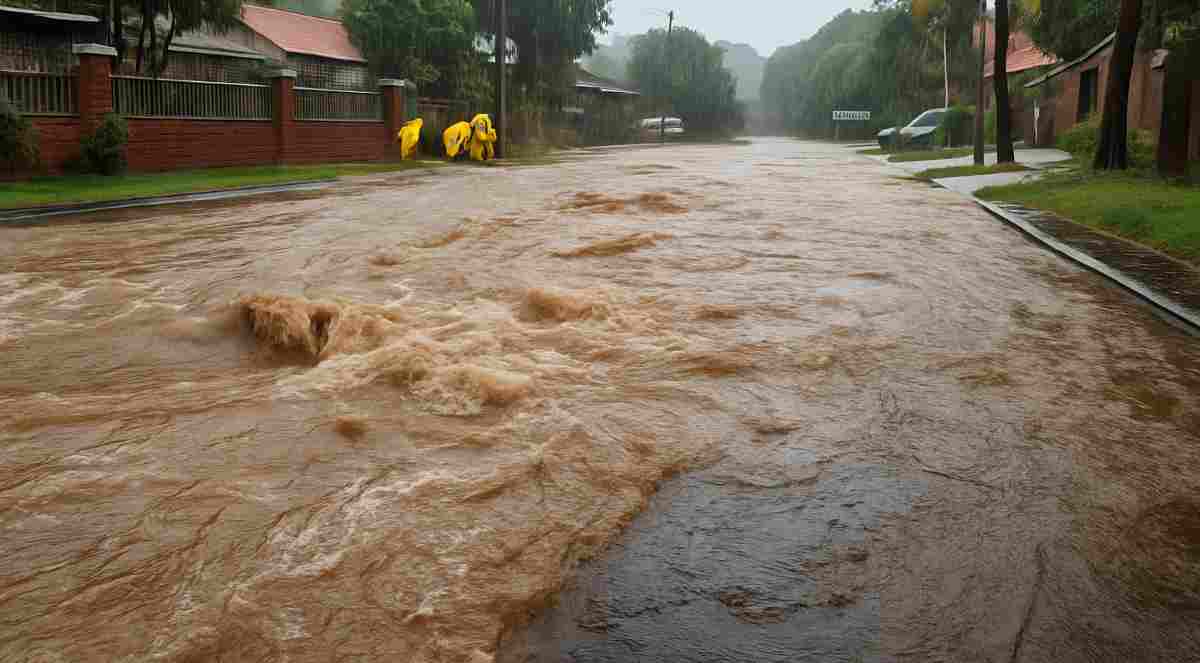
Newcastle residents are once again bracing for heavy rains and severe thunderstorms, with meteorologists warning that KwaZulu-Natal is in for an unusually wet and hot summer.
As the South African Weather Service (SAWS) forecasts above-normal rainfall and heightened heat between October 2025 and March 2026, attention has turned to the Newcastle Municipality’s ability to manage flooding, fires, and other weather-related emergencies.

According to SAWS, a combination of intense rainfall and warmer conditions could increase the frequency of severe thunderstorms and flash floods across KwaZulu-Natal.
For Newcastle, this brings renewed concern for flood-prone areas such as Paradise and the lower Central Business District, where previous storms have inundated streets and homes. Prolonged heat spells are also expected to strain local infrastructure and water systems, increasing the risk of fires and heat-related emergencies.
Over the past three years, Newcastle has repeatedly faced flooding that has disrupted transport, damaged property, and highlighted weaknesses in stormwater infrastructure. In February 2023, several major roads — including Voortrekker, Kirkland, and Bridger Streets — were closed after heavy rainfall overwhelmed the drainage system.
Despite increased drain-clearing and awareness programmes introduced in 2024, low-lying areas remain highly vulnerable.
Speaking on the matter, Newcastle Municipality spokesperson Mthandeni Myende said the city’s Disaster Management Plan was reviewed in July 2025 to address these ongoing risks. “The plan now reflects the current disaster risks faced by the municipality and provides for disaster-risk-reduction projects to mitigate and eliminate those risks,” he explained. Myende added that the plan forms part of the Integrated Development Plan (IDP), ensuring that future development considers flood-risk prevention.
To reduce the impact of torrential rain, the municipality stated that it continues its stormwater drain-cleaning and inspection programme, conducted regularly by the Technical Services Department.
Furthermore, Myende said high-risk zones are monitored closely ahead of the rainy season, and flood sirens have been installed along the Ncandu River to alert residents of imminent danger.
Environmental planning has also become a focus. The municipality has incorporated its Disaster Risk Assessment into the Spatial Development Framework (SDF) to ensure that land-use planning decisions account for natural hazards. This integration, guided by the KwaZulu-Natal Department of Cooperative Governance and Traditional Affairs (CoGTA), allows municipalities to identify high-risk areas and implement preventive measures that improve community safety in flood-prone regions.
Alongside these technical efforts, Newcastle has partnered with the Al-Imdaad Foundation to launch water-safety and drowning-prevention programmes in local schools. “The initiative began on 27 August 2025 at S’godiphola Primary in Mndozo/Osizweni and Qhawelesizwe Primary in Vezubuhle, with plans to extend to additional schools,” Myende confirmed.
On the firefighting front, the municipality operates ten fire engines, however, only five are currently fully functional.
The fleet does include rescue, major, and light pumpers, as well as specialised units such as a foam tanker, water tanker, and grassfire vehicle. These are stationed across three fire stations and supported by 59 trained personnel under the leadership of the Chief Fire and Disaster Management Officer.
“The different classes of vehicles cater for a range of emergencies — from structural fires and grass fires to motor-vehicle accidents and disaster incidents,” Myende explained. He added that the municipality also receives assistance from the Amajuba District and KZN CoGTA Provincial Disaster Management Centres when large-scale events occur.
Despite these improvements, district-level challenges persist. During an oversight visit earlier this year, the KwaZulu-Natal Legislature’s CoGTA Portfolio Committee noted that the Amajuba District Municipality still lacks its own fire engine and that several local municipalities remain understaffed — a concern for coordinated regional responses during major disasters.
Furthermore, Myende confirmed that Newcastle recently received a municipal disaster relief grant allocation in August 2025, although the specific amount has not yet been disclosed.

While Newcastle appears better equipped than in previous years, its history of flooding demonstrates that preparedness is an ongoing process. Continuous investment in drainage infrastructure, public awareness, and coordinated emergency management will determine whether the city can withstand another intense summer without major disruption.
With the above information in mind, what are your thoughts? Let us know below.
Also, be sure to read, Bafana Bafana Qualifies for 2026 FIFA World Cup, if you missed it.