



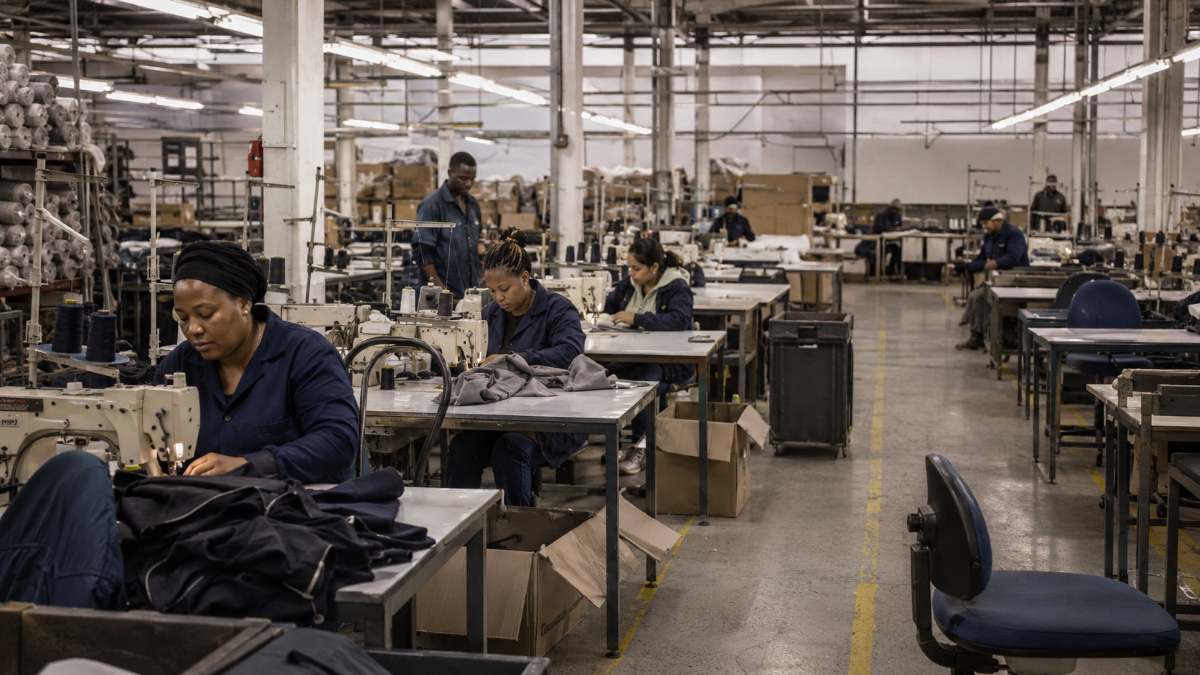
For generations, blue-collar jobs were the lifeblood of South African towns. From mining shafts and factory floors to construction sites and industrial parks, these hands-on roles gave rise to working-class families, local economies, and stable communities. But over the last 20 years, that foundation has slowly eroded — and with it, the socio-economic security of millions.
Blue-collar jobs across South Africa have declined in both availability and stability.
While technological change and global competition are partially responsible, poor policy direction and lack of future-proofing are making a bad situation worse. In towns like Newcastle — historically anchored by steel, textile, and manufacturing industries — the shift has been deeply felt. Today, as government rhetoric continues to promote blue-collar sector development without pivoting to new economic models, many fear the country is heading down a road with no return.
In the early 2000s, blue-collar jobs made up a sizable portion of South Africa’s formal employment base.
According to data from Statistics South Africa and industry watchdogs, the formal manufacturing sector employed over 1.4 million people in 2005, with an overall population of 46.9 million South Africans. Fast forward to 2023, and that number has shrunk by more than 200,000. This, while the population has jumped to 63 million.
The mining industry, once a cornerstone of national revenue and employment, tells a similar story. In 2000, South Africa had just over 500,000 direct mining jobs. By 2023, the figure had fallen to below 450,000 — and continues to decline each year, even as the cost of living and unemployment rise.
Construction, another critical blue-collar field, has also faced downturns, particularly during post-2008 recession years and following COVID-19. A once-booming industry that contributed over 3.5% to GDP in 2008 has hovered below 2.5% since 2016, with fewer major public infrastructure projects and inconsistent tender pipelines further draining confidence and job creation.
In short: blue-collar work is drying up, and the country has not meaningfully adapted.
Furthermore, a variety of complex forces have driven this decline.
Globalisation saw many companies outsource their labour-intensive processes to cheaper markets such as China, Bangladesh, and Vietnam. South African firms that once employed hundreds of local workers to sew, mould, weld, or assemble could no longer compete on cost alone.
Simultaneously, good old automation entered even traditional industries. Bricklayers are being replaced with robotic arms. Car assembly lines now require a fraction of the human labour they once did. Mining operations increasingly rely on remote-controlled or autonomous equipment, further reducing headcount in dangerous environments.
These global realities aren’t unique to South Africa — but what is unique is the country’s inertia in adapting to them.
The government continues to prioritise blue-collar work as the engine of job creation. Sectoral Master Plans, industrial park revitalisations, and preferential procurement policies all heavily lean on manufacturing, construction, and mining as solutions to unemployment. But these efforts often neglect the evolving realities of modern economics — and risk investing in industries that no longer carry long-term sustainability.
Nowhere is this more visible than in regional towns.
Newcastle, once a thriving industrial hub, has seen waves of job losses across multiple sectors. In the 2011 Census, for example, 37.4% of economically active individuals in the Newcastle area were unemployed. Among youth (aged 15–34), the unemployment rate in the little city was even higher at 49.0%, according to Statistics South Africa.
More recently, local reporting places Newcastle’s unemployment at 43.3%, reflecting persistent economic distress in the region. Newcastillian News
The broader manufacturing sector has contracted sharply in South Africa. Between 2011 and 2021, the sector shed over 200,000 jobs — a decline across nearly all sub‑industries except food and beverage.
Ladysmith, too, has lost much of its former industrial vitality. Once host to large factories such as Zorbatex, the Dunlop/Sumitomo rubber plant, and even a Defy appliances plant, it has seen minimal new industrial growth to replace losses. Cooperative Governance and Traditional Affairs In textile incentives data, Ezakheni (near Ladysmith) recorded 1,763 jobs created in some incentive schemes compared to just 391 in Ladysmith itself — a telling contrast in labour intensity.
As for towns like Durnacol and Dundee, reliable up‑to‑date employment figures are harder to surface in public datasets. But anecdotal and municipal narratives suggest that both towns are struggling to retain industrial investment, resulting in shrinking factory footprint, rising service-sector or informal work, and outward migration of younger workers who cannot find stable employment locally.
The results are visible on the ground:
- More informal traders and spaza shops replacing formal retail employment.
- Young people leaving town for Durban, Gauteng, or Cape Town.
- Rising household debt, grant dependency, and underemployment.
- Local businesses closing as disposable income shrinks.
This is not a Newcastle-specific problem— it’s a South African one. But without tailored responses, smaller towns will continue to haemorrhage talent, spending power, and social cohesion.
Furthermore, what happens if South Africa keeps prioritising blue-collar job revival in a world that’s moved on?
The answer may be deeply uncomfortable. Countries that fail to modernise their labour economies often face chronic unemployment, brain drain, and increased political unrest. This is already happening in various ways across South Africa.
Investing billions into outdated industrial parks, forcing localisation policies on globally mobile industries, or trying to sustain artificially bloated state construction tenders — all without reskilling or transitioning the workforce — could become a case study in economic short-sightedness.
If this trajectory continues, the country may find itself locked into a low-growth trap, unable to attract the kind of investment, innovation, and entrepreneurship needed to generate modern jobs in green energy, digital services, advanced logistics, or biotechnology.
To alter course, the national and provincial governments need to stop viewing blue-collar revival as a silver bullet and start viewing it as part of a broader transformation plan.
Key priorities must include:
- Technical retraining: Use colleges and apprenticeship programmes to upskill blue-collar workers for modern equivalents (e.g., renewable energy installers, CNC operators, drone pilots in agriculture, etc.)
- Regional tech incubators: Bring pilot programs and digital innovation hubs to towns like Newcastle, not just cities.
- Incentivised private investment: Make it easier and more attractive for companies in emerging sectors to operate in smaller towns by offering tax breaks and cutting red tape.
- Diversify beyond industrial hubs: Embrace service-based job creation in healthcare, logistics, tourism, and education to support economic ecosystems beyond traditional industry.
While South Africa continues to tie its hopes to blue-collar revitalisation, countries like South Korea have already shown what a successful transition from industrial dependence to modern, diversified employment can look like.
In the 1970s and 1980s, South Korea’s economy was heavily industrial and export-driven — powered by shipbuilding, textiles, and steel production. Blue-collar jobs accounted for nearly 45% of total employment. But rather than clinging to those industries, the government made a strategic decision to gradually shift towards technology, innovation, and education-led growth.
Between 1990 and 2020, South Korea increased public investment in research and development (R&D) from 0.9% to over 4.9% of GDP — one of the highest in the world. The government introduced long-term industrial diversification policies, offering incentives to companies in semiconductors, renewable energy, and information technology, while retraining factory workers through technical colleges and vocational upskilling programmes.
Today, blue-collar industries in South Korea employ just under 25% of the workforce, yet the average income per worker has more than doubled since 2000. The country’s transition has not meant abandoning industry — rather, it has modernised it. Smart manufacturing, automation engineering, and robotics now employ hundreds of thousands of former labourers in higher-value, tech-enabled roles.
The results
- Unemployment rate: Steadily under 4% for the past decade.
- GDP growth: Averaging 2.5–3% annually despite global downturns.
- Education-to-employment transition rate: Over 70% of technical college graduates find work within six months.
- Global ranking: 5th worldwide in innovation capability (Bloomberg Innovation Index 2024).
By focusing on future-proof industries, not just protecting legacy ones, South Korea avoided the structural unemployment trap now threatening many developing nations. Its government used targeted fiscal support, digital infrastructure investment, and partnerships with private industry to ensure displaced workers had real pathways forward.
South Africa can take inspiration from this model.
Instead of trying to resuscitate dying manufacturing segments or propping up industries that can’t compete globally, the focus must shift to building new competencies: renewable energy components, AI-assisted agriculture, green construction, and industrial automation.
If South Korea’s journey shows anything, it’s that the path forward lies not in defending the past, but in retraining the present to meet the demands of tomorrow.
South Africa’s blue-collar workforce deserves better than nostalgia. They deserve a future. And that future cannot be built by holding onto economic models that no longer work.
If policy continues to cling to a declining past, while ignoring the demands of a modern, adaptive economy, the result will be more than just lost jobs, it will be lost generations.
The challenge now is not to protect every blue-collar job that once existed, but to create a bridge to the next era of work. And that bridge must be built quickly, intelligently, and inclusively, before the road truly runs out.
What are your thoughts on this? Do you agree or disagree? Let us know below.
Be sure to read, Aspen gains approval to market Mounjaro for weight loss in South Africa, if you missed it.












2 Responses
Tradesmen and women were so important in our work force now trained staff are so hard to come by it is easily fixable
I do agree