

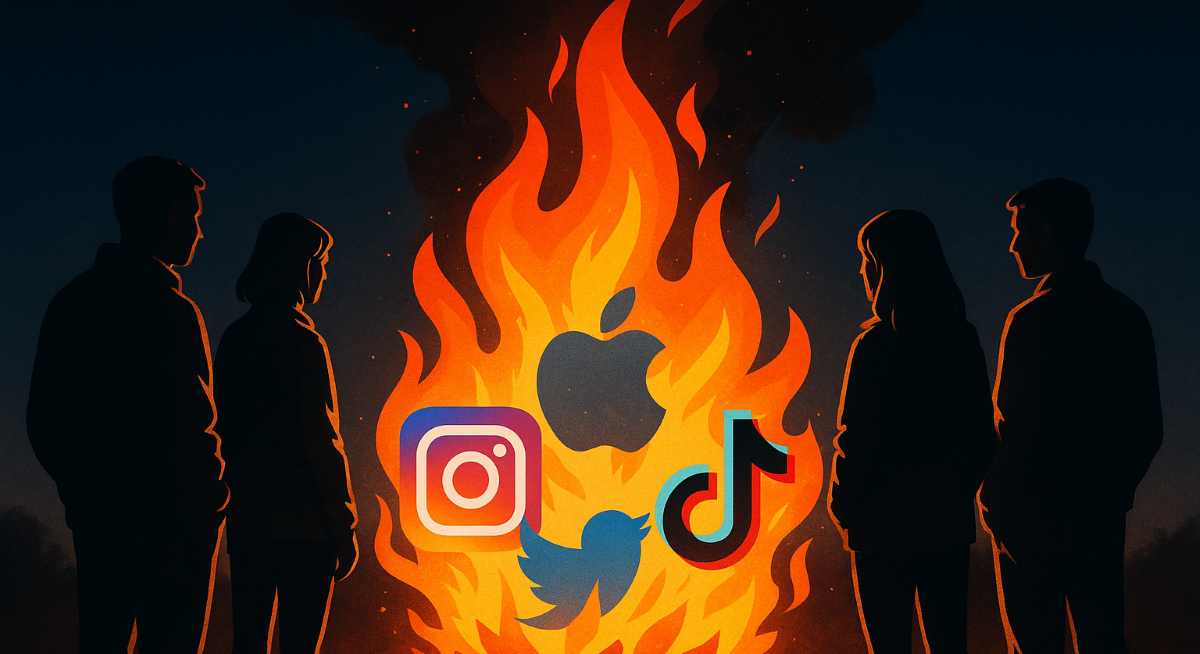
“If you wanted to control millions without firing a shot, you wouldn’t need armies or governments. You’d just need a budget, social media, and a handful of psychological tricks that have lived in the human brain for thousands of years.”
It may sound dramatic, but it isn’t. Every single day, from presidential campaigns to global corporations, even down to your favourite sports team or influencer, those ancient levers are being pulled.

They rally loyalty, stir outrage, amplify division, and keep people locked into tribes where belonging feels safer than questioning.
The unsettling part is this: the people pulling the strings don’t have to be evil masterminds. Some are, but most are simply playing the game because the game works. These tactics bypass reason, hijack survival instincts, and travel across networks at the speed of a swipe. Outrage spreads faster than truth, and manipulation is easier than honest persuasion.
This isn’t speculation. It’s not a conspiracy. It’s the operating manual of the digital age — a playbook sharpened by psychologists, tested by marketers, perfected by political strategists, and now automated by algorithms that never sleep.
And whether you realise it or not, it’s being used on you right now.
Why Social Media Is the Ultimate Weapon of Control
Social media didn’t just change communication, it rewired power. A single post can reach millions faster than any newspaper, TV network, or rally ever could. Studies show false news spreads six times faster on Twitter/X than truth, largely because it sparks stronger emotional reactions.
In short, whoever controls the feed, controls the tribe.
The Ancient Psychology That Makes Social Media Work
Long before hashtags, viral videos, or global platforms, your ancestors survived by clinging to their tribe. In a world filled with predators, rival clans, and scarce resources, loyalty wasn’t a virtue — it was survival. Trusting your own meant safety, food, and protection. Distrusting outsiders meant fewer chances of betrayal, attack, or exploitation.
Over thousands of years, this instinct carved itself into the human brain. It trained us to divide the world into friend or foe, us or them, often in the blink of an eye.
That reflex never disappeared. It still fires every time you see a symbol, hear a slogan, or sense an outsider challenging “your side.” The battleground has simply shifted: it’s no longer the savannah, it’s your newsfeed.
How Social Media Hijacks the Brain: The Science of Manipulation
You don’t notice it because it happens faster than conscious thought. Here’s what gets hijacked every time you scroll:
| Brain Area | What It Does | How It’s Hijacked | Example |
|---|---|---|---|
| Amygdala | Detects threats | Pumped with fear, pride, outrage | Headlines like “They’re destroying your future” |
| Hypothalamus | Triggers stress & excitement | Crisis framing | “Act Now” campaigns |
| ACC | Maintains group loyalty | Shames dissent, rewards conformity | “If you’re not with us, you’re against us” |
| vmPFC | Moral reasoning via emotion | Wraps goals in ethics | “We fight for justice” |
| TPJ | Filters empathy | Boosts “us,” blocks “them” | Propaganda, stereotyping |
| Striatum | Rewards | Likes, shares, validation | Dopamine hits for posting |
| Hippocampus | Stores long-term memory | Repetition until it feels true | Slogans, chants, hashtags |
This isn’t random. It’s neuroscience turned into code.
The Playbook to Take Over the World Through Social Media
- Define the Tribe – Symbols, slogans, colours.
Identity first, always. Jerseys, flags, hashtags, even emojis — they’re not decoration. They’re signals of belonging.
Example: Sports chants unify thousands who will never meet, yet fight as one. - Elevate the In-Group – “We” are moral, smart, chosen.
A tribe without superiority loses meaning. This is why movements and brands don’t just sell goods — they sell virtue.
Example: Apple and Tesla position buyers as visionaries, not just customers. - Create the Enemy – Blame or fear.
No loyalty without a villain. Rivals, scapegoats, or abstract threats all keep the tribe united.
Example: Political rivals framed as existential threats to the nation. - Fire Up Emotion – Outrage beats facts.
Fear and anger travel faster than nuance. Once outrage ignites, logic never catches up.
Example: False viral scandals spreading long before fact-checks arrive. - Repeat Until True – Catchy lines win.
The brain trusts repetition. The more familiar the phrase, the truer it feels. Algorithms amplify it, embedding slogans into culture.
Example: “Make America Great Again,” “Take Back Control.” - Give Them an Action – Share, march, buy, vote.
Action cements loyalty. Each click, chant, or purchase deepens the bond.
Example: Online movements live and die on reposts, not just belief.
Social media didn’t invent these tactics. It turbocharged them.
Real-World Examples of Social Media Manipulation
- Politics: The Brexit referendum and multiple U.S. elections showed how engineered slogans fractured nations. “Take Back Control” and “Make America Great Again” weren’t arguments — they were chants that bypassed debate and turned neighbours into enemies.
- Culture Wars: From the Depp–Heard trial to debates on identity and values, algorithms rewarded toxicity. Conflict became currency, and the angrier the post, the higher it spread.
- Public Health: During the pandemic, what should have been a shared crisis response dissolved into tribal warfare. Science itself was split into camps — “our experts” versus “their experts” — with loyalty dictating belief more than facts.
These aren’t historical footnotes. They’re live tactics, tested and perfected in real time.
The Cost of Weaponised Social Media
When loyalty trumps truth, accuracy dies. A single misleading post can gather millions of views in hours, outpacing corrections and embedding itself in public memory. Even after debunking, the emotional scar remains.
Over time, nuance collapses. Complex realities are flattened into black-and-white battles: good versus evil, us versus them. Compromise feels like betrayal. Listening feels impossible.
The cost isn’t just misinformation. It’s the erosion of empathy, the collapse of trust, and the destruction of common ground.
The Moment You Remember
Think back to the last digital firestorm.
Maybe it was Depp–Heard. Maybe it was an election. Maybe it was the pandemic. Whatever it was, here’s the uncomfortable truth: you weren’t just an observer. You were a participant. Every like, every share, every heated comment whispered to the algorithm: “This is what people want.”
And the machine obeyed.
What This Means for You
This isn’t just about politicians, corporations, or celebrities. It’s about you. Every time you feel triggered online, you’re part of the experiment. Understanding the playbook means you can spot it, pause, and decide if you want to play along.
The question isn’t whether the tactics work. It’s whether you choose to be controlled by them.
Breaking the Cycle: How to Resist the Social Media Playbook
The most rebellious act online today isn’t raging, trolling, or dunking. It’s pausing.
Before you hit “share,” ask:
- Who is behind this message, and what do they gain if I spread it?
- Is this framed to make me feel rather than think?
- Am I reacting because it’s true, or because it flatters my tribe?
That pause is freedom. It’s the one moment the architects of division cannot control. And if enough of us choose it, the system bends. The storms don’t burn as hot. The lies don’t spread as far.

The Quietest Revolution
It may seem small, but history has always been shaped by quiet acts of resistance that ripple outward. Pausing might just be the quietest revolution of all.
Because in the end, social media isn’t the problem. It’s a tool. The real question is: will we let it weaponise our instincts, or will we reclaim them?
And if you found this useful, share it — but share it mindfully. Don’t let outrage dictate your clicks. Be part of the solution, not the problem.
- This article is intended purely for educational and awareness purposes. It does not advocate, promote, or encourage dishonest or unethical behaviour in any form.
FAQs: How to Take Over the World Through Social Media
It refers to how social media platforms can be used to influence mass behaviour without governments or armies. By exploiting human psychology, groups can shape opinions, spread outrage, and control narratives at a global scale.
Social media hijacks survival instincts rooted in the brain. It triggers the amygdala with fear, the striatum with dopamine rewards (likes and shares), and reinforces messages through repetition until they feel true.
Digital tribalism is the tendency for people online to form “us versus them” groups. Social media accelerates this instinct by amplifying symbols, slogans, and enemies, keeping people loyal to their digital tribes.
Outrage creates stronger emotional reactions than reasoned arguments. Studies show false or sensational posts spread far faster than factual corrections because they trigger the brain’s survival and threat detection systems.
The playbook involves six steps: define the tribe, elevate the in-group, create an enemy, fire up emotion, repeat until true, and give people an action. These tactics drive engagement and loyalty.
The best defence is pausing before you react. Ask who benefits from the message, whether it appeals to emotion instead of reason, and if you’re responding because it flatters your tribe. Awareness weakens manipulation.
Be sure to read, 20 KZN Municipalities in Financial Distress Face Possible Treasury Sanctions, if you missed it.