


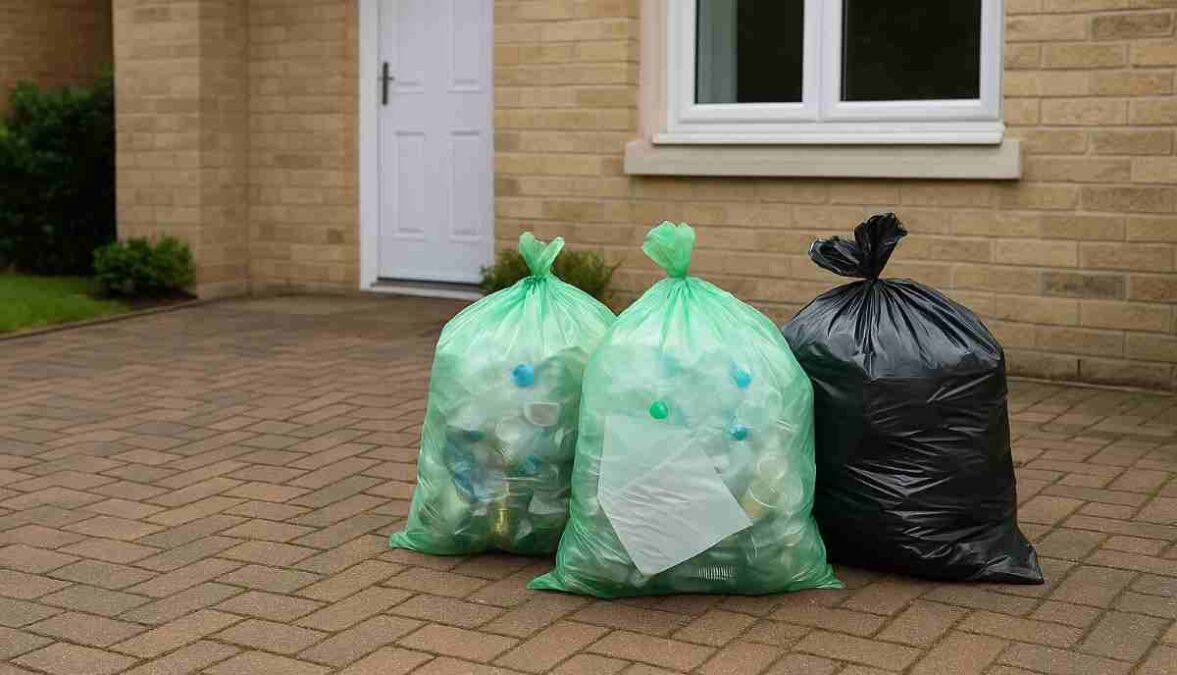
Despite South Africa’s supposed commitment to recycling, a deeply uncomfortable truth lies buried beneath the landfill mounds of KwaZulu-Natal and beyond: much of what you separate into green bags for recycling is still ending up in the same dump site as regular rubbish. And it’s not just a KwaZulu-Natal problem—this systemic failure spans municipalities across the country.

The various municipalities and local recycling initiatives proudly parade their “two-bag systems” and awareness drives. But while these efforts sound great on paper, they rarely translate into actual, measurable results on the ground.
Most residents continue to put in the effort to sort their waste at home, believing they’re contributing to a greener future. Yet, behind the scenes, recyclables and non-recyclables are often thrown into the same truck, compacted together, and dumped into rapidly overflowing landfill sites.
Adding to this, South Africa is facing a landfill crisis.
More than 80% of municipal landfill sites are either non-compliant, near capacity, or grossly outdated. In certain towns, the municipalities only holds a few trucks servicing tens of thousands of households. There is no feasible way to operate a genuine recycling programme under such constraints. Regardless of the coloured bags, the logistics simply don’t support proper waste stream separation.
What makes the situation even more frustrating is the fact that South Africa continues to import plastic, rubber, glass, and lead waste from other countries to feed local recycling industries. At first glance, this might seem like a business opportunity—but when you zoom out, it becomes clear: we’re importing waste while choking on our own.
As per a parliamentary meeting on 15 February 2022, 98% of this imported waste is recycled, recovered, or beneficiated, with only 2% being dumped. The imported waste is often cleaner and pre-sorted, making it more economical for recycling industries to process compared to the contaminated local waste. This practice underscores the inefficiencies in our domestic waste management system rather than being a solution to it. It’s a stark reminder that South Africa’s recycling challenges are not just logistical but also economic and environmental.
What makes this even more frustrating is the fact that many households diligently separate their waste, believing they are helping with the problem.
The reality, however, is disheartening. Poor infrastructure, inconsistent collection, and poor transparency about what happens post-collection means many homes and businesses are recycling in vain.
Reports confirm that lorries often collect both types of bags simultaneously. This defeats the purpose of separation-at-source and invalidates the effort of environmentally conscious citizens. If the municipality lacks the means to handle recycling properly, why promote the illusion of a functioning system?
Interestingly, the people doing the most effective recycling in South Africa aren’t working for municipalities at all. They are the thousands of informal waste pickers, who recover an estimated 80–90% of post-consumer packaging that’s actually recycled.
Yet, instead of being integrated into the official waste economy, they are often ignored or criminalised. If the government truly wanted to fix the system, supporting and formalising these workers would be a logical and immediate first step.
The irony is brutal. While South African landfills overflow, and natural ecosystems suffer from illegal dumping and burning of waste, we are also buying waste from other countries because it’s cleaner, pre-sorted, and better for manufacturing.
This reflects not just a logistical failure, but an economic and environmental one as well.
Moreover, contaminated local waste is often too expensive to sort and clean. The country lacks sufficient Material Recovery Facilities (MRFs) to handle the volume. The result? It’s cheaper to import rubbish than deal with our own.
You must remember, South Africa doesn’t have a recycling problem—it has a governance problem. The solutions aren’t complex:
- Invest in MRFs and decentralised waste-to-energy plants
- Enforce real separation-at-source programmes
- Publicly track municipal waste flows to improve transparency
- Empower informal pickers and integrate them into the system
- Educate communities beyond just bag colour
Until these steps are taken, recycling in South Africa will remain largely performative.
Nevertheless, the Reality of South Africa’s Waste Problem becomes quite clear when looking at the below figures:
- 122 million tonnes of waste are generated annually in South Africa, of which only 10% is recycled.
- More than 90% of recyclable waste still ends up in landfills or is illegally dumped.
- South Africa imports recyclable materials like plastic and rubber from countries such as Namibia, Mauritius, and even European nations, despite local landfill overflows.
- Informal waste pickers contribute to up to 90% of all actual recycling done, yet receive no formal compensation or state support.
- The number of non-compliant landfill sites continues to grow, with more than 60% of municipal landfills failing audits in recent years.
- Less than 3% of municipalities have functioning Material Recovery Facilities (MRFs).
According to the National Waste Management Strategy 2020 (NWMS 2020), the country aimed to divert 40% of waste from landfills by 2025, with specific recycling rates of 70% for paper, 60% for plastics, 90% for glass, and 90% for metals. However, as per a research article published on 14 March 2025, these targets have not been met, with recycling rates still hovering around 10%.
This failure highlights the urgent need for systemic changes in waste management practices, as the current trajectory shows no significant improvement despite the government’s stated goals.
These stats paint a harsh but honest picture of a nation that talks green but dumps dirty.
Remember, it’s easy to feel disillusioned when your efforts to do the right thing are rendered meaningless by the system meant to support them. But the first step to change is awareness. Understanding what’s happening behind the scenes is crucial to demanding better from local government and holding them accountable.

So next time you place your green bag on the pavement, ask yourself: Is this really going to a recycling plant? Or is it just another lie wrapped in plastic?
Be sure to share your thoughts in the comment section below?










18 Responses
I’m devastated beyond measure.
It’s shocking in other countries it works so well
Have have witnessed this on most municipalities in the Free State were my doctorate student a study on waste dumping sites of 15 towns.
The situation is extremely bad and none compliance is a new normal. Animals feeds on waste and it’s being blown back to the people with no proper infrastructure and compacting systems
Hi. Pls reference the article referred to of 14 March 2025
Excellent article!
Thank you so much, Mark!
TAX plastic to death. Packaging industry should grow up and stop this madness. My 2 cents. Skillie.
This is really a shocking situation. It actually feels to me that leaving a comment is just as wasteful since nobody in the goverment really cares about anything except lining their own pockets. Dark days ahead.
KZN HAS ORANGE BAGS OR AM I WRONG.
SO WHATS THE SOLUTION
Municipality should have long time implemented waste to energy plant and waste management program’s to communities must done 3 times in a year. Preventing illegal dumping. Remember a town or city without waste bins, waste will be everywhere that make rat’s feel at home.
Rather sad to read this but the article does not name and shame the Municipality.
Garden waste is also mixed at source and they end up in landfills Garden Waste Centre in Tongaat .I don’t take mine to the Garden Waste Centre I compost mine. My recycling is taken to Napri in Truro lands industrial estate for recycling. Sadly our recycling Orange Bags in eThekwini Municipality has failed us.I was one of the authors of the policy. Waste Pickers actually do us a great favour they take the recycling to Napri and earn some money.Waste pickers are more efficient than our current eThekwini Municipality.
Our government and their local municipalities are failing the nation . We see our civilian every day going up and down down passionately doing recycling at the lower scale but with resilience without support and recognition any form of motivation. Private companies again are to blame for not issuing permits to recyclers who have capacity to can deliver directly to them (manufactures) their red tape is unrealistic and kill the morality people are stuck with pile of waste that deserves to be delivered direct without middle man. If the government could help by putting pressure on this private companies to recognize ground pickers (recyclers) companies without unnecessary delays and requirements we can win this. The government again should generally wake-up and work since is a big cause for this decaying.
If south African government including municipality can start opening their hands an their hearts to the registered recycling small companies, they can stop more than 50% that goes straight to the landfills.
It is just that it is making sense to municipality to payout billions of rands to waste tenders just to dump the recyclable materials to the landfill.
Blame municipality for not sharing the job with waste tenders an recyclers.
We are suffering greatly while tenders are making a lot of money throwing away our recyclables which is our daily bread 🙏
Thank you for this article.
People should however not be discouraged to continue to sort waste from home. It is everyone’s responsibility to at least do that because the waste we dump comes back to our food chain, our water indirectly. The recyclables can be taken directly to agencies that buy recycled waste. There are churches and Neighborhood Associations that collect recyclables and take them to recycling agents. We need to consider plastic credits as well.
You are most welcome and what you say is true.
Thanks making the effort to educate people. All we can do is consider our high consumer lifestyle and reduce the volume of waste we generate. We need to stop blaming others snd start taking an honest look ag ourselves.we are the problem.
You are most welcome Lynn. Thank you for your comment
I’ve been wondering about this for a long time. My mother noticed that our recycling bags were being hauled into the same truck as the rubbish and said she didn’t believe our recycling was actually going to the right place. Now, I am saddened to see this be confirmed. I also questioned why our neighbourhood gets recycling bags, when just the road above in the poorer community (a lower income neighbourhood and then the township above) does not get recycling bags. It’s quite infantalising, and almost implying that people of colour living in poverty are not capable of recycling, and there is no effort to implement it.