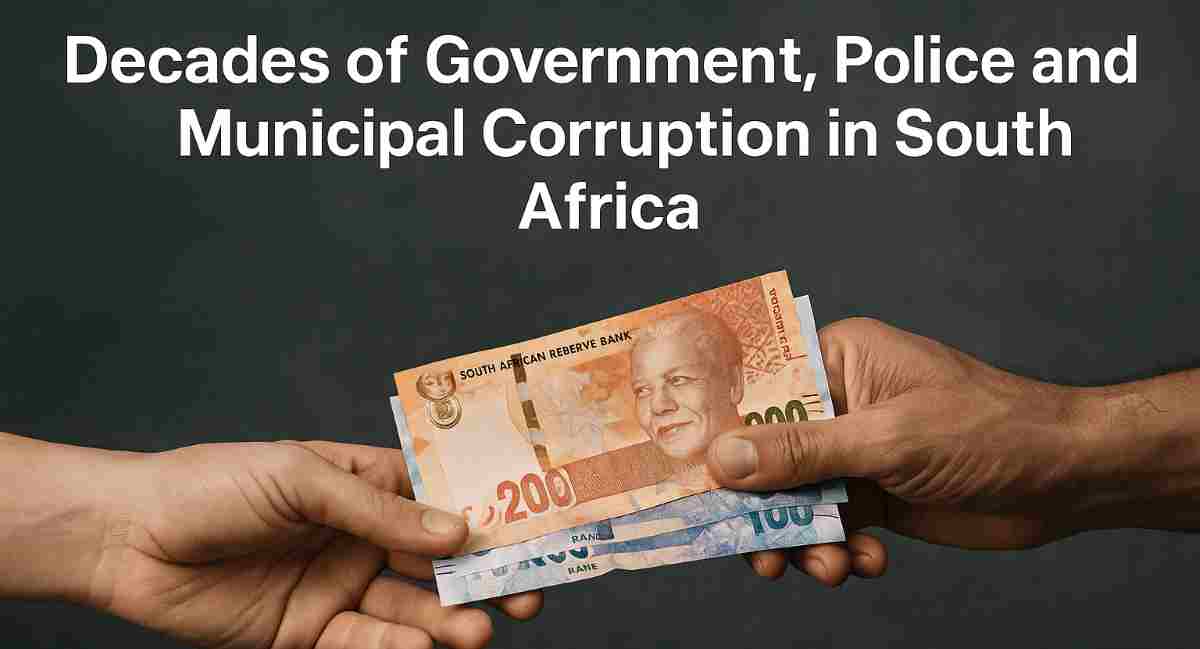
South Africa’s democratic journey since 1994 has been tarnished by a relentless scourge: corruption. Just looking from May 2005 to May 2025, this pervasive issue has infiltrated government institutions, the South African Police Service (SAPS), and local municipalities, eroding public trust, siphoning taxpayer funds, and stalling socio-economic progress.

Drawing exclusively on official government sources, non-governmental organisations, and anti-corruption agencies, Newcastillian News examines the charges and convictions of corrupt police and government officials, South Africa’s global corruption ranking, and the staggering annual cost to taxpayers, with a spotlight on municipal corruption.
As you would expect, the evidence reveals a deeply entrenched problem.
Corruption, defined as the abuse of entrusted power for private gain, manifests through bribery, nepotism, and misappropriation of public funds. According to the Judicial Commission of Inquiry into Allegations of State Capture, known as the Zondo Commission, state capture—a systematic takeover of state institutions for private benefit—thrived during former President Jacob Zuma’s tenure (2009–2018). As reported by the South African Government website, nearly R50 billion ($3.3 billion) flowed from government coffers to entities linked to the Gupta family (South African Government; Al Jazeera), and this is just the tip of the iceberg when looking at the overall problem.
The South African Police Service (SAPS) is equally afflicted. As reported by the Institute for Security Studies, the disbandment of the SAPS Anti-Corruption Unit in 2002 weakened efforts to combat police corruption, eroding public faith (ISS). According to SAPS in a 2020 presentation to Parliament’s Standing Committee on Public Accounts, 397 corruption cases involving police officers were under investigation, with over 257 officers arrested (Parliamentary Monitoring Group).
As noted by the Independent Police Investigative Directorate (IPID), bribery is a significant issue, with 28.9% of officers reportedly accepting bribes to destroy dockets or ignore crimes (De Jure Study).
However, according to Corruption Watch, South Africa’s chapter of Transparency International, SAPS is one of the most complained-about institutions, with bribery constituting 31% of police-related allegations (Corruption Watch).
Government institutions, including schools, municipalities, and state-owned enterprises (SOEs), face similar challenges. As reported by the University of Pretoria’s De Jure study (2025), 44% of SOE procurements are irregular, with 20.3% involving bribery, such as funding lavish lifestyles for officials (De Jure Study). High-profile scandals, like the 2004 Oilgate affair—where R11 million was diverted from PetroSA to the African National Congress (ANC)—and the Strategic Defence Package (arms deal) costing billions, underscore the scale of mismanagement, as noted on Wikipedia (Wikipedia).
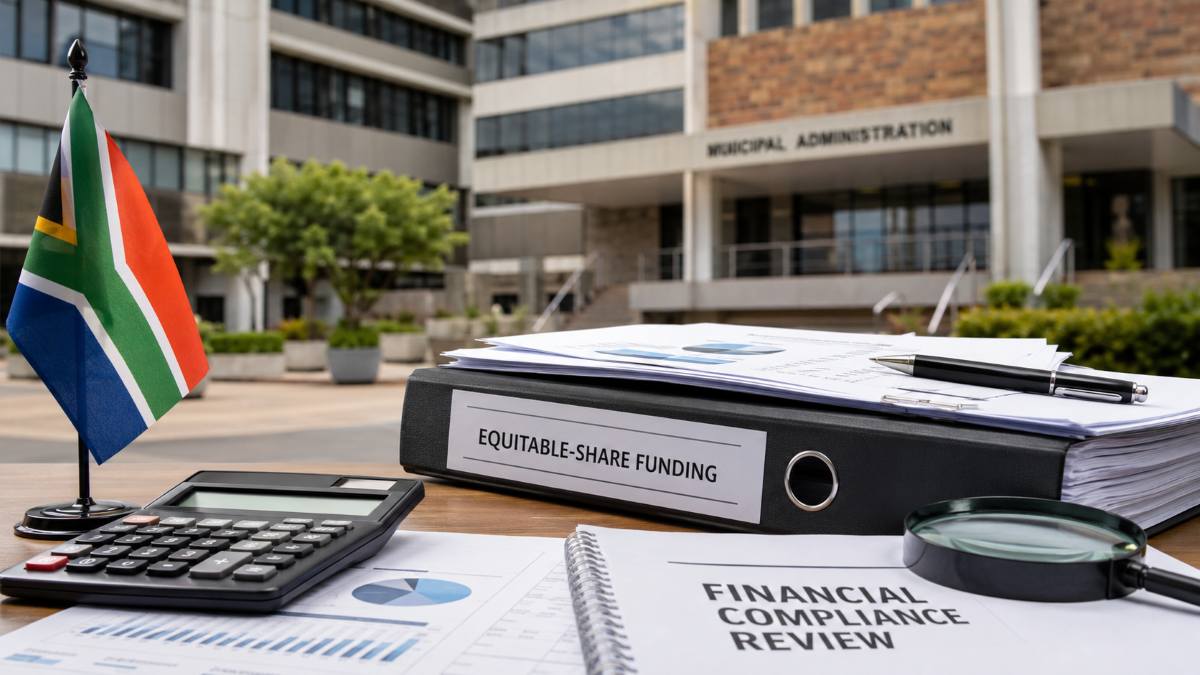
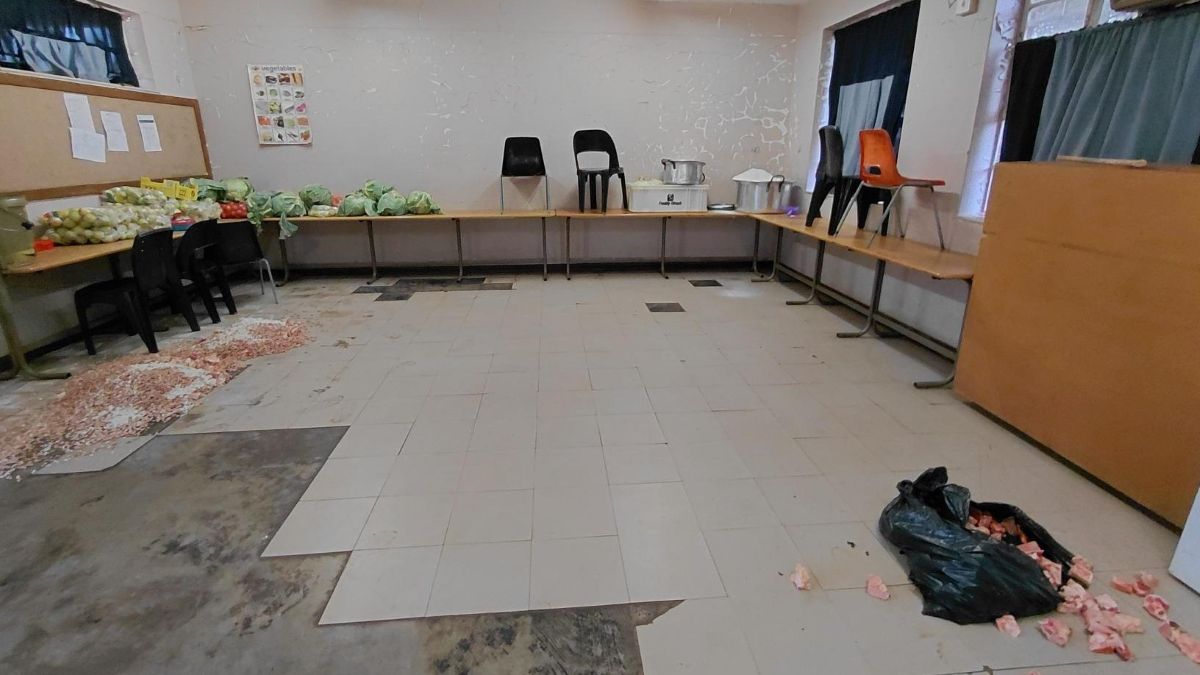
Furthermore, municipal corruption is particularly devastating, directly impacting service delivery and public trust. According to the Auditor-General of South Africa (AGSA), only 34 out of 257 municipalities received clean audits in 2022/23, with 36 regressing since 2020-21 and 14 receiving disclaimed opinions due to severe irregularities (AGSA).
As reported by Moonstone, metropolitan municipalities like Johannesburg, Tshwane, Cape Town, eThekwini, and Ekurhuleni account for 51% of local government corruption cases, with Gauteng leading at 45% of complaints, followed by KwaZulu-Natal (11%), Western Cape (9%), and Eastern Cape (8%) (Moonstone). It is important to remember, that these are just the reported cases.
Specific cases highlight the severity:
- In Alfred Nzo Local Municipality, R38 million was allegedly stolen in 2008, but the case disappeared from the roll, and another case involved the loss of R25 million with unclear investigation progress, as reported by the Parliamentary Monitoring Group (Parliamentary Monitoring Group).
- In Emalahleni Local Municipality, the Mayor allegedly increased salary upper limits without proper resolution, while in Dr JS Moroka Local Municipality, the Mayor was accused of misusing R223,000 for personal expenses like fuel and toll gates, as noted by the Parliamentary Monitoring Group (Parliamentary Monitoring Group).
- The Makhado Local Municipality paid a contractor R1.1 million for an uncompleted pool refurbishment without investigation, according to the Parliamentary Monitoring Group (Parliamentary Monitoring Group).
- In eThekwini, a corruption case against the former Mayor involving R320 million in fraud and racketeering has faced delays, while Buffalo City and Mokgalakwena saw officials arrested, as reported by the Parliamentary Monitoring Group (Parliamentary Monitoring Group).
- The Knysna Local Municipality faced scrutiny when its Municipal Manager resigned twice and was appointed at Cederberg, as noted by the Parliamentary Monitoring Group (Parliamentary Monitoring Group).
- In Dr Ruth Segomotsi Mompati District Municipality, R582 million of R697 million from the national fiscus was unaccounted for, as reported by Good Governance Africa (GGA).
- In Tshwane, a questionable chief of staff appointment cost R1.2 million annually, and the VBS Mutual Bank scandal saw municipal deposits misused, according to Good Governance Africa (GGA).
As reported by Good Governance Africa, municipal corruption diverts funds from essential services like water and electricity, exacerbating poverty and increasing taxpayer burdens (GGA).
Efforts to combat corruption show mixed results, at best.
According to the State of the Nation Address (SONA) 2025, over 1,300 corruption convictions, including 500 government officials, were secured in the past four years, with the National Prosecuting Authority (NPA) enrolling 34 cases involving over 200 accused individuals and 65 entities, including former Ministers and corporations like McKinsey and ABB (SONA 2025).
As reported by SONA 2025, ABB settled for over R2.5 billion in punitive reparations, adding to R6 billion paid to Eskom in 2020 (SONA 2025). According to the Institute for Security Studies, the Special Investigating Unit (SIU) froze R14 billion and recovered R11 billion in state capture cases (ISS Africa). As noted on Wikipedia, over 100 officials across sectors were arrested by November 2020, spurred by the Zondo Commission (Wikipedia). However, with corruption being a standard practice, one has to ask, are these convictions and cash recoveries nearly enough?
For police officials, SAPS reported 397 corruption cases under investigation in 2020, with over 257 officers arrested, concerningly though conviction numbers are unclear, as noted by the Parliamentary Monitoring Group (Parliamentary Monitoring Group). According to IPID, bribery investigations are ongoing, but comprehensive conviction data is lacking (IPID). Municipal cases, like those in Alfred Nzo and eThekwini, face delays in prosecution, as reported by the Parliamentary Monitoring Group (Parliamentary Monitoring Group).
High-profile cases include:
- Former President Jacob Zuma, charged with 12 counts of fraud, one of racketeering, two of corruption, and one of money laundering in the $2.5 billion arms deal, with charges reinstated in 2018, as reported on Wikipedia (Wikipedia).
- Former National Police Commissioner Jackie Selebi, convicted in 2010 for receiving R120,000 in bribes from Glenn Agliotti, as noted on Wikipedia (Wikipedia).
- A 2016 parliamentary fraud case implicating 435 MPs, with 50 plea-bargaining, as reported on Wikipedia (Wikipedia).
Challenges persist, with the Zondo Commission noting an “almost complete absence” of prosecutions under the Prevention and Combating of Corrupt Activities Act (PRECCA) since 2004 due to political interference, as reported by Pinsent Masons (Pinsent Masons).
According to the Institute for Security Studies, the DPCI struggles with complex cases as powerful actors exploit legal defenses (ISS Africa).
According to Transparency International’s 2024 Corruption Perceptions Index (CPI), South Africa ranks 82 out of 180 countries with a score of 41 out of 100, a decline from 43 in 2012, reflecting perceived public sector corruption (Transparency International).
As reported by Corruption Watch, this places South Africa alongside Burkina Faso and Kosovo as a “flawed democracy,” above the sub-Saharan African average of 33 but below the global average of 43 (Corruption Watch). According to the Afrobarometer 2024 survey, 83% of South Africans believe corruption has worsened, signaling deep public disillusionment (Afrobarometer). As noted by the Institute for Security Studies, the decline since 2009 highlights systemic governance issues (ISS Africa).
The financial toll of corruption is immense. According to Minister of Economic Development Ebrahim Patel in 2017, corruption costs South Africa’s GDP at least R27 billion annually, equivalent to US$1.7 billion, and results in 76,000 lost jobs (BusinessTech). Higher estimates suggest losses between R159 and R400 billion annually in illicit financial flows, as reported by the South African Government (South African Government).
According to the Zondo Commission, billions were lost to state capture, with R14.18 billion in assets frozen, as noted in SONA 2025 (SONA 2025).
Moreover, as reported by the University of Pretoria’s De Jure study, 44% of SOE procurements are irregular, costing tens of billions annually (De Jure Study). Municipal corruption exacerbates this, with the AGSA reporting R26 billion in irregular expenditure in 2022/23, totaling over R186 billion over a decade, as noted by Good Governance Africa (GGA). Examples include the PRASA locomotive purchase wasting millions and a R16.1 million advance payment for no work, as reported by GAN Integrity and Good Governance Africa (GAN Integrity; GGA).
According to Transparency International’s Global Corruption Barometer, 75 million sub-Saharan Africans pay bribes annually, with 22% of South African public service users reporting bribe payments, as per the Afrobarometer 2024 survey (Transparency International; Afrobarometer).
South Africa’s legal framework, including the Prevention and Combating of Corrupt Activities Act (PRECCA) and the Public Finance Management Act, mandates accountability, as reported by Norton Rose Fulbright (Norton Rose Fulbright). The country has ratified the United Nations and African Union Conventions Against Corruption, as noted by the De Jure study (De Jure Study). According to SONA 2025, the NPA’s Investigating Directorate has enrolled 34 cases, charging 202 individuals and 65 entities, with R14.18 billion in assets frozen (SONA 2025). The NPA Amendment Bill aims to establish a permanent anti-corruption unit, as reported by SONA 2025 (SONA 2025).
Lastly, the Zondo Commission recommended an independent anti-corruption agency, as reported by Al Jazeera (Al Jazeera). According to Transparency International, Corruption Watch’s ALAC empowers citizens to report corruption (Transparency International).
The NACS 2020-2030 and LGACS strengthen oversight, as reported by the South African Government and CoGTA (South African Government; CoGTA). However, according to the Institute for Security Studies, prosecutions lag due to legal loopholes and resource constraints (ISS Africa).
Taking the above into consideration, corruption in South Africa’s municipalities has crushed the hopes of ordinary citizens, leaving millions without basic services like water and electricity. As reported by Good Governance Africa, rampant fraud in places like Alfred Nzo and eThekwini robs communities of dignity, forcing families to endure poverty worsened by greedy officials (GGA). According to the Afrobarometer 2024 survey, 83% of South Africans see corruption growing, reflecting the anger of people betrayed by those meant to serve them (Afrobarometer).

South Africa must act to protect its people. According to Transparency International, tools like Corruption Watch’s ALAC let citizens fight back by reporting abuses (Transparency International). As noted by Al Jazeera, the Zondo Commission’s call for an independent anti-corruption agency could shield communities from further harm (Al Jazeera). The South African Government’s NACS 2020-2030 aims to restore resources to citizens, but it needs real enforcement to deliver justice (South African Government).
Reflecting on this, what are your thoughts on the above? Share your views in the comment section below,