


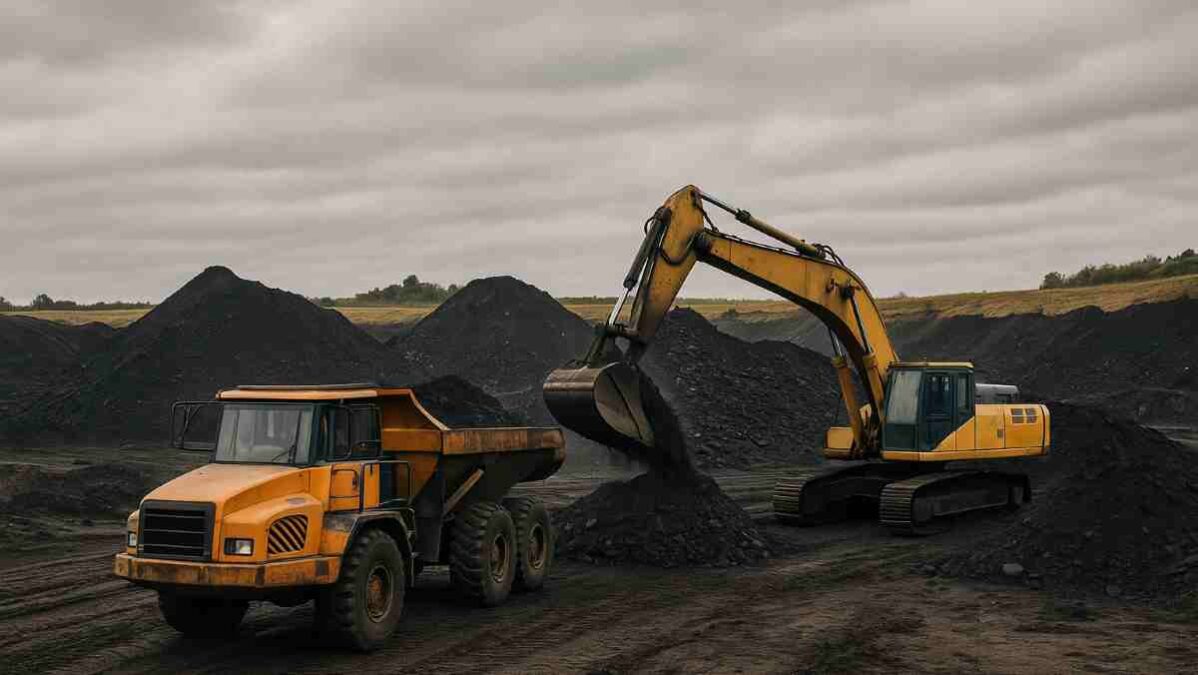
Mining has profoundly shaped South Africa’s economic, environmental, and social fabric—particularly in Limpopo, Gauteng, and KwaZulu-Natal (KZN). More than just a sector, mining is embedded in the nation’s history and development. Johannesburg is not called indawo yezinto (“place of things”)—it is Egoli, (the place of gold).

Now, with several mining companies seeking prospecting rights across Northern KwaZulu-Natal, residents find themselves at a crossroads. Communities are increasingly divided: some advocate for the potential job creation and economic benefits, while others warn of long-term harm to health, land, and livelihoods.
This article explores both sides of the debate, drawing on reliable sources and current data. It unpacks the impacts of mining across key areas: environmental degradation, health risks, economic contributions, employment, mine closures, exports, and the future of coal. The goal? To offer clarity via a brief conversation.
Environmental Impacts Across Provinces
Mining has inflicted considerable environmental damage across Limpopo, Gauteng, and KZN. According to the Federation for a Sustainable Environment (FSE), acid mine drainage (AMD) in Gauteng’s Witwatersrand Basin affects 124 square miles of water resources, threatening Johannesburg’s water supply and posing health risks like kidney damage from uranium exposure.
To read more, click here – FSE Report.
Moreover, in Limpopo, a 2024 study published in the Journal of the Southern African Institute of Mining and Metallurgy reveals that copper and phosphate mining in the Phalaborwa Igneous Complex contaminates water sources, leading to livestock fatalities and agricultural losses.
To read more, click here – Limpopo Study.
In KZN, the Mfolozi Community Environmental Justice Network reports that coal mining in Somkhele pollutes the Mfolozi River with coal dust and runoff, adversely affecting fishing and farming livelihoods.
To read more, click here – Mfolozi Network.
Air pollution remains a pressing concern. In Gauteng, a 2017 BMC Public Health study found that dust from gold mine tailings, laden with silica and uranium, elevates the incidence of respiratory diseases such as silicosis (BMC Public Health Study). In KZN, a 2018 Human Rights Watch report states that coal dust in Somkhele causes asthma in children (Human Rights Watch Report). In Limpopo, platinum mining dust in Mokopane compromises rural air quality, as highlighted in a 2024 mine closure risk study.
To read more, click here – Mine Closure Study in SA.
Furthermore, land degradation and biodiversity loss are pervasive, with approximately 5,700 derelict mines nationwide. In Gauteng, gold mine tailings trigger sinkholes. In Limpopo, platinum mining in the Bushveld Complex endangers the black rhino. In KZN’s titanium mining disrupts coastal wetlands, according to a 2022 Human Rights Watch report (Human Rights Watch Report).
Additionally, a 2022 Frontiers study underscores that coal mining exacerbates climate-driven droughts, intensifying water scarcity in Limpopo (Frontiers Study). Additionally, the SAHRC Annual Report 2018-19 notes that pre-1991 mining left a toxic legacy of asbestos and coal pollution in KZN and gold pollution in Gauteng (SAHRC Annual Report 2018-19).
However, it is undeniable that mining underpins South Africa’s economy.
The Minerals Council SA states that in 2023, the sector contributed R483 billion (7.3%) to GDP and R882 billion (14% of GDP) in exports, with South Africa holding 90% of global PGM reserves (Minerals Council SA Facts and Figures 2024). By the way, it also accounts for 50% of Transnet’s rail and port volume.
As of Q3 2024, the African Mining Market reports 471,882 formal mining jobs, with Limpopo (110,319 jobs), Gauteng (69,965 jobs), and Mpumalanga (94,804 jobs) as key employment hubs (African Mining Market on Employment 2024). Initiatives like De Beers’ Venetia Underground in Limpopo generate employment, though job losses in gold and coal sectors threaten livelihoods.
Moreover, the Minerals Council SA notes that mining attracted R93 billion (17% of private sector investment) in 2018, but policy uncertainty and rail inefficiencies hinder FDI (Minerals Council SA Facts and Figures 2024). Limpopo’s Waterberg PGM Project and KZN’s Richards Bay Minerals remain focal points for foreign direct investment.
The Department of Mineral Resources and Energy (DMRE) estimates approximately 230 operational mines in 2024, spanning Gauteng (gold, uranium), Limpopo (platinum, diamonds, copper), and KZN (coal, titanium) (DMRE Operating Mines Directory).
A 2021 Journal for Transdisciplinary Research study reports 2,787 closed coal, gold, and base metal mines, with 799 closure certificates granted from 2011–2016, mostly for small-scale sites (Mine Closure Study in SA). The DMRE’s 2021 National Mine Closure Strategy estimates rehabilitation costs at R500 million annually, significantly below the R100 billion required for 6,000 derelict mines over 800 years (Journal for Transdisciplinary Research Study).
According to data, closures stem from depleted reserves, escalating costs, low commodity prices, and environmental liabilities.
Additionally, the Minerals Council SA reports R780.7 billion in mineral exports in 2023, down 11.4% from 2022 (Minerals Council SA Facts and Figures 2024). South Africa, the world’s third-largest coal exporter, channels 40% of its production to over 30 countries, with Asia (71.7%, India 39.3%) and Europe (14.7%) as primary markets. Richards Bay Coal Terminal facilitates over 90% of coal exports.
This means that the industry as a whole is not just a player in the South African economy, but rather a major pillar holding up more than many realise, regardless of its challenges. It also clearly holds the potential for growth, but it is now about finding a balance between profit, conservation and strict mining practices.
On this note, a 2022 ScienceDirect study highlights South Africa’s lithium and PGM reserves as critical for battery and hydrogen fuel cell markets, necessitating investment in beneficiation (ScienceDirect on Mining Cities). The Department of Energy’s 2024 Renewable Energy Independent Power Producer Procurement Programme (REIPPPP) has generated employment in Mpumalanga, with potential expansion in KZN (Department of Energy REIPPPP). Exxaro’s reskilling initiatives in Mpumalanga transition coal miners to solar projects, as noted in a 2023 Energy Policy study (Energy Policy Study). In other words,
And when taking a step out of SA, the Natural Resource Governance Institute (2022) observes that Chile’s copper revenue tax funds robust social programs, contrasts with South Africa’s current limited redistribution (NRGI Report). Australia’s stringent closure regulations minimise derelict mines, unlike South Africa’s 5,700 unrehabilitated sites, per a 2021 Resources Policy study (Resources Policy Study). Canada’s community benefit agreements with Indigenous groups offer a model for Limpopo and KZN, according to a 2023 Extractive Industries and Society study (Extractive Industries Study).
Reflecting on the above, the mining sector in South Africa embodies a complex interplay of economic profits and costs. The persistent challenges of environmental degradation, health crises, and corporate accountability to ensure communities are not left bearing the brunt of exploitation, needs to be a key focus.
As regions like Northern KZN face various new mining proposals, prioritising sustainable practices and equitable benefit-sharing is critcal to breaking the cycle of historical inequities.
This means, that those who apose and those who are pro mines, ironcially need to find common, reasonable ground in order to present a united front on what is expected when these proposals are tabled.

Nevertheless, South Africa’s strategic mineral reserves and renewable energy potential offer a transformative opportunity to redefine the industry’s legacy. By investing in beneficiation, reskilling workers, and adopting global best practices, the nation can forge a path towards inclusive growth, balancing economic advancement with the well-being of its communities and the preservation of its natural heritage.
With the above in mind, what are your thoughts?
Key Citations
- FSE Report
- Limpopo Study
- Mfolozi Network
- Frontiers Study
- SAHRC Annual Report 2018-19
- Minerals Council SA Facts and Figures 2024
- African Mining Market on Employment 2024
- DMRE Operating Mines Directory
- Mine Closure Study in SA
- Stanford Report on Mining Legacy
- ScienceDirect on Mining Cities
- BMC Public Health Study
- Human Rights Watch Report
- Occupational Medicine Study
- ActionAid SA Report
- Land Use Policy Study
- African Health Sciences Study
- Department of Energy REIPPPP
- Energy Policy Study
- NRGI Report
- Resources Policy Study
- Extractive Industries Study
- Journal of Cleaner Production Study
- EnvJusticeSA X Post







2 Responses
Yes they are mining,, the authorities must come for site visit not to give rights to mine only. This trucks are distroying all the roads and our Newcastle municipality is quiet about tht, grazing areas are affected. People of Newcastle must stand up for their rights,in some areas they weren’t going to do as they are doing
There two benefits about mining in amajuba,depends which view are looking at,either disadvantage or advantage. These mines when making applications they promise good jobs to African SME. During operation time, only white big companies take everything even that 30% promised to be allocated for African smaller companies. What is the greed about these companies? Those companies failed to comply must be not given permits to mine, but if already given must be withdrawn due to misuse of rights given to them.