


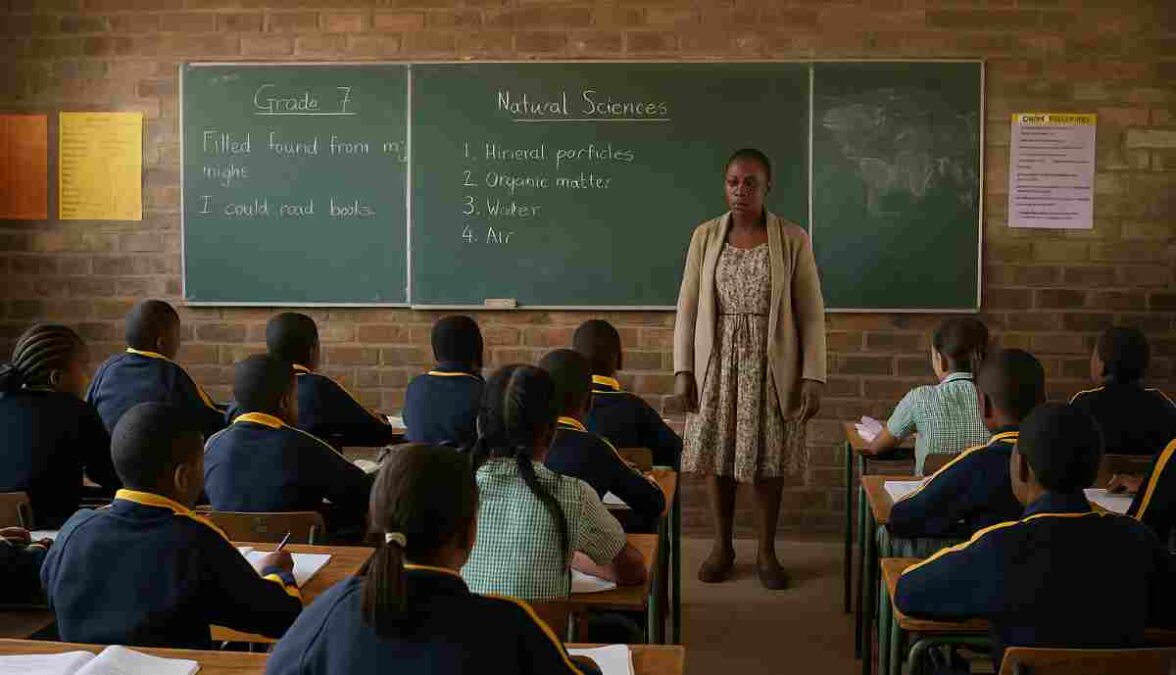
South Africa’s Grade 7 classrooms brim with ambition under the CAPS curriculum, yet a pressing question looms: can they master reading, critical thinking, and global competitiveness on par with peers in the United States, England, Germany, or Norway? Or even match the progress of neighbouring African countries like Kenya and Zimbabwe, who maximise modest budgets? With 81% of Grade 4 learners unable to read for meaning and schools grappling with shortages of books and teachers, South Africa’s lofty educational aspirations often ring hollow. This analysis delves into the reality—prepare for a sobering journey.

This analysis scrutinises the government education standards for Grade 7 students in South Africa, focusing on literacy, critical thinking, and digital literacy skills as delineated in the Curriculum and Assessment Policy Statement (CAPS).
It juxtaposes these standards and outcomes with those of four first-world nations—the United States, England, Germany, and Norway—and four neighbouring African countries—Kenya, Botswana, Eswatini (formerly Swaziland), and Zimbabwe.
Drawing on authoritative sources, including national curricula, international assessments (PISA, TIMSS, PIRLS), and recent 2024–2025 reports, the analysis illuminates expectations, outcomes, systemic challenges, recent policy interventions, and student/teacher perspectives to offer a comprehensive overview of the situation.
South Africa: Grade 7 Education Standards
Curriculum and Expectations
According to the South African Department of Basic Education (DBE), Grade 7 forms part of the Senior Phase (Grades 7–9) under the CAPS curriculum, crafted to foster foundational skills for advanced learning. Core subjects encompass Home Language, First Additional Language (typically English), Mathematics, Natural Sciences, Social Sciences, and Life Orientation, with explicit objectives for literacy, critical thinking, and nascent digital competencies.
Literacy:
Home Language: Students are tasked with reading and dissecting diverse texts, such as novels, short stories, poems, and informational articles. They must discern themes, summarise content, and infer meaning. Writing assignments include narrative essays, argumentative texts, and reports (200–300 words), employing precise grammar and vocabulary. Oral proficiency is honed through delivering presentations and engaging in debates.
First Additional Language: Students tackle simpler texts, compose short essays (150–200 words), and participate in conversations, prioritising comprehension and expression. According to the DBE CAPS Home Language document (2011), students must “interpret texts critically” and “use language structures effectively.”
Example:Students might analyse a short story to explore character motivations or draft a letter articulating an opinion on climate change.
Critical Thinking:
Critical thinking permeates the curriculum. In Social Sciences, students assess historical events (e.g., apartheid) and geographical phenomena (e.g., urbanisation) to formulate evidence-based conclusions. In Natural Sciences, they devise simple experiments, interpret data, and propose hypotheses. Life Orientation underscores ethical decision-making and problem-solving.
According to the DBE CAPS Life Orientation document (2011), students should “demonstrate critical awareness of social and environmental issues” and “apply problem-solving skills to real-life scenarios.”
Example: In Natural Sciences, students might explore the impact of water pH on plant growth, necessitating hypothesis formulation and data analysis.
Digital Literacy:
According to the DBE’s 2024 Digital Learning Strategy, Grade 7 students are introduced to rudimentary ICT skills, such as using word processors and internet browsers for research. However, coding remains non-mandatory, and digital literacy is curtailed by infrastructural limitations.
Example: Students might use a shared computer to research a science topic, but access is often confined to one lesson per week.
Assessment: Assessment entails continuous evaluation through tests, projects, presentations, and classwork. The Systemic Evaluation Programme, reinstated in 2021, evaluates Grade 6 literacy and numeracy to guide Grade 7 interventions.
Challenges and Outcomes
According to the Progress in International Reading Literacy Study (PIRLS) 2021, 81% of South African Grade 4 learners could not read for meaning in any of the 11 official languages, a regression from 78% in 2016, signalling profound literacy deficits persisting into Grade 7. The 2030 Reading Panel Report (2024) estimates that merely 18% of Grade 4 learners can read for meaning, undermining Grade 7 comprehension and writing proficiency.
According to the Trends in International Mathematics and Science Study (TIMSS) 2019, South Africa ranked near the bottom among 39 countries for Grade 9 mathematics (389) and science (370) on a 500-point scale, with Grade 9 outcomes reflecting Grade 7 preparedness. Preliminary TIMSS 2023 data, cited by the DBE in 2024, indicate modest progress, with 42% of Grade 9 students achieving basic mathematics proficiency, yet critical thinking deficiencies persist.
According to the DBE’s 2023/24 Annual Report, systemic challenges include:
Infrastructure: 60% of schools lack adequate libraries, and 30% lack functional science laboratories, restricting hands-on learning. Only 15% of schools have computer laboratories, and 10% have reliable internet (Amnesty International, 2024).
Teacher Capacity: 20% of teachers lack formal CAPS training, particularly in rural areas, and only 60% receive annual professional development (DBE, 2024 Teacher Development Plan). A 2024 Stellenbosch University report highlights union resistance to teacher evaluations, diminishing accountability.
Socio-Economic Factors: 70% of students live in poverty, impacting attendance and preparedness. Parental engagement is low, with only 30% of parents in low-income areas participating in school activities due to work constraints and low adult literacy (4.7% functionally illiterate, World Literacy Foundation, 2024).
Dropout Rates: Only 37% of students who begin school complete Grade 12, with literacy and numeracy deficits contributing to early departures.
According to the World Literacy Foundation (2024), low literacy costs South Africa R119 billion annually due to diminished earning potential. A 2024 University of Pretoria study found that 25% of Grade 6 students cannot write coherent paragraphs, impeding Grade 7 performance. The DBE’s 2024 Systemic Evaluation reports that only 30% of Grade 6 students demonstrate basic problem-solving skills, constraining critical thinking readiness.
Student and Teacher Perspectives
According to a 2024 UNICEF South Africa report, Grade 7 students in rural areas describe challenges like “no books at home” and “teachers absent for weeks,” while urban students cite overcrowded classrooms (40–50 students). Teachers express frustration with outdated materials and large class sizes, with one reporting, “I can’t teach critical thinking when half my students can’t read” (DBE, 2024). These perspectives underscore systemic barriers to literacy and critical thinking development.
Comparison with First-World Countries
United States
Curriculum and Expectations:
According to the Common Core State Standards (CCSS, 2010), Grade 7 students engage with complex texts (e.g., The Giver, scientific journals), analysing themes, author’s intent, and evidence. They produce argumentative essays (500–700 words) and research reports, citing sources. Speaking and listening skills encompass debates and multimedia presentations.
In mathematics, students master ratios, proportions, and introductory algebra, applying these to practical problems. Science prioritises inquiry-based learning (e.g., ecosystem experiments).
Critical thinking is explicit: CCSS ELA standards require students to “evaluate arguments” and “synthesize multiple sources.”
Digital literacy is embedded, with 70% of Grade 7 students accessing coding programmes (e.g., Code.org) and evaluating online sources, per NCES (2024).
Example: Students might debate renewable energy, citing data from digital sources, and code a simple programme to model energy use.
Outcomes:
According to PISA 2022, U.S. 15-year-olds scored 504 in reading, 465 in mathematics, and 499 in science (OECD averages: 476, 472, 485).
According to the National Assessment of Educational Progress (NAEP) 2024, 32% of Grade 8 students were proficient in reading, and 30% in mathematics. NCES (2024) reports 85% of Grade 7 students meet basic reading benchmarks, but only 50% demonstrate advanced critical analysis.
Digital literacy is robust, with 80% of students proficient in online research (NCES, 2024).
Teacher Capacity and Parental Involvement:
NCES (2024) reports 95% of teachers are certified, with 40 hours of annual professional development. Parental engagement is high (70% attend school meetings), with PTAs funding extracurriculars in 80% of schools, though low-income areas see 40% engagement.
Student and Teacher Perspectives:
NCES (2024) surveys show Grade 7 students value project-based learning but seek more real-world applications. Teachers report needing enhanced digital training to bolster critical thinking lessons.
England
Curriculum and Expectations:
According to the UK Department for Education’s National Curriculum (2014), Key Stage 3 (ages 11–14, including Grade 7 equivalent) mandates reading pre-20th-century literature (e.g., Shakespeare) and modern texts, analysing language and context. Students craft extended essays (600–800 words) and creative pieces.
Critical thinking involves evaluating arguments in English, analysing data in science, and debating historical perspectives (e.g., Industrial Revolution).
Computing is compulsory, with Grade 7 students learning algorithms and digital safety, per Ofsted (2024).
Example: Students might analyse a poem’s imagery, code a simple game, and present a critique linking to historical context.
Outcomes:
According to PISA 2022, England’s 15-year-olds scored 496 in reading, 489 in mathematics, and 503 in science.
Ofsted (2024) reports 80% of Key Stage 3 students achieve literacy standards, with 60% demonstrating advanced critical thinking. Digital literacy is near-universal, with 90% proficiency in basic coding.
Disadvantaged areas show 30% of students below benchmarks.
Teacher Capacity and Parental Involvement:
Ofsted (2024) notes 98% of teachers are trained, with 50 hours of professional development required. Parental engagement is 65%, with community reading programmes in 90% of schools.
Student and Teacher Perspectives:
Ofsted (2024) cites students enjoying diverse texts but wanting more creative writing. Teachers value professional development but seek additional digital resources.
Germany
Curriculum and Expectations:
According to the German Standing Conference of the Ministers of Education (KMK, 2020), Grade 7 in Gymnasium mandates reading complex texts in German and English, writing analytical essays (400–600 words), and debating. Multilingualism is prioritised (English/French).
Critical thinking is fostered through interdisciplinary projects (e.g., sustainability) and scientific inquiry (e.g., physics experiments).
Digital competence is integrated, with 80% of schools offering coding electives (KMK, 2024).
Example: Students might research renewable energy, code a data visualisation, and debate policy implications.
Outcomes:
According to PISA 2022, Germany’s 15-year-olds scored 480 in reading, 475 in mathematics, and 492 in science.
KMK (2024) reports 90% of Grade 7 students meet literacy benchmarks, 70% excel in project-based critical thinking, and 85% are digitally proficient. Immigrant students score 15% lower.
Teacher Capacity and Parental Involvement:
KMK (2024) mandates continuous professional development, with 90% of teachers participating. Parental engagement is 75%, with community centres supporting literacy.
Student and Teacher Perspectives:
KMK (2024) notes students appreciate projects but request more digital tools. Teachers value interdisciplinary training but seek enhanced support for immigrant students.
Norway
Curriculum and Expectations:
According to the Norwegian Directorate for Education and Training, the Knowledge Promotion Curriculum (LK20, 2020) emphasises reading comprehension across genres, writing persuasive texts, and oral communication. Digital literacy is central, with students analysing online sources and using platforms like Feide.
Critical thinking requires students to “question sources critically” and “solve interdisciplinary problems” in social studies and science.
Example: Students might evaluate a climate change article’s credibility, code a model, and propose solutions in a group project.
Outcomes:
According to PISA 2022, Norway’s 15-year-olds scored 478 in reading, 468 in mathematics, and 490 in science.
Norwegian Directorate (2024) reports 95% of Grade 7 students achieve literacy, 80% demonstrate critical thinking, and 95% are digitally proficient. Low student-to-teacher ratios (10:1) bolster outcomes.
Teacher Capacity and Parental Involvement:
All teachers are certified, with 60 hours of professional development annually (Norwegian Directorate, 2024). Parental engagement is 85%, with public libraries (1 per 5,000 people) enhancing reading.
Student and Teacher Perspectives:
Students praise inclusive classrooms and digital learning, while teachers value professional development but seek more special needs training (Norwegian Directorate, 2024).
Comparison with Neighbouring African Countries
Kenya
Curriculum and Expectations:
According to the Kenya Institute of Curriculum Development (KICD), Grade 7 under the Competency-Based Curriculum (CBC, 2019) focuses on literacy through reading comprehension, creative writing, and oral skills in English and Kiswahili. Students read novels and produce written responses (200–300 words).
Critical thinking is embedded in project-based learning (e.g., community projects) and problem-solving in Integrated Science.
Digital literacy is introduced, with 50% of urban students accessing e-learning platforms (KNEC, 2024).
Example: Students might design a water conservation project and present findings digitally.
Outcomes:
According to SACMEQ IV (2013), Kenya outperformed South Africa in Grade 6 literacy (70% proficient).
UNESCO (2024) reports an 85% youth literacy rate, and KNEC (2024) notes 75% of Grade 6 students meet CBC literacy benchmarks, suggesting Grade 7 readiness.
Digital literacy is limited to urban areas, with 30% overall proficiency.
Teacher Capacity and Parental Involvement:
KICD (2024) trains 80% of teachers in CBC, with annual workshops. Parental engagement is 50%, with community radio promoting literacy.
Student and Teacher Perspectives:
KNEC (2024) cites students valuing projects but needing textbooks. Teachers report CBC training improves pedagogy but seek more resources.
Botswana
Curriculum and Expectations:
According to the Botswana Ministry of Basic Education, Grade 7 students read texts in Setswana and English, writing essays (250–350 words). Critical thinking involves science experiments and social studies analysis.
Basic ICT is introduced, but only 20% of schools have computers (UNESCO, 2024).
Example: Students might analyse tourism’s economic impact and propose sustainable practices.
Outcomes:
SACMEQ IV reports 65% Grade 6 reading proficiency. UNESCO (2024) notes 88% adult and 92% youth literacy.
Digital literacy is low, with 15% proficiency (Ministry of Education, 2024).
Teacher Capacity and Parental Involvement:
85% of teachers are trained, with retention incentives (Ministry of Education, 2024). Parental engagement is 60%, with village committees supporting schools.
Student and Teacher Perspectives:
Students enjoy experiments but lack laboratory access; teachers seek more ICT training (Ministry of Education, 2024).
Eswatini
Curriculum and Expectations:
According to the Eswatini Ministry of Education, Grade 7 students read siSwati and English texts, writing compositions (200–300 words). Critical thinking involves science and social studies inquiry.
Digital literacy is minimal, with 10% of schools equipped (Ministry of Education, 2024).
Example: Students might debate urbanisation’s impact, using local data.
Outcomes:
SACMEQ IV reports 68% Grade 6 reading proficiency. UNESCO (2024) notes 87% youth literacy.
Ministry of Education (2024) reports 70% of Grade 7 students meet literacy benchmarks.
Teacher Capacity and Parental Involvement:
75% of teachers are trained; parental engagement is 45% (Ministry of Education, 2024).
Student and Teacher Perspectives:
Students report language barriers in English; teachers need more training (Ministry of Education, 2024).
Zimbabwe
Curriculum and Expectations:
According to the Zimbabwe Ministry of Primary and Secondary Education, Grade 7 students read English and indigenous language texts, writing essays (250–400 words). Critical thinking is emphasised in Heritage Studies and science.
ICT is aspirational, with 5% of schools offering digital tools (ZIMSTAT, 2024).
Example: Students might investigate soil erosion and present solutions.
Outcomes:
SACMEQ IV reports 81% Grade 6 reading proficiency. UNESCO (2024) notes 87% youth literacy.
ZIMSTAT (2024) reports 80% of Grade 7 students meet benchmarks.
Teacher Capacity and Parental Involvement:
90% of teachers are trained; community engagement is 70% (ZIMSTAT, 2024).
Student and Teacher Perspectives:
Students value heritage studies but lack resources; teachers prioritise professional development (ZIMSTAT, 2024).
Recent Policy Interventions
South Africa: According to the DBE’s 2024/25 Budget Speech, new initiatives include:
- R2 billion for teacher training to address the 20% untrained rate.
- R1.5 billion for infrastructure, targeting 1,000 new libraries by 2027.
- The Reading Champions Programme, training 10,000 volunteers to boost Grade 4–7 literacy by 2030.
Impact: The 2030 Reading Panel (2024) projects a 10% literacy increase by 2027, though corruption risks remain (Stellenbosch University, 2024).
First-World Countries:
United States: The 2024 Every Student Succeeds Act reauthorisation funds literacy programmes ($2 billion) for low-income schools (NCES, 2024).
England: The 2024 Education Recovery Plan invests £1 billion in teacher training and digital tools (Ofsted, 2024).
Germany: The 2024 DigitalPakt Schule allocates €6.5 billion for digitalisation (KMK, 2024).
Norway: The 2024 Inclusive Education Plan funds special needs support (Norwegian Directorate, 2024).
African Neighbours:
Kenya: The 2024 CBC Scale-Up Plan invests $100 million in teacher training and e-learning, targeting 90% Grade 7 literacy (KICD, 2024).
Botswana: The 2024 Education Vision adds 500 computer laboratories, aiming for 80% digital literacy (Ministry of Education, 2024).
Eswatini: The 2024 Literacy Boost Programme trains 1,000 teachers, targeting 85% Grade 7 literacy (Ministry of Education, 2024).
Zimbabwe: The 2024 Education Recovery Plan prioritises teacher incentives, aiming for 90% literacy (ZIMSTAT, 2024).
Synthesis and Key Differences
South Africa vs. First-World Countries
Literacy:
Curriculum: South Africa’s CAPS aligns with first-world standards, requiring Grade 7 students to read complex texts, write coherently, and communicate effectively, akin to CCSS (U.S.) or LK20 (Norway). For example, CAPS’ text analysis mirrors England’s literary critique.
Outcomes: South Africa’s 81% Grade 4 illiteracy rate (PIRLS 2021) and 18% Grade 4 proficiency (2030 Reading Panel, 2024) contrast with first-world rates: U.S. (85% Grade 7 reading), England (80%), Germany (90%), Norway (95%). PISA 2022 reading scores (478–504) far exceed South Africa’s estimated <300.
Gaps: First-world countries benefit from consistent instruction, well-resourced schools, and high parental engagement (65–85% vs. South Africa’s 30%). South Africa’s literacy crisis, exacerbated by COVID-19 closures (Motshekga, 2023), reflects inadequate reading instruction.
Critical Thinking:
Curriculum: CAPS integrates critical thinking, akin to Germany’s project-based learning or Norway’s problem-solving focus.
Outcomes: First-world countries excel (Germany: 70% project proficiency, Norway: 80% problem-solving) due to pedagogies like flipped classrooms. South Africa’s 30% Grade 6 problem-solving rate (DBE, 2024) limits Grade 7 readiness.
Gaps: Smaller class sizes (Norway: 10:1, Germany: 15:1 vs. South Africa: 33:1) and trained teachers (98–100% vs. 80%) drive first-world outcomes.
Digital Literacy:
South Africa’s 15% computer laboratory access and 10% internet connectivity (DBE, 2024) lag behind Norway (95% digital proficiency), Germany (85%), and the U.S. (80%). England’s mandatory computing ensures 90% coding skills. South Africa’s lack of coding in CAPS hinders 21st-century skills, critical for global competitiveness.
Resources and Equity:
First-world countries invest heavily (Norway: 6.7% GDP, U.S.: 5.7%) with robust teacher training (40–60 hours professional development) and parental support. South Africa’s 6% GDP is substantial but inefficient due to corruption, infrastructure gaps (60% no libraries), and low parental engagement (30%).
South Africa vs. Neighboring African Countries
Literacy:
Curriculum: CAPS’ multilingual focus aligns with Kenya’s CBC and Zimbabwe’s Competence-Based Curriculum, emphasising reading and writing.
Outcomes: South Africa’s 27% Grade 6 literacy (SACMEQ IV) trails Kenya (70%), Botswana (65%), Eswatini (68%), and Zimbabwe (81%). UNESCO (2024) confirms neighbours’ higher youth literacy (85–92% vs. 81% Grade 4 reading).
Gaps: Neighbours achieve more with less (Kenya: $258 per pupil vs. South Africa: $1,225), leveraging teacher training (80–90% trained) and community support (45–70%).
Critical Thinking:
Curriculum: All emphasise projects and problem-solving, but neighbours’ stronger literacy enables better outcomes.
Outcomes: Kenya’s 75% Grade 6 problem-solving (KNEC, 2024) and Zimbabwe’s 80% Grade 7 benchmarks outpace South Africa’s 30% (DBE, 2024).
Gaps: Smaller class sizes (Kenya: 25:1, Botswana: 20:1) and infrastructure (Botswana: 20% computer laboratories vs. South Africa: 15%) aid neighbours.
Digital Literacy:
Kenya’s 50% urban e-learning and Botswana’s 20% computer access outpace South Africa’s 15%, though all lag behind first-world standards. Eswatini (10%) and Zimbabwe (5%) face similar constraints, but Kenya’s CBC digital focus shows promise.
Resources and Efficiency:
Botswana (19% GDP) and Eswatini (7%) invest heavily, while Kenya and Zimbabwe prioritise teacher training and community engagement (50–70%). South Africa’s 63% dropout rate and systemic issues (e.g., union influence, Stellenbosch University, 2024) reduce efficiency.
Student and Teacher Perspectives
South Africa’s students highlight resource scarcity (“no books,” UNICEF, 2024), unlike Norway’s praise for digital access or Kenya’s enthusiasm for projects. First-world teachers value professional development, while South African teachers lament systemic barriers. Neighbours’ teachers seek resources but report higher student motivation.
Policy Interventions
South Africa’s R3.5 billion 2024/25 investment in libraries and training is ambitious but trails Germany’s €6.5 billion digitalisation or the U.S.’s $2 billion literacy programs. Kenya’s $100 million CBC scale-up and Zimbabwe’s teacher incentives show efficiency. South Africa’s success hinges on addressing corruption and implementation gaps.
Furthermore, South Africa’s Grade 7 education system, despite its ambitious CAPS curriculum, ranks at the bottom among the countries examined, trailing far behind first-world nations like Norway, Germany, England, and the United States, where 80–95% of students achieve literacy and 60–80% excel in critical thinking.
Even more sobering, South Africa lags behind its African neighbours—Kenya, Botswana, Eswatini, and Zimbabwe—where 65–81% of students meet literacy benchmarks and policies stretch limited budgets further. With only 18% of Grade 4 students reading proficiently and systemic barriers like under-resourced schools holding firm, South Africa’s educational promise remains a distant goal, outpaced by both global leaders and regional peers who deliver more with less.
Yet, glimmers of hope emerge with South Africa’s R3.5 billion investment in teacher training and libraries, signalling a commitment to change. To climb the ranks, it must learn from Norway’s inclusive, tech-savvy classrooms and Zimbabwe’s resilient efficiency, tackling corruption and infrastructure gaps head-on. As students voice their frustration over “no books” and teachers grapple with overcrowded classrooms, the path forward demands urgency and accountability to ensure South Africa’s youth can one day compete on the world stage.

One would think education would be the number one prioroty for South Africa’s Goverment to reduce poverty while increasing the volume of educated people in the work force. However, this does not appear to be the result.
Nevertheless, what are your thoughts on the above? Share your views in the comment section below.
Sources used for Content:
- South African Department of Basic Education (DBE), CAPS Documents (Home Language, Life Orientation, 2011).
- DBE Annual Report 2023/24, 2024 Digital Learning Strategy, 2024/25 Budget Speech.
- DBE Systemic Evaluation 2024 Preliminary Results.
- Progress in International Reading Literacy Study (PIRLS) 2021.
- Trends in International Mathematics and Science Study (TIMSS) 2019, 2023 Preliminary.
- 2030 Reading Panel Report (2024).
- World Literacy Foundation, Economic Cost of Illiteracy (2024).
- PISA 2022 Results (OECD).
- U.S. Common Core State Standards (CCSS, 2010).
- National Center for Education Statistics (NCES), NAEP 2024, Education Surveys (2024).
- UK Department for Education, National Curriculum (2014).
- Ofsted Annual Report 2024.
- German Standing Conference of the Ministers of Education (KMK, 2020, 2024).
- Norwegian Directorate for Education and Training, LK20 Curriculum (2020), 2024 Report.
- Kenya Institute of Curriculum Development (KICD), CBC Framework (2019), 2024 Scale-Up Plan.
- Kenya National Examinations Council (KNEC) 2024.
- Botswana Ministry of Basic Education, Curriculum (2010), 2024 Updates.
- Eswatini Ministry of Education, Curriculum (2018), 2024 Report.
- Zimbabwe Ministry of Primary and Secondary Education, Competence-Based Curriculum (2015).
- Zimbabwe National Statistics Agency (ZIMSTAT), 2024.
- Southern and Eastern Africa Consortium for Monitoring Educational Quality (SACMEQ) IV (2013).
- UNESCO Institute for Statistics, World Education Statistics 2024.
- Amnesty International, South Africa Education Report (2020, 2024 Update).
- Stellenbosch University, Education Study (2024).
- University of Pretoria, Literacy Study (2024).
- UNICEF South Africa, Education Report (2024).








11 Responses
This is still a very seriously worrying trend. Not much positive movement is being made to address the noted sources of the existing challenges. We can no longer afford to subject our children to this level of educational achievements.
The needle must start shifting positively or else the comingeneratuins will never forgive us.
South Africans are too lazy and entitled to bother
I agree that oir systemic results for grade were depressing. However besides overcrowded classrooms where the ratio is way beyond 1:33. Its betwen 36-60 learners per class. Yes poverty, drug addicition, gang infested areas influence the school contexts and learner motivation as well teacher attendance. The recent budget cuts, letting 1000’s of teachers go, worsened the situation even further. The online registration is another schlep, it has resulted in learners livng within a 5km radius of the chosen school te be sent to a school outside their residential area adding to financial constraints for traveling, but children outside the local school radius are accepted from other areas mote than 10 km from the selected school. Now this is one of the factors that adds to the dropout rate. Fatigue, finances and safety concerns displaces learner motivation, concentration and parent involvement immensely. With every teacher training their comes more admin. (This explains why SA teachers are going to eastern countries as admin and discipline issues are minimal and they can teach effectively and efficiently with required resources and support. Not every school has teacher assistants. Learner defiance and a system that has removed corparal punishment/ discipline has disempowered teachers, whether teachers are assualted by learner and or their parents, the learners rights are priotised either way. The educator as a human too, rights does not seem to demand the same protection. Mamy schools have a large number of Years ts in Phase learners, that do not meet the benchmarks of the required grade, but because the cant repeat twice in a phase they must be progressed to the next class. Their
learning gaps get bigger as foundational critical thinking skills and literacy abilities are lacking due to development and cognitive delays, trauma and special needs etc. All of these micro and macro factors of the education system in SA affect the quality of the the results published inbthe media. Im on the ground on the Frontline not sucking this out of my thumb. I had to with my class dodge bullets at dismissal times. My learners had to wet their pants in class because it wasn’t safe to go the the toilet. (bullets flying outside). I personally had to dodge a bricks and stones thrown at me by learners to survive and am able to comment here today.
Comment on Calvin Swemmer’s article: “How South African Grade 7s Stack Against the World (It’s Scary)”
Thank you, Mr. Swemmer, and The Newcastillian News, for publishing such an important article on education. It’s refreshing to see a community platform from Newcastle—serving readers in areas like Utrecht, Vryheid, Dundee, and Greytown—tackling global benchmarks like PISA, PIRLS, and TIMSS.
These international tools are valuable in helping us reflect on our education system, and the comparisons to high-performing countries like the US, UK, and Norway are sobering. But we must be careful in how we interpret them. South Africa is a deeply unequal society, still carrying the weight of apartheid and governance challenges of the past 30 years—especially here in KwaZulu-Natal, where the provincial education department struggles under immense pressure.
More controversial is the comparison with fellow African countries like Kenya, Eswatini, Botswana, and Zimbabwe. While some may outperform South Africa on certain metrics, it’s worth asking what happens after that education. Many families in those countries encourage academic success not to build at home, but to escape—to South Africa or the global North. We may well be benchmarking ourselves against systems geared for departure, not development.
Meanwhile, the reality at home is dire. The latest PIRLS results show 81% of Grade 4s can’t read for meaning. That problem only deepens by Grade 7 and beyond. CAPS is overloaded, unevenly delivered, and poorly supported. In rural areas, digital literacy and coding—while essential—are almost impossible where there’s no electricity or internet.
Add to that “cohort progression” and weak discipline, and learners are often pushed up without mastering the basics. Many are traumatised by violence, poverty, and exploitation. Some labour just to earn a meal at home. Others come from child- or granny-headed households. And at school, younger teachers face burnout, resistance from peers, and no real performance management—thanks to union pressure.
We spend more per learner than many African peers, but without safety, digital access, accountability, or parental support, outcomes remain dismal. Even Elon Musk’s Starlink gives rural Mozambique free broadband. In South Africa, we’re told we can’t—ideology gets in the way of innovation.
Education is now a survival issue, not just a development one. Our universities receive learners with huge learning gaps—only 6% of working adults here have a degree. That’s a national emergency. And while we reflect on global comparisons, let’s ask: are we equipping learners to build here, or just survive long enough to flee?
This article opens an important debate. Thank you for giving it a broader audience.
Good day, Vusumuzi. Thank you for your positive and insightful feedback. Have a great day.
The problem is that in South Africa a politian who was never be in classroom situation be appointed to be a Minster of Education which which he will not even try to learn and understand the sector be the one who made law and decisions without involving the education on the ground.
The other problem is the throwing away of matured and experience teachers by compelling them to pension early for new youth teachers which they claim they have fresh mind while they need them to mentor the novice teachers.Another factor is the system of employment which consider cold drink than competent.
Firstly, I’m going to share this article as much as possible. It needs widespread reading.
Most of my comments have already been covered.
My experience is that the obsession that the govt system has with rules, regulations and complete-waste-of-time admin tasks is a big drain on teachers personal resources.
Every single year, the scenario of push-them-up repeats, over and over and over, yet the govt insists on persuing exactly the same strategies that didn’t produce the desired outcomes, again and again.
Well, not exactly the same, there are usually a further set of that favourite word ‘interventions’ to further dampen teachers enthusiasm and suck out whatever was left of their weekend time.
My opinion : the management of SA education is well and truly divorced from the realities in the trenches.
Policies are dictated by those who seem not to have spent a week actually teaching in a clasroom and completing all the other tasks required to get the job done in the last five years.
And second one, throwing around figures in billions of what will be spent on a.k.a thrown at ‘education’ .
My solution : replace 75% of the top layer education decision makers with real practicing teachers to rewrite the rules.
Then you’ll see a difference.
This article is no surprise to me. I am a Remedial Teacher who spent the last 13 years before retirement as a support structure in the mainstream. The curriculum is unfortunately part of the many other barriers to learning.
One would think that education would be at the forefront of priorities in our government. But it is not. And it hasnt been since they took over.
Might I offer a why?
As long as they keep the masses uneducated, they will stay in power longer. With education comes insight, and you wouldn’t need a lot of that to see that our government only cares for their own futures, not the country’s.
Who can take education seriously when they know that they will get monthly grants for survival even when they are uneducated, unemployed or otherwise? Free money is the cause for concern while the working class is impoverished with high rates and taxes. The situation is far from changing in South Africa.
Foundation phase teachers need to be taught HOW to teach reading. They also need further guidance on teaching reading in large classes (40-60) children. Reading material must be accessible to EVERY pupil to carry home so that they can practice what they’ve learnt in class(older siblings or neighbors can assist if parents are unable to). Progression to grade 4 should only take place when a child can read for meaning.