


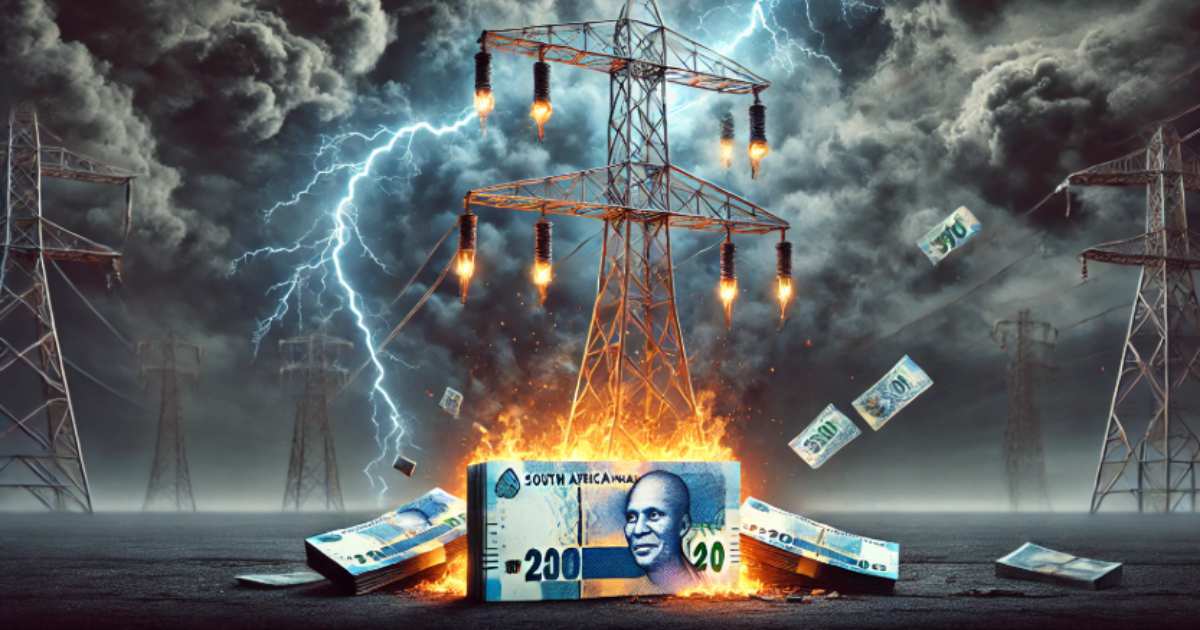
- NERSA has officially endorsed Eskom’s proposed tariff hikes, set to increase electricity costs for South Africans starting April 2025.
- The approved revenues for the fiscal years 2025/26, 2026/27, and 2027/28 are R384,610 million, R409,524 million, and R436,860 million respectively, reflecting percentage increases of 12.74%, 5.36%, and 6.19%.
- Eskom originally requested higher amounts for each year, but adjustments were made to balance consumer impact with Eskom’s financial sustainability.
- Despite the tariff approval, Eskom warns of potential load shedding, highlighting the ongoing challenges in maintaining power supply stability.

The National Energy Regulator of South Africa (NERSA) has officially endorsed Eskom’s proposed tariff hikes, which will compel South Africans to shell out more for electricity starting in April 2025.
In an official communique, NERSA declared that, based on comprehensive data analysis and the scrutiny of Eskom’s sixth Multi-Year Price Determination (MYPD6) revenue application for the fiscal years 2025/26, 2026/27, and 2027/28, the Energy Regulator, during its session on 30 January 2025, decided on:
- Approved revenues amounting to R384,610 million for the 2025/26 fiscal year, reflecting a percentage increase of 12.74%.
- Approved revenues of R409,524 million for the 2026/27 fiscal year, equating to a percentage increase of 5.36%.
- Approved revenues of R436,860 million for the 2027/28 fiscal year, which translates to a percentage increase of 6.19%.
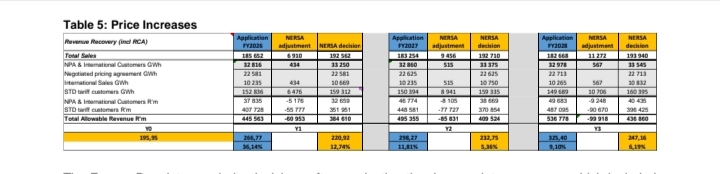
Furthermore, NERSA confirmed that Eskom’s revenue request for these years was R445,563 million, R495,355 million, and R536,778 million, respectively.
“Given this application, the suggested standard tariff escalations were forecasted at 36.15%, 11.81%, and 9.10% over the three years. Eskom lodged three distinct applications for the Generation Business, the National Transmission Company of South Africa (NTCSA), and the Distribution Business,” the energy regulator stated.
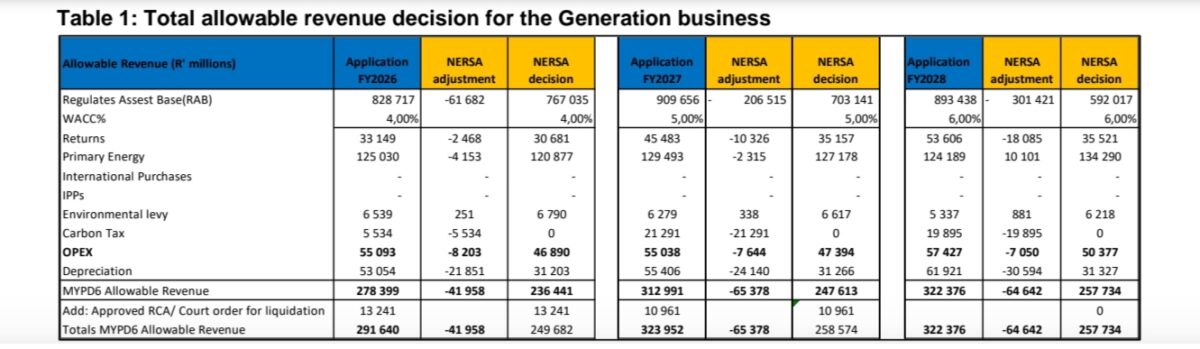
Table 1 below delineates the total allowable revenue decisions for the Generation business. NERSA clarified that for the 2025/26 fiscal year, the approved revenue stands at R249,682 million, after Eskom sought R291,640 million, with an adjustment of -R41,958 million. For 2026/27, the approved amount is R258,574 million from an application of R323,952 million, adjusted by -R65,378 million. For 2027/28, R257,734 million was approved from an application of R322,376 million, adjusted by -R64,642 million.
Moreover, Table 2 outlines the total allowable revenue decisions for NTCSA. NERSA’s approved revenue for the 2025/26 fiscal year comes to R95,593 million, after an application for R100,526 million was adjusted by -R4,933 million. For 2026/27, the approval is R109,289 million from R114,878 million, with an adjustment of -R5,589 million. In 2027/28, R135,048 million was sanctioned from an application of R154,994 million, adjusted by -R19,946 million.
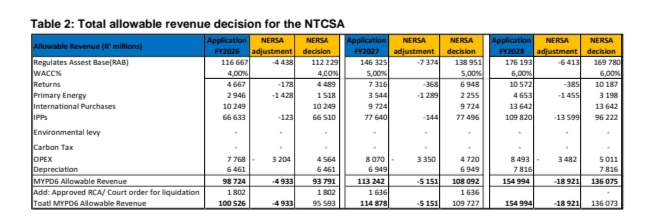
Table 3 presents the total allowable revenue decisions for the Distribution business. The approved revenue for the 2025/26 fiscal year is R39,334 million, following an application for R53,396 million, adjusted by -R14,063 million. For 2026/27, R41,223 million was approved from R56,526 million, with an adjustment of -R15,302 million. NTCSA’s approved revenues are bound by stringent revenue and budget constraints, including mandatory reporting on budget utilization to NERSA, according to the MYPD methodology. The 2027/28 fiscal year’s approved revenue is R43,052 million.
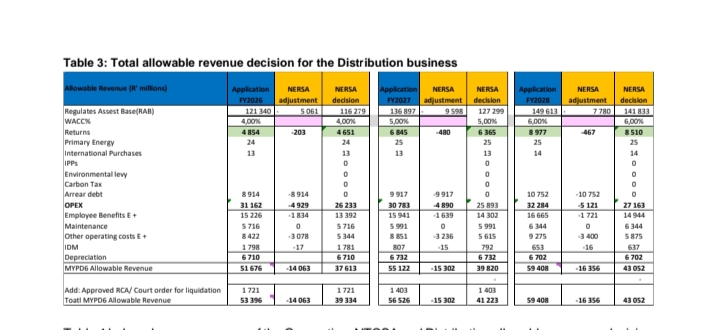
Table 4 summarises the allowable revenues for Generation, NTCSA, and Distribution. NERSA approved R384,610 million, R409,524 million, and R436,860 million for the respective fiscal years.
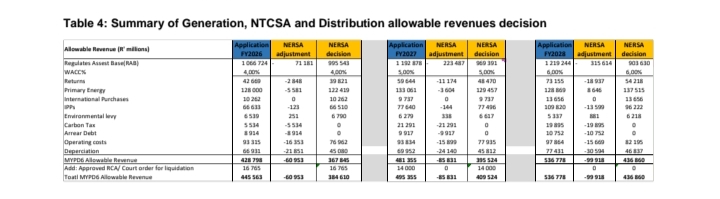
Table 5 illustrates the percentage increases in the approved revenues. The approved revenue for 2025/26 yields a 12.74% increase, 2026/27 a 5.36% increase, and 2027/28 a 6.19% increase.
Moreover, the Energy Regulator emphasised that these decisions were the outcome of a meticulous regulatory process, involving the publication of Eskom’s MYPD6 revenue application and soliciting stakeholder input through written comments and public hearings.
Over 1,200 submissions were received, raising issues like affordability, Eskom’s operational performance, the consequences of negotiated pricing, municipal debt, and the necessity for enhanced dialogue from Eskom and municipalities.
NERSA acknowledged the consumer’s financial struggles and underscored the commitment to maintaining affordable electricity while ensuring Eskom’s financial viability. “This decision, markedly lower than Eskom’s initial request, will positively influence the South African economy, with a notably reduced burden on consumers,” stated NERSA.
NERSA further noted that a more favorable revenue scenario, supported by proactive regulatory measures, could enhance investor confidence, potentially boosting production, economic growth, and electricity demand.
“We believe this decision achieves a crucial equilibrium between Eskom’s requirements and consumer’s economic realities. We value the involvement of all stakeholders in this process and anticipate continued collaboration as we strive towards a sustainable energy landscape for South Africa,” remarked Thembani Bukula, NERSA’s Chairperson.
The Energy Regulator also highlighted that conditions will be attached to the execution of these approved revenues, necessitating quarterly reports from Eskom and NTCSA to ensure alignment with their stated goals.
Despite the approval of tariffs to be implemented from 1 April 2025, Eskom has signaled potential load shedding. In an official statement on Friday, 31 January 2025, Eskom noted that after more than 10 months without interruptions thanks to the Generation Recovery Plan, recent setbacks have prompted an alert for potential short notice load shedding.
“This situation represents a possible short-term challenge. Load shedding is mostly a thing of the past due to significant infrastructural enhancements in our generation capabilities. However, the last week has seen multiple unexpected breakdowns requiring prolonged repairs, which has depleted our emergency reserves. We are now focused on refilling these reserves, and load shedding could reach Stage 4 this weekend,” explained Eskom Group Chief Executive, Dan Marokane.

While Eskom promises further updates in due time, what are your thoughts on these developments?
Please share your views in the comment section below.






One Response
I can’t believe this price hikes and loadshedding