

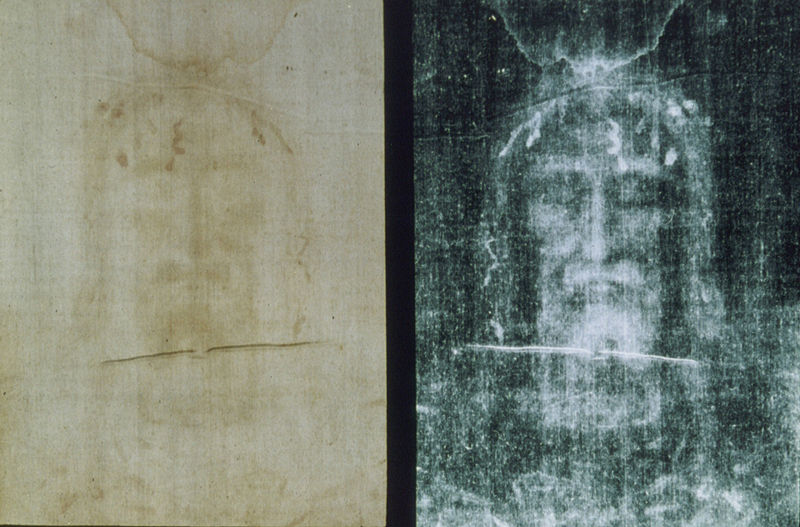
In the royal chapel of the Cathedral of Saint John the Baptist in Turin, Northern Italy, sits the Shroud of Turin.
A piece of linen that some consider to be one of the holiest artefacts in Christianity. It is believed it is the burial shroud that Jesus was wrapped in after his crucifixion. How do people know this to be true?
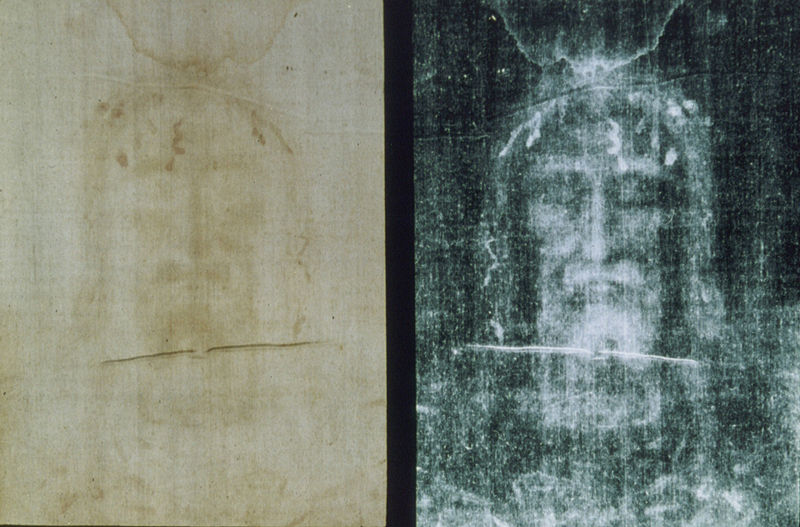
The shroud has an image of a man that was apparently crucified. While scores of people were crucified under Roman rule, the image shows a certain amount of blood flow around the forehead and temples. This gives a certain degree of truth to the biblical story of the crown of thorns put on Jesus shortly before his death.
Historical records show the Shroud of Turin can be divided into two time periods, before 1390 and from 1390 to present. One of the first records of the Shroud’s existence dates to 1353 or 1357. During that period, Bishop Pierre d’Arcis wrote a memorandum to Antipope Clement VII, stating that the shroud was a forgery and that the artist had confessed.
It was common in the Middle Ages for con artists to sell artefacts allegedly linked to Jesus. This ranges from fragments of the cross used for the crucifixion to the crown of thorns. It is also said that more than one “burial cloth” made its way through history.
While to some enthuse it is a true reflection of Jesus while sceptics claim it is impossible that it can be the burial shroud.
In 1988, three radiocarbon dating tests dated a piece of the shroud to the Middle Ages, claiming it was created sometime between the years 1260 and 1390. While this seemed to settle the argument, some argued the results were skewed by the introduction of material from the Middle Ages to the Shroud which tampered with the radiocarbon dating.
With the argument going to-and-fro, both believers and sceptics adamant that they are right, there are certain conspiracies surrounding the Shroud.
One of the biggest conspiracies around the Shroud of Turin is that Leonardo da Vinci created the Shroud. This comes after American artist Lillian Schwartz, a graphic consultant at the School of Visual Arts in New York, made a startling discovery.
Schwartz came into prominence in the 1980s when she matched the face of the Mona Lisa to a self-portrait of Leonardo da Vinci. Using computer scans, she discovered the face on the Shroud has the same dimensions as da Vinci.
But how could da Vinci create the image? After all, the image was not painted on the shroud.
Apparently, the Shroud could have been hung over a frame in a blacked-out room. Da Vinci could have then coated it with silver sulphate. Silver sulphate was a substance readily available in 15th century Italy, which would have made it light-sensitive.
When the sun’s rays passed through a lens, da Vinci’s facial features would have been projected onto the material, creating a permanent image. Thus making it an early form of photography.
As outlandish as this might sound, an art historian from the Nelson Mandela Metropolitan University, by the name of Nicholas Allen did not feel Schwartz was too far off.
Although he called for more tests on the Shroud for the presence of silver sulphate, he says if you look at the Shroud, it appears to be a negative image of a human being. However, if you take a photograph of the image, it produces a positive image.
As the radiocarbon dating in 1988 showed the cloth was made between 1260 and 1390, this theory states da Vinci made the forgery to replace an earlier version which was exposed to be a poor fake.
Apparently, the initial Shroud was bought by the Savoy family in 1453 and it disappeared for 50 years. When it returned to for public display, it was suddenly considered the real deal.
But could da Vinci really be responsible?
According to an American Professor at Longwood University in Virginia, Larissa Tracy, “if anyone could pull it off, it would have been da Vinci.” She explains, he had the necessary skills and knowledge of the human body. “He also had the knowledge to work with camera obscura an early photographic technique.”
There are those who doubt these findings, still believing the Turin Shroud to be the real deal. Whether the image of the person was made through the divine or through a cunning artist, one thing is for certain, it is truly a remarkable work of art.
What are your thoughts? Do you think the Shroud of Turin holds the image of Jesus of Nazareth? Or do you think it is man made?
Until the next time, have yourself a FREAKY FRIDAY!!