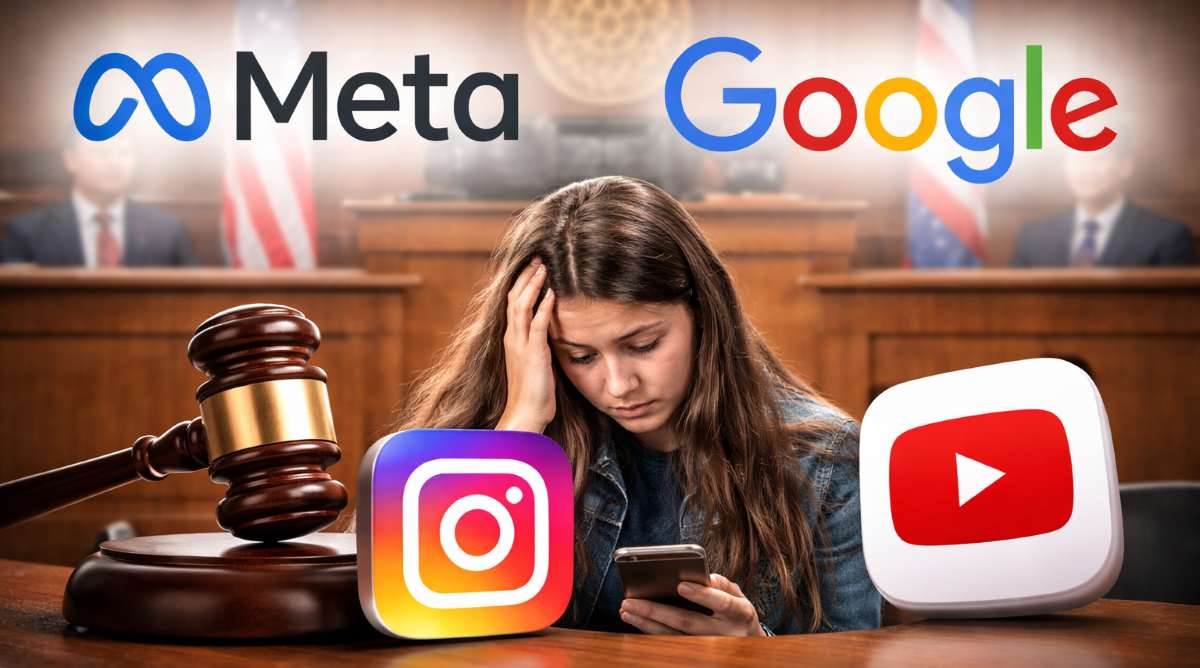
Meta and Google have been dealt a significant legal setback in the United States after a Los Angeles jury found that Instagram and YouTube were negligently designed in a manner that harmed a young user.
The verdict, delivered on Wednesday, 25 March 2026, is being viewed as a potentially pivotal moment in the broader legal fight over whether social media platforms can be held responsible for the way their products are built and the psychological toll those designs may have on children and teenagers.

The case centred on a 20-year-old plaintiff identified in court as KGM, referred to in some reports as Kaley, who argued that she became hooked on YouTube as a child before later developing a damaging dependence on Instagram.
Her legal team contended that the platforms were not simply popular online spaces, but products intentionally engineered to maximise time spent on them through features such as autoplay, continuous content delivery and endless scrolling. Jurors ultimately concluded that both companies were negligent in the design or operation of their platforms and that their conduct was a substantial factor in causing harm.
According to Reuters and AP, the jury awarded a total of $6 million in damages, with 70% of the responsibility assigned to Meta and 30% to Google.
Reuters reported the breakdown as $4.2 million against Meta and $1.8 million against Google, while AP reported that the jury awarded $3 million in compensatory damages and recommended a further $3 million in punitive damages, with the final punitive outcome still subject to judicial determination.
Either way, the finding was clear: jurors believed the two tech giants failed to adequately warn users of the dangers associated with their platforms, with Meta found to bear the greater share of responsibility.
What makes the ruling especially significant is the legal route used to get around one of Big Tech’s most powerful defences.
For years, internet companies have leaned heavily on Section 230 of the US Communications Decency Act, which broadly shields platforms from liability for user-generated content.
In this case, however, the plaintiff’s team argued that the harm did not arise primarily from what users posted, but from the companies’ own product design choices and their alleged failure to warn young users and families about known risks. That distinction could prove highly consequential as similar cases move forward.
The verdict is also important because it is not an isolated dispute.
AP described the matter as a first-of-its-kind social media addiction trial, while Reuters reported that it is expected to influence thousands of similar lawsuits already underway in the United States. TikTok and Snap were initially among the defendants in the broader litigation, but both settled before this trial began.
With thousands of related cases still pending, the Los Angeles outcome is likely to be studied closely by lawyers, regulators and lawmakers alike.
Both companies have pushed back strongly against the ruling and are expected to appeal. Google said the verdict mischaracterised YouTube and maintained that the platform provides a wide range of tools and protections for younger users.
Meta similarly argued that teenage mental health is a complicated issue that cannot be reduced to a single digital product.
Even so, the ruling lands at a time when pressure is already mounting on large technology firms over child safety, product design and mental health concerns linked to online engagement.
The timing is particularly damaging for Meta because it came just a day after another jury, this time in New Mexico, found the company liable in a separate case involving the safety of children online.
That jury ordered Meta to pay $375 million, adding to what has become an increasingly bruising legal period for the company. Although the New Mexico matter focused on different allegations, the back-to-back courtroom defeats suggest growing willingness among juries to scrutinise not only the content on social platforms, but also the systems and incentives underpinning them.
For years, critics of the social media industry have argued that major platforms have profited from engagement-driven systems that reward prolonged use while doing too little to address the possible consequences for younger audiences.

This latest verdict does not by itself force immediate redesigns to Instagram or YouTube, and the appeals process could take considerable time. However, it does signal that courts may now be more prepared to separate product design from protected online speech, and that shift could have serious implications for the future legal boundaries of the digital economy.
What are your thoughts on all of this? Let us know below.
Be sure to read: