


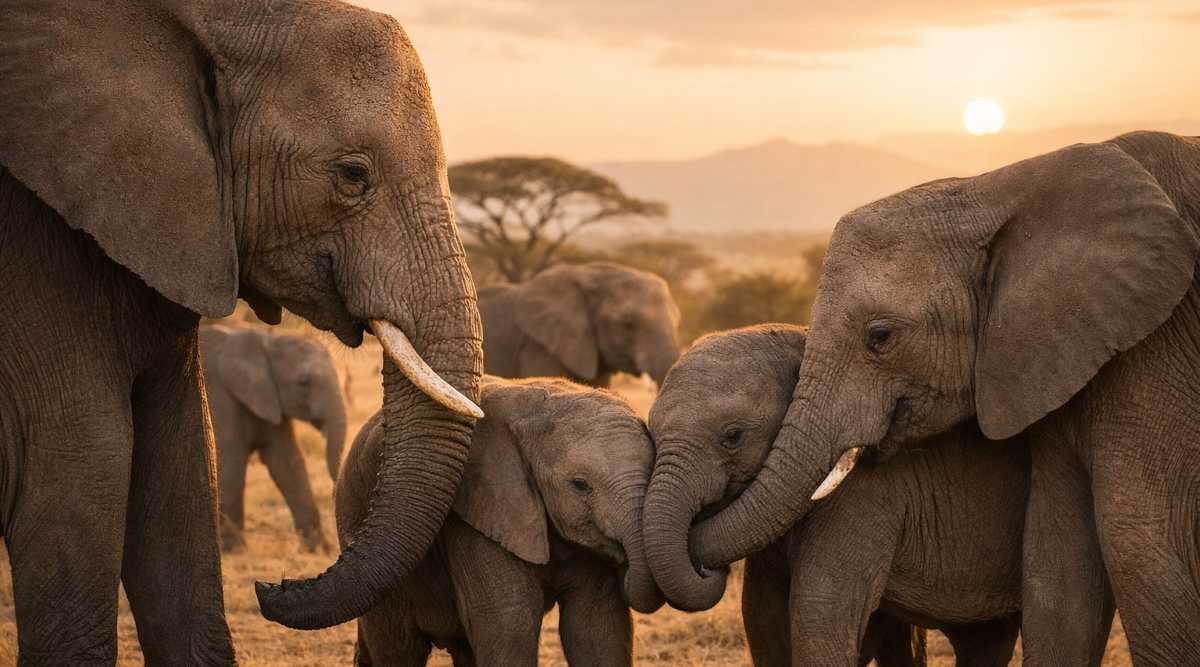
A renewed debate around elephant hunting in South Africa has emerged as government processes move toward reinstating wildlife export quotas, while new scientific research continues to reveal just how socially and intellectually sophisticated elephants may be.
The topic has gained traction nationally after discussions around the possible setting of new 2026 CITES export quotas for species including elephants, black rhinos and leopards.

This is a process that effectively determines how many legally hunted trophies may be exported internationally each year.
Although public discussion has framed this as a “new law” allowing elephant hunting again, official documentation indicates that South Africa has not introduced new legislation specifically authorising elephant hunting. Instead, the current process relates to proposed export quotas that allow trophy exports under existing conservation law and sustainable-use policy frameworks.
South Africa’s Department of Forestry, Fisheries and the Environment (DFFE) previously confirmed that export quotas for elephants, black rhinoceros and leopards were not set for 2024–2025 while legal matters surrounding the quota process were before the courts.
The department stated that future decisions would follow judicial outcomes and scientific assessment processes.
The broader policy direction was reaffirmed in 2024 when Cabinet approved a revised policy position supporting conservation alongside sustainable use, an approach that includes regulated hunting as one of several management tools. Government’s position emphasises balancing biodiversity protection, rural economic development and long-term species survival.
Supporters of quota systems argue that controlled hunting generates revenue for conservation programmes, anti-poaching operations and rural communities situated near protected areas. They contend that in regions where elephant populations are stable or increasing, regulated offtake can form part of broader wildlife management strategies.
Yet at the same time, scientific research has been shifting global perceptions of elephants, adding a strong ethical dimension to the policy debate.
A growing body of research suggests elephants possess highly advanced social structures and cognitive abilities that rival some of the most intelligent non-human species studied to date.
A 2024 study published in Nature Ecology & Evolution found evidence that African elephants may use individual-specific vocalisations that function similarly to names.
Researchers analysing elephant calls in Kenya found that elephants responded more strongly when a call appeared directed at them, indicating a level of social recognition and communication complexity rarely observed outside humans and certain marine mammals.
The study adds to long-standing behavioural research showing that elephant societies are organised around multi-generational family units led by experienced matriarchs.
These structures rely heavily on social memory, cooperative care of young, and long-term bonds between individuals.
Scientists have documented behaviours suggesting mourning, coordinated movement decisions, and inter-family cooperation — all indicators of advanced social intelligence.
These findings are driving renewed questions internationally about whether traditional conservation approaches adequately account for the emotional and social lives of elephants. Some researchers argue that the removal of older animals through hunting could disrupt family dynamics and knowledge transfer within herds, while others maintain that carefully regulated quotas can coexist with healthy populations when guided by robust science.
The policy tension now unfolding is therefore not simply about economics or conservation numbers. It reflects a broader global shift in how humans view highly intelligent wildlife.
On one side are conservation frameworks built around sustainable use models that have operated for decades across Southern Africa.
On the other is rapidly evolving scientific understanding that positions elephants as deeply social beings with complex communication systems and strong family bonds.
South Africa’s official policy currently maintains that conservation outcomes, legal compliance and sustainability remain central to quota decisions. The country also continues to oppose unrestricted ivory trade and emphasises international obligations under CITES conventions.
As discussions around 2026 quotas continue, the debate is likely to intensify — particularly as new research reaches mainstream audiences and reshapes public perceptions of elephants not merely as wildlife resources, but as socially sophisticated animals.

For many South Africans, the issue now sits at the intersection of conservation economics, rural livelihoods, scientific discovery and ethics.
Whether future policy adjustments will shift toward stricter protection or maintain existing sustainable-use frameworks remains unclear, but one thing is certain: the conversation is no longer driven solely by numbers.
The growing understanding of elephant intelligence is changing the tone of the debate itself.
What are your thoughts on this? Let us know below.
Remember to read, Nine elephants killed near Vryheid, Ezemvelo faces backlash, if you missed it.
The quotas relate to export allowances under existing conservation policy and sustainable-use frameworks rather than a new hunting law.
Recent studies suggest elephants have complex social structures, strong family bonds, and communication systems that may function similarly to names.
No. South Africa maintains restrictions aligned with CITES and does not support unrestricted ivory trade.
Supporters see quotas as conservation funding tools, while critics argue new research on elephant intelligence raises ethical concerns.