

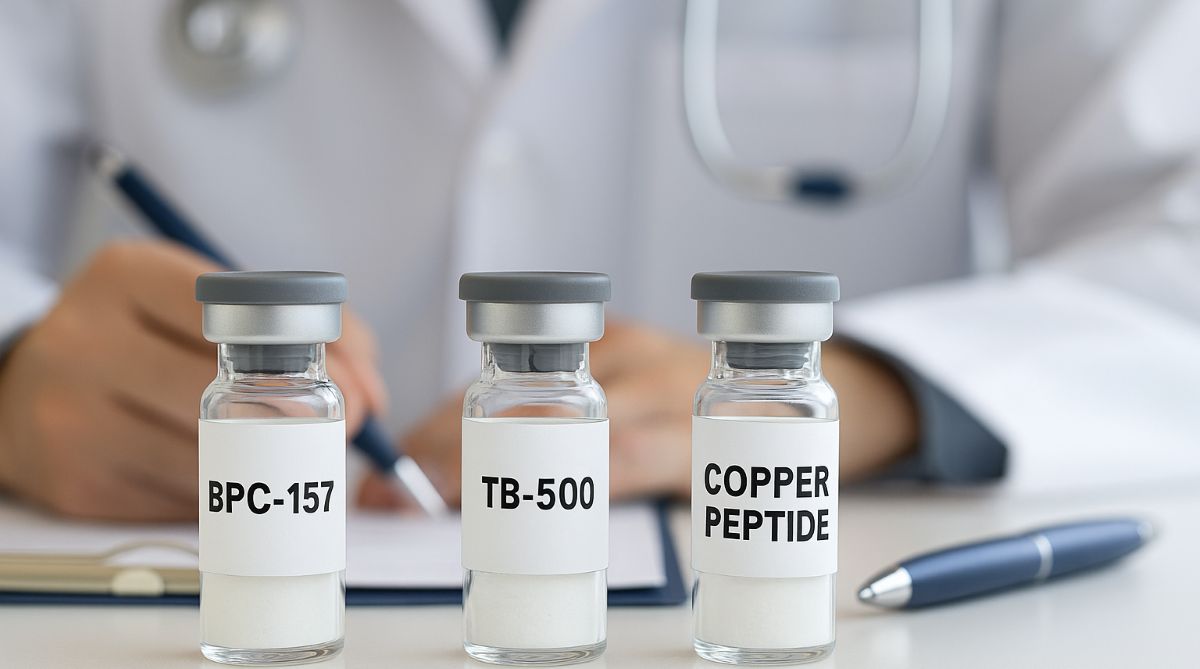
Regenerative peptides such as BPC-157, TB-500 and GHK-Cu are steadily moving from scientific curiosity to mainstream conversation, largely because practitioners are seeing encouraging signs of their therapeutic benefits.
These compounds work very differently from anabolic steroids: rather than altering hormones or forcing the body into an abnormal state, they function as highly specific signalling molecules that support natural repair processes.
This is why so many patients with chronic tendon injuries, slow-healing muscle tears or gut-related inflammation have taken an interest in them — not for aesthetics or performance, but for recovery.

BPC-157, for example, is a peptide derived from a naturally occurring gastric protein. In animal studies, it has repeatedly shown an ability to accelerate the repair of tendons, ligaments and other soft tissues by stimulating fibroblast activity, improving local blood flow and reducing inflammatory cytokines.
Researchers have also noted its protective effects on the gastrointestinal lining, which is why some clinicians explore it in cases involving chronic gut irritation. While human trials are still limited, the biological rationale is well-established enough to keep the scientific community invested in its future.
Whereas, TB-500, a synthetic fragment of Thymosin Beta-4, has a slightly different role.
Its primary function lies in regulating actin — a protein crucial for cellular movement. This regulation appears to help direct repair cells to injury sites more efficiently, allowing wounds and soft-tissue injuries to begin healing sooner. Early research also suggests benefits in angiogenesis (blood cell growth) and inflammation control.
Again, these are not muscle-building effects; they are restorative processes, which is why this peptide is often discussed in the context of post-operative healing and tissue regeneration rather than performance enhancement.
GHK-Cu, commonly known as the copper peptide, has been studied for decades in dermatology and wound-care research. It is naturally present in human plasma and declines with age. Its value lies in its ability to stimulate collagen and elastin production while simultaneously reducing inflammation and oxidative stress.
In wound-healing research, it has demonstrated clear regenerative effects, and in cosmetic medicine it is often used for skin repair and scar improvement. Its injectable form is now being explored for deeper tissue-healing applications.
Although regenerative peptides are showing genuine potential, the scientific picture is far from complete. What is emerging, however, is a clear distinction between what can reasonably be said today and what still requires rigorous human research.
What we currently know is that peptides such as BPC-157, TB-500 and GHK-Cu demonstrate measurable biological effects in laboratory and animal models.
They appear to promote tissue repair through mechanisms such as enhanced angiogenesis, reduced inflammatory signalling, improved cellular migration and, in the case of GHK-Cu, increased collagen and elastin production. Clinicians who work with peptide-based therapies often report positive outcomes in soft-tissue injuries, post-surgical recovery, wound healing and certain inflammatory conditions.
The safety profile, when peptides are manufactured to a pharmaceutical standard and administered appropriately, appears to be relatively favourable in the short term.
What we don’t yet know is equally important.
Large-scale, placebo-controlled human trials remain limited, meaning optimal dosing, long-term safety and the full range of physiological effects are not fully established.
Much of the enthusiasm is grounded in preclinical evidence, mechanistic understanding and practitioner experience rather than broad clinical consensus. We also lack comprehensive data on how these peptides behave when self-administered without medical oversight, when sourced from unregulated suppliers or when used in combinations that have never been studied.
The long-term implications of chronic or excessive use are not yet understood, and comparisons to more established therapies are still emerging.
In short, the potential is real, but so are the gaps. Peptides are promising tools in regenerative medicine, but their future depends on responsible use, proper manufacturing standards and a culture that values scientific guidance over experimentation.
These peptides are not “miracle cures,” and no responsible clinician will position them as such. But the combined evidence — spanning animal studies, mechanistic understanding, personal cases and anecdotal practitioner reports — points to meaningful biological activity that could make these peptides legitimate tools in regenerative medicine.
And this is where the problem begins.
As public awareness grows, the fitness and “biohacking” communities have started treating peptides the way people treated anabolic steroids in the 1990s: as shortcuts.
Instead of using them for medically relevant injuries, some individuals are self-injecting them in unsupervised environments, stacking them aimlessly, doubling dosages when they fail to see immediate results and purchasing unregulated products from online suppliers. The danger here is not that peptides behave like steroids — they don’t — but that the mentality is identical. The same impatience, the same risk-taking, the same belief that “more is better.”
This behaviour is precisely what destroyed the reputation of anabolic steroids. Originally developed for medical conditions such as muscle-wasting diseases, severe burns and hormone deficiencies, steroids were effective, valuable tools — until athletes and recreational users began abusing them far outside clinical ranges.
The fallout included contaminated underground products, serious side effects, sensationalised media coverage and eventually severe legal restrictions. The medical value remained, but access became complicated, and public understanding collapsed into fear and stigma.
Peptides now sit on that same knife-edge. Misuse leads to predictable consequences: infections from improper injection technique, unpredictable systemic effects from excessive dosing, unverified protocols circulated online and contaminants from poorly regulated manufacturers.
Most importantly, it creates the kind of public backlash that can push regulators to shut the entire field down, making it harder for legitimate patients to benefit.
The only way forward is responsible use. Peptides should not be treated as shortcuts, cosmetic boosters or quick fixes for people who want fast results without discipline.
They are therapeutic tools intended for targeted medical scenarios — chronic injuries, post-operative recovery, tissue degeneration, and in some cases gastrointestinal support. Their value lies in the quiet, biological work they do behind the scenes, not in creating visible changes overnight.
If society repeats the steroid-era mindset — the impatience, the reckless dosing, the underground sourcing — peptides will follow the same path: overuse, accidents, controversy and eventually restrictive regulation. But if they are guided by medical oversight, used within rational boundaries and respected for what they are meant to do, they may become one of the most promising additions to modern regenerative medicine.
Their future depends not on the molecules themselves, but on the mindset of the people using them.
What are your thoughts on this? Be sure to let us know below.
Do not forget to read, Why You Are Working Harder But Getting Poorer in South Africa, if you missed it.
Important: This article is intended for educational and informational purposes only. Peptides such as BPC-157, TB-500 and GHK-Cu remain under ongoing scientific investigation, and their clinical use is not universally standardised. Individuals should not interpret this information as medical advice or as a recommendation for treatment. Always consult a qualified medical professional before considering peptide therapy or any related intervention, as proper guidance, dosing oversight and safety monitoring are essential.